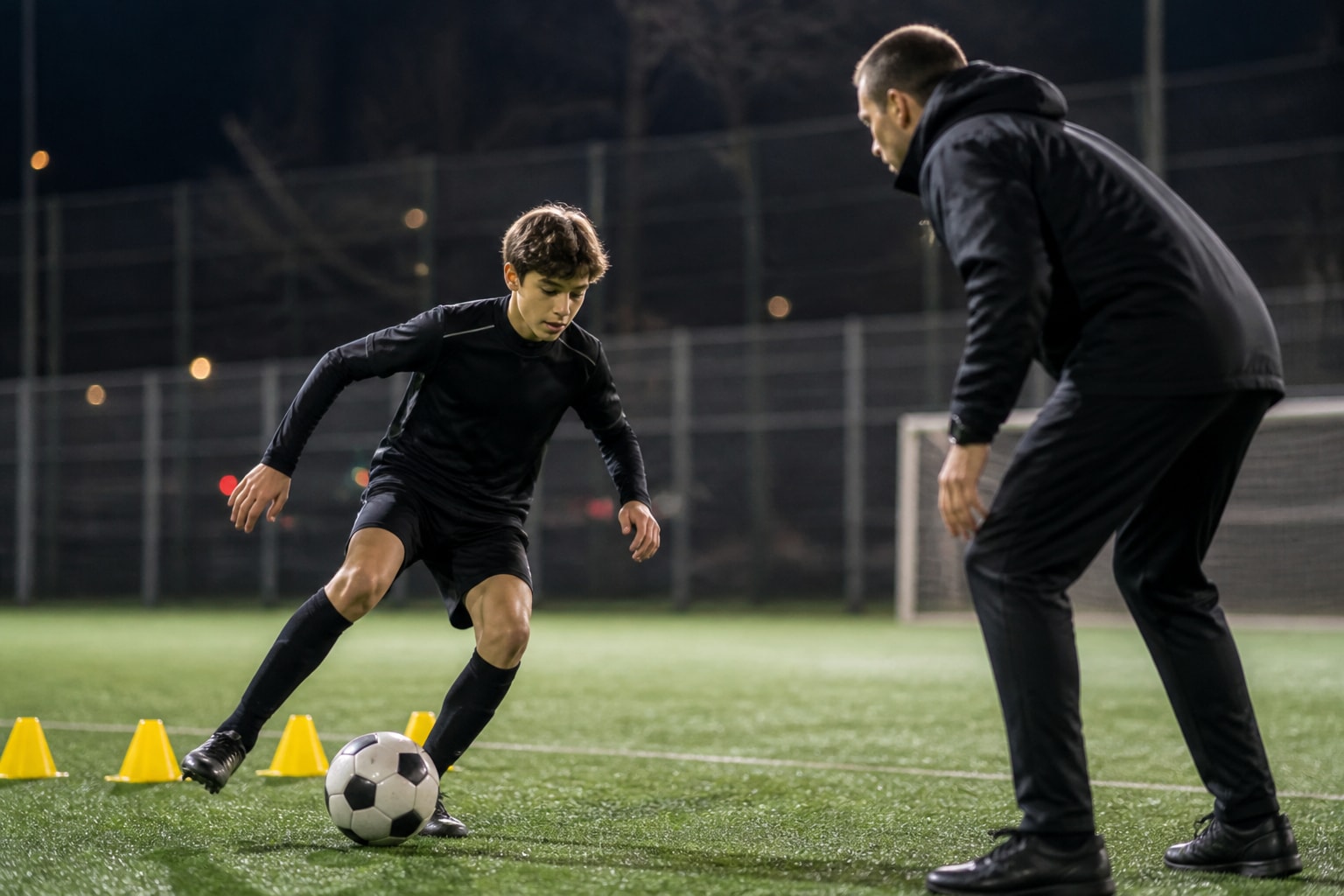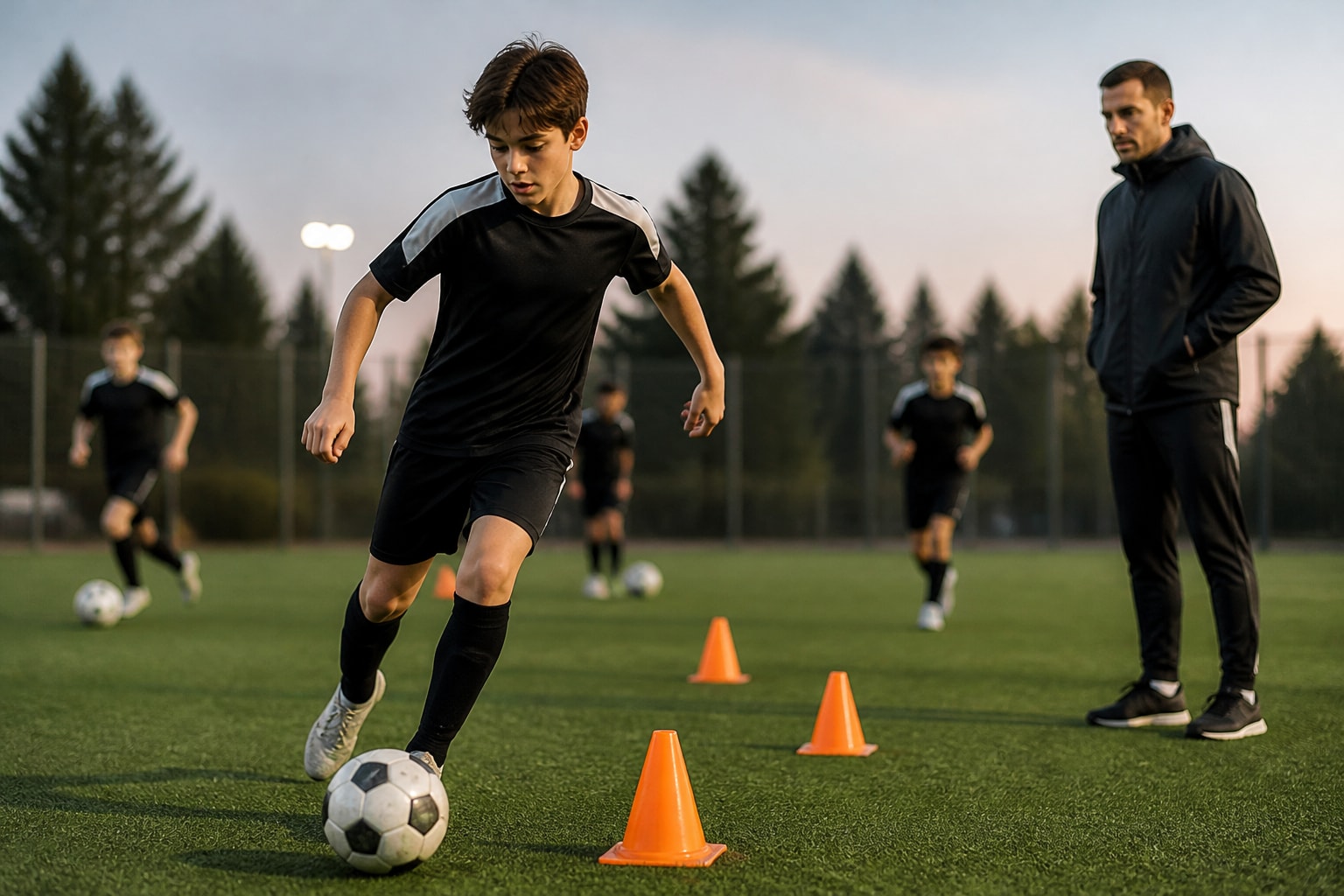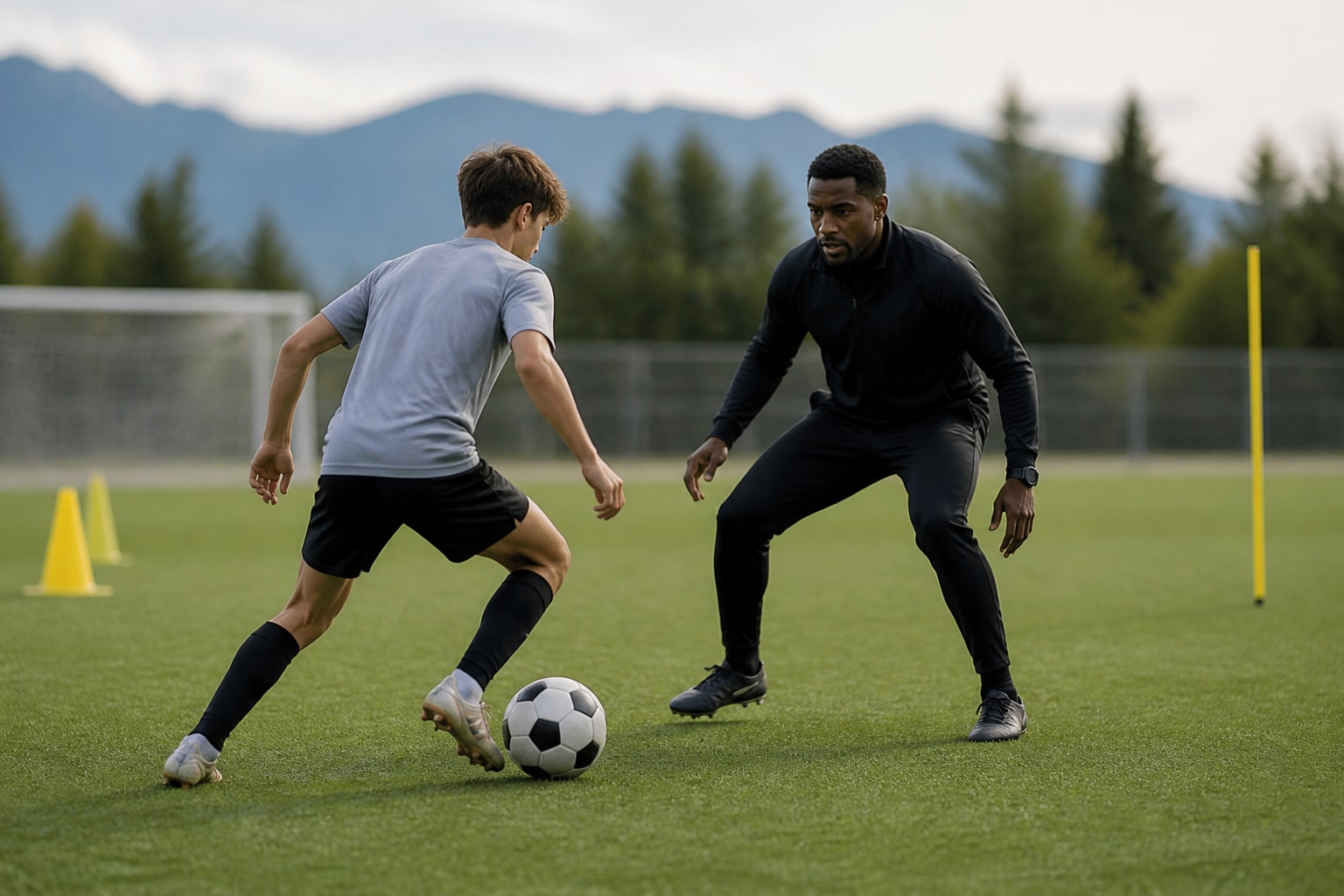
Private soccer training near Langley BC typically means one-on-one or small-group sessions with a licensed coach who builds a plan around your child's specific technical, tactical, physical and psychological needs. For committed players aged 5 to 18, the best sessions combine a high volume of ball contacts, clear feedback and measurable progress over months, not a single drop-in hour. The sections below explain what a session looks like, what it costs to budget for, how to judge a coach, and how training connects to travel teams, academies and college pathways.
What Happens in a Private Soccer Training Session?
A well-run private session is a focused 60 to 90 minutes built around a small number of skills, repeated under increasing pressure until they hold up in a game. Expect a short warm-up, a technical block, a decision-making block and a closing game-realistic exercise.
The best sessions follow a recognizable progression:
- Movement preparation. Dynamic mobility, coordination and ball mastery to prepare the body and raise the first touch count.
- Technical block. Passing, receiving, dribbling, finishing or striking technique, coached in isolation first.
- Applied block. The same skill inside a small-sided or opposed exercise, so the player must choose when and why to use it.
- Feedback and review. Video or verbal notes, plus one or two points to practice before the next session.
Volume matters. Strive Soccer Academy designs small-sided, high-touch sessions that deliver far more repetition than most team practices can offer when one coach is managing a large squad.

Who Benefits Most From Private Training?
Private training suits players who already commit to a club or school team and want to close specific gaps faster than team practice allows. It is a supplement to team soccer, not a substitute for it.
Players who typically gain the most include:
- Competitive and travel-team players preparing for tryouts or a step up in level
- Players with a clear weakness, such as a weaker foot, first touch under pressure or finishing
- Goalkeepers who need position-specific repetition that field sessions rarely provide
- Older players aiming for U SPORTS or NCAA recruitment who need film-ready technical polish
- Players returning from injury who need controlled, progressive touches
It is not designed for families seeking only casual recreational play, and it cannot shortcut years of development. Strive Soccer Academy points complete beginners toward recreational or introductory programs first, because structured high-level coaching works best once a player wants the work. Families looking for a fast-track professional contract without the development process will not find that here either.
Credentials to Look for in a Private Soccer Coach
The most reliable signal of coaching quality is a current Canada Soccer license combined with documented safe sport screening. Anyone can advertise as a trainer, so verify before you book.
Canada Soccer's coach resources list safe sport requirements for member organizations that include criminal record checks, Respect in Sport training and stage-appropriate NCCP modules. Ask any prospective coach which of these they hold and whether the checks are current.
Beyond paperwork, ask three practical questions:
- What license level do you hold, and what age group does it apply to?
- Can you describe how you assess a new player in the first session?
- How do you report progress to parents?
At Strive, all coaches are fully licensed through Canada Soccer, ranging from National A Licenses to Soccer for Life certifications for developing coaches. That range is deliberate. Experienced staff lead development design, while newer coaches work under a structure that keeps quality consistent.
How Much Does Private Soccer Training Cost?
Private training costs vary widely by coach experience, session length and group size, so the most useful comparison is cost per quality repetition, not hourly rate alone. A one-on-one session with a senior licensed coach costs more per hour than a small group, but a group of eight with poor coaching delivers fewer meaningful touches than a group of four with strong coaching.
Several factors drive pricing:
| Factor | What it affects |
|---|---|
| Coach license level and experience | Hourly rate and depth of feedback |
| Session format (1:1, small group, team) | Cost per player and touches per player |
| Session length | Total volume per visit |
| Package vs. drop-in | Per-session price and continuity |
| Venue (indoor, turf, grass) | Facility costs and weather reliability |
Strive Soccer Academy does not publish a fixed price for private sessions in this article. For current rates and package options, check the academy's soccer training sessions page or contact the team directly.
One budgeting principle holds regardless of provider: a consistent weekly session over a full season produces more development than an occasional intensive burst. Plan for continuity before you plan for intensity.
Where to Train Near Langley
Langley and the surrounding Fraser Valley offer plenty of municipal field space, and the best choice depends on surface, lighting and season. The City of Langley's parks and trails directory identifies soccer amenities at Brydon Park, City Park and Linwood Park.
Linwood Park is a practical example for families: it has a soccer field, a wheelchair-accessible playground, three picnic tables, a community garden, an off-leash area and parking off Michaud Crescent. Siblings can play nearby while one child trains, which matters when you are managing two or three schedules.
Public fields are useful for casual practice, but private coaching sessions usually run on reserved or program-controlled space so the session is not interrupted. In the wetter, darker months, indoor turf or futsal facilities are often the more reliable choice, since rain and short daylight make outdoor work inconsistent.
If Surrey is within your travel range, Strive's training is based there. Families in Langley often combine the drive with other commitments, which is why the academy's soccer academy near Langley, BC page is a good starting point for logistics.
Private Soccer Training Near Langley BC: One-on-One vs. Small Group
Both formats have a place, and the right choice depends on the player's stage and goal. One-on-one training delivers the most individual attention. Small-group training adds competition, realistic pressure and peer motivation.
One-on-one works best when:
- A player needs correction of a technical flaw, such as striking mechanics or body shape on the first touch
- A goalkeeper needs position-specific volume
- A player is recovering confidence after an injury or a difficult season
- The family wants a highly customized plan
Small groups work best when:
- The player already has sound technique and needs to apply it against opponents
- Competition and decision-making speed are the main growth areas
- The player trains better alongside peers
Strive uses skill-based grouping and bio-banding in its group programming. Bio-banding groups players by physical maturity as well as age, which prevents a late developer from being overwhelmed by an early developer and keeps the challenge level appropriate. Families interested in tailored attention can review the academy's 1-on-1 soccer training and small group soccer training options.
The Four Pillars of Player Development
Strong private training addresses technical, tactical, physical and psychological growth together, because a player who is strong in one area and weak in another stalls. Strive builds its programming on all four.
- Technical: Ball mastery, passing range, first touch, finishing and striking technique.
- Tactical: Positioning, scanning before receiving, timing of runs and reading the game.
- Physical: Speed, agility, coordination and age-appropriate strength, adjusted for growth stages.
- Psychological: Confidence after mistakes, focus under pressure, resilience and competitive mindset.
A useful way to evaluate any program is to ask how it handles the last two pillars. Many sessions drill technique well but never train decision-making or composure. Players who reach academy or college levels are rarely separated by technique alone; they are separated by how quickly and calmly they decide. The academy's technical training overview explains how these areas connect.
Setting Realistic Expectations and Measuring Progress
Meaningful change in a player's game typically takes weeks to months of consistent work, not a handful of sessions. Parents should expect visible technical improvement in training first, then transfer to match play later as the habits become automatic.
Reasonable checkpoints include:
- After four to six weeks: Cleaner technique in isolated drills and more confident touches
- After one season: Noticeable changes in match behavior, such as scanning, weaker-foot use and decision speed
- After a full year: Readiness for a higher level of play, tryouts or showcase environments
Ask the coach to define two or three measurable goals at the start, such as completing a set number of weaker-foot passes under pressure or improving finishing accuracy from a set range. Review them every month. Progress without a target is hard to see and easy to doubt.
Year-Round Planning: Seasons, Leagues and Rest
Effective private training follows the soccer calendar so work in each season supports the matches that matter. A common structure for youth players in the Lower Mainland is fall and spring outdoor league play, with winter indoor and futsal work filling the gap.
Strive runs programming across the year, so a player's training can stay continuous. Futsal is especially valuable in winter because the smaller ball and tighter space force faster decisions and more touches per minute.
Plan rest as deliberately as training. Players who add private sessions on top of club practice, school soccer and weekend matches need at least one full day off each week and a genuine break between seasons. Overload is a common reason keen players lose form or pick up overuse injuries. The academy's youth soccer training schedule can help families map sessions around existing commitments.
From Private Training to Academies and College Soccer
Private training supports pathways such as club academies, U SPORTS and NCAA programs, but selection always depends on a player's performance in match environments. Training builds the tools; scouts and coaches judge how those tools show up in games.
Strive-trained players have moved into professional academy environments, earned U SPORTS and NCAA Division I and II scholarships, and gone to overseas trials in Europe. Strive has spent years developing youth players from the grassroots level, and that long view shapes its approach: build a solid base first, then layer on higher-level demands.
For families asking how to enter a major club's academy system, the honest answer is that each club sets its own selection process through open tryouts, scouting and referral from competitive club teams. Strong technical foundations, consistent match performance and visibility at a good competitive level improve a player's odds. Private training helps with the first of those and indirectly supports the others. Families focused on the next level can look at elite soccer training built for that step.
Choosing the Right Program for Your Player
The right private training program matches your child's level, goals and schedule, and demonstrates a clear development method. Use this checklist when comparing options:
- Coach credentials verified: Current Canada Soccer license, Respect in Sport and a criminal record check
- Session structure explained: A clear plan for each session and for the full season
- Ratio and grouping: Small numbers, and grouping by skill or maturity, not age alone
- Touch volume: Evidence that players get high repetition, not long waits in line
- Progress reporting: Defined goals and regular updates for parents
- Calendar fit: Sessions that match your child's league and school schedule
For players who want a structured technical foundation, Strive's Soccer Skills Training program is the most direct starting point, and it is built around the four pillars and high-touch repetition described above.
If you want a neutral way to organize your comparison, a simple spreadsheet or scheduling tool helps. Resources such as Test Business can be useful for keeping track of vendor details while you compare options, though the coaching evaluation itself should always come from a direct conversation and a trial session.
FAQ
What is the best youth academy for soccer?
The best academy is the one whose coaching method, coach credentials and level of competition fit your child's current stage and goals. Look for licensed coaches, small groups, clear development pathways and evidence of players advancing. A trial session is the most reliable way to judge fit.
Where can I play soccer in Vancouver?
Metro Vancouver offers municipal fields, club leagues, indoor facilities and futsal venues across its cities. Each municipality's parks and recreation department lists public fields, and local clubs run registered youth leagues in fall and spring. For structured development beyond league play, a training academy adds technical and tactical coaching.
How do I get into a professional club academy?
Professional academies typically recruit through open tryouts, scouting at competitive club and league matches, and referrals from coaches. Strong match performance at a competitive level matters most, and private technical training helps players show their best in those evaluations. Each club sets its own process, so check its official site for tryout dates.
Your next step is simple: write down your child's top two development goals and bring them to a trial session so the coach can assess them in person. If you are weighing options near Langley, Strive Soccer Academy brings a European-style training philosophy to Surrey, BC, built on the technical, tactical, physical and psychological sides of player growth, and its Soccer Skills Training program is a good place to begin. With Canada Soccer licensed coaches, from National A Licenses to Soccer for Life certifications, you can see the coaching first-hand and Book a Trial to find out where your player fits.