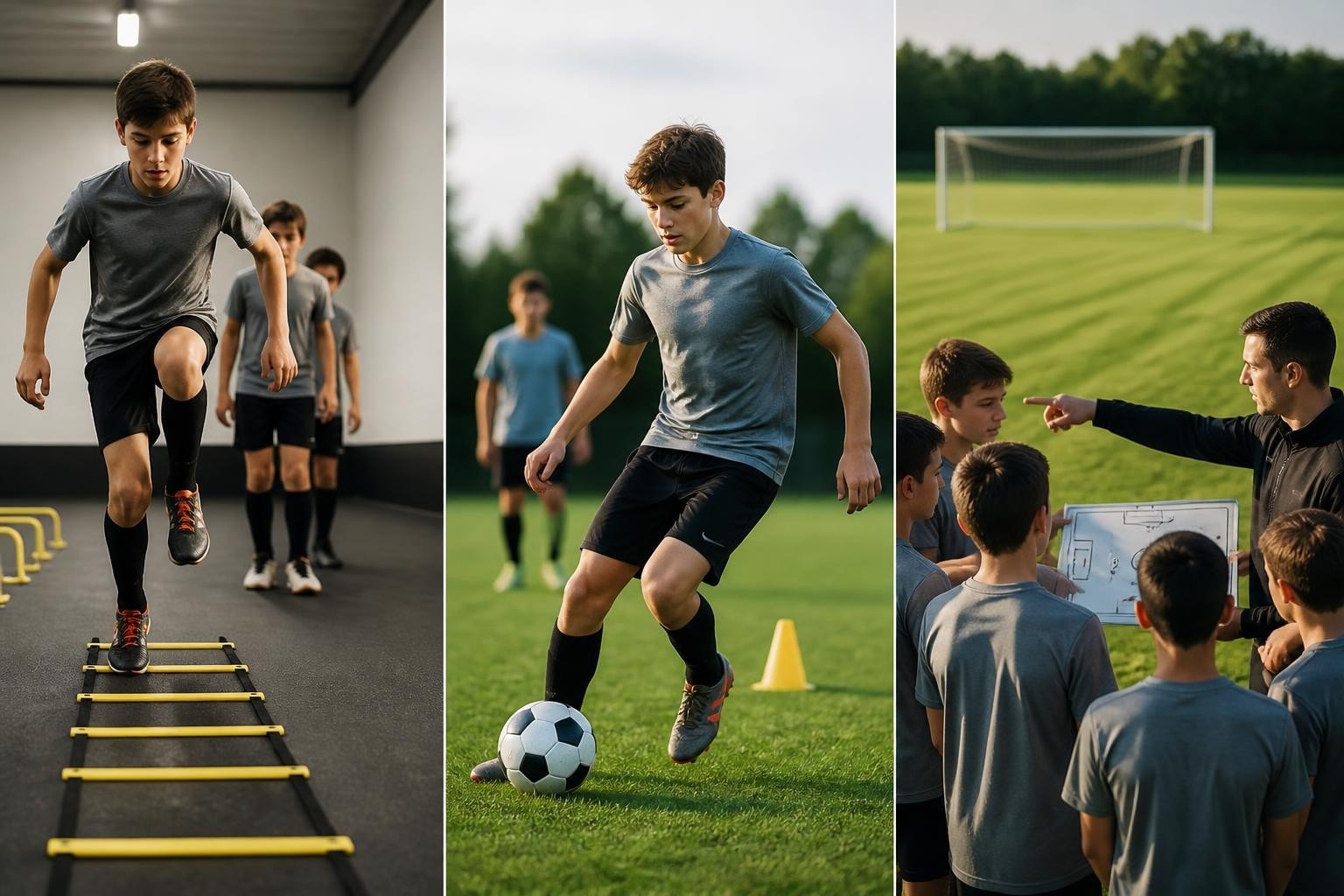
As youth soccer continues to grow, many parents wonder how to give their child the best possible foundation. One of the most common questions is whether personal 1-on-1 technical training is necessary—or even beneficial—for kids under 12.
At first glance, private training seems like the fastest path to improvement. More touches, more attention, fewer distractions. But when we look deeper into child development, motor learning, and the demands of the modern game, the reality is more nuanced.
Why 1-on-1 Isn’t Always the Best Fit for Young Players
For children under 12, soccer is not just about mastering a step-over or learning to dribble in a straight line. At this stage, development should focus on:
Exploration and creativity – Kids need freedom to try, fail, and try again, not constant correction.
Decision-making under pressure – The game is unpredictable. Players must learn how to act in relation to teammates, opponents, space, and the ball.
Social interaction – Young players thrive when they learn alongside peers, developing communication, resilience, and teamwork.
Contextual learning – A move practiced in isolation may not translate when defenders, angles, and real-game chaos are introduced.
In short, while private training can sharpen isolated skills, it often misses the larger picture of what kids actually need at this stage: adaptability, confidence, and game intelligence.
The Strive Method: Small Groups, Big Impact
Instead of isolating kids in 1-on-1 sessions, Strive Academy emphasizes small group training—using formats like 1v1, 2v2, and 3v3. Why? Because this model mirrors the reality of the game while still maximizing touches on the ball.
In every Strive session, young players:
Get hundreds of touches per session (far more than in traditional team training).
Face real pressure in tight spaces, forcing them to make decisions, shield the ball, and find solutions.
Build creativity and confidence by constantly engaging in scenarios where they must outthink and outplay opponents.
Develop the four pillars of the game—technical, tactical, physical, and psychological—rather than focusing only on mechanics.
Real Growth Happens Between Players, Not in Isolation
Soccer is a team sport. A 7-year-old learning a flawless dribble in a private session may still freeze when an actual defender approaches. By contrast, a player who consistently trains in small-sided, game-like situations learns not only the “how” but the “when and why”—skills that carry over into matches.
When 1-on-1 Training Is Essential
That’s not to say personal training has no place in development. As players grow and their needs become more specific, 1-on-1 sessions can be highly effective. They are most beneficial when:
A player has a glaring weakness (e.g., weak foot, striking technique, body positioning) that needs focused correction.
Older players (U12+) are preparing for higher levels of competition and require refinement in specific technical or tactical areas.
Confidence building is necessary for a child who is shy, hesitant, or struggling in group settings—private attention can help bridge that gap before returning to group play.
Position-specific skills need extra work (e.g., goalkeeper distribution, defender footwork, finishing for forwards).
Injury recovery requires a gradual reintroduction to the game in a controlled, individualized environment.
The Bottom Line for Parents
For kids under 12, the best investment isn’t in a personal trainer who drills them in isolation. It’s in an environment that combines high reps, game-like pressure, and social growth. That’s why Strive Academy has built its methodology around small-group, high-touch sessions.
Because at this age, the goal isn’t just to build players who can juggle or dribble in a straight line—it’s to build adaptable, confident, and resilient young athletes who love the game.