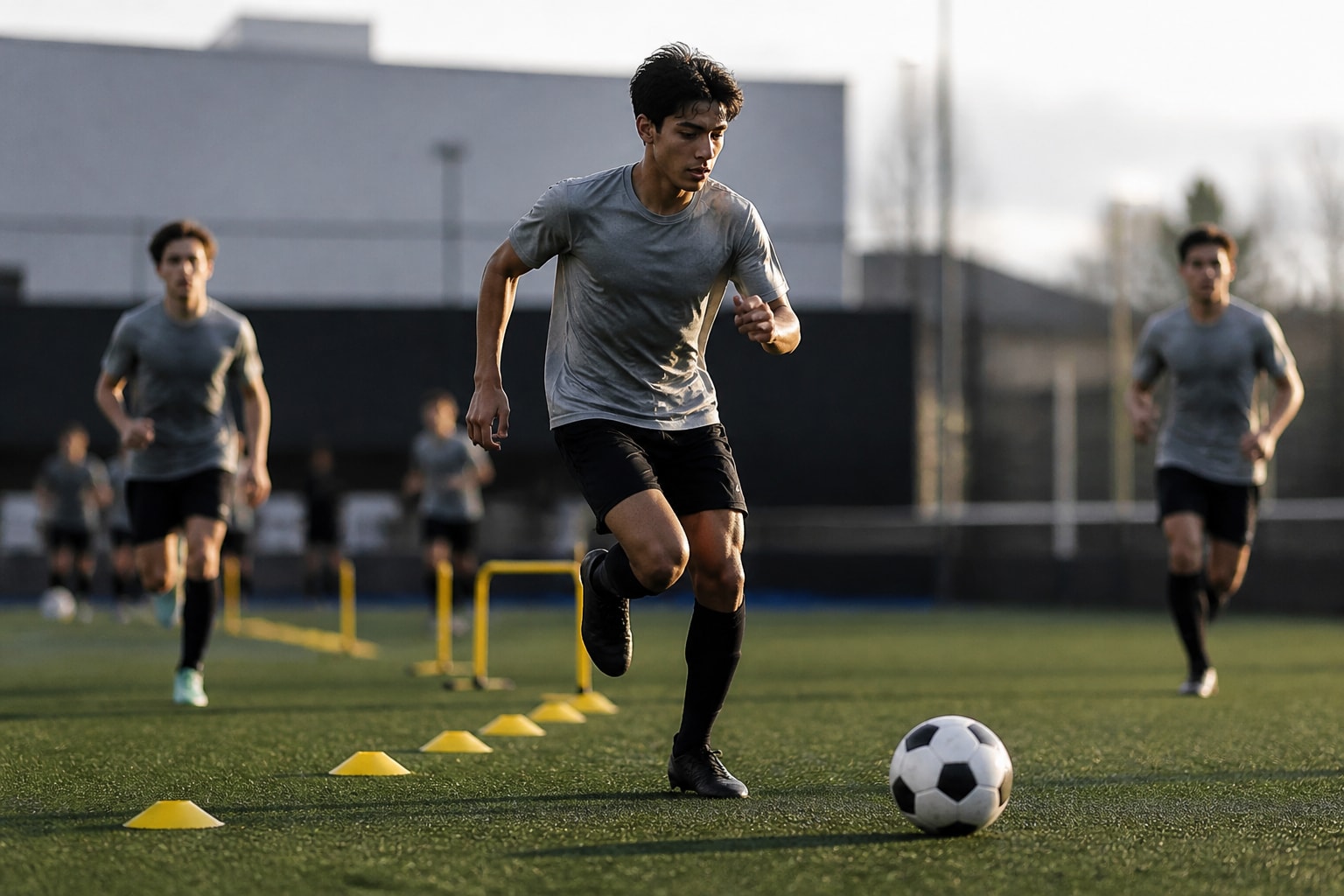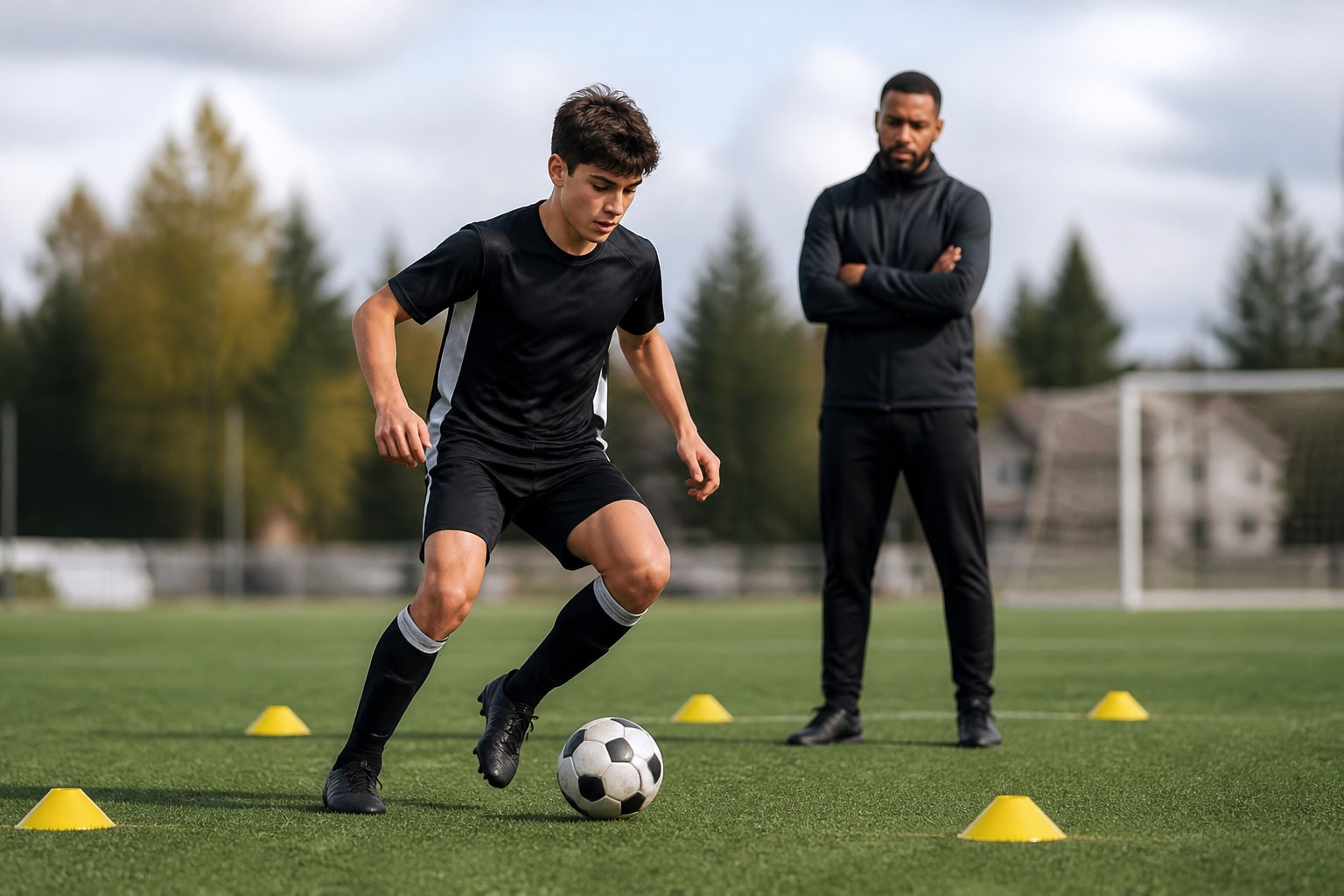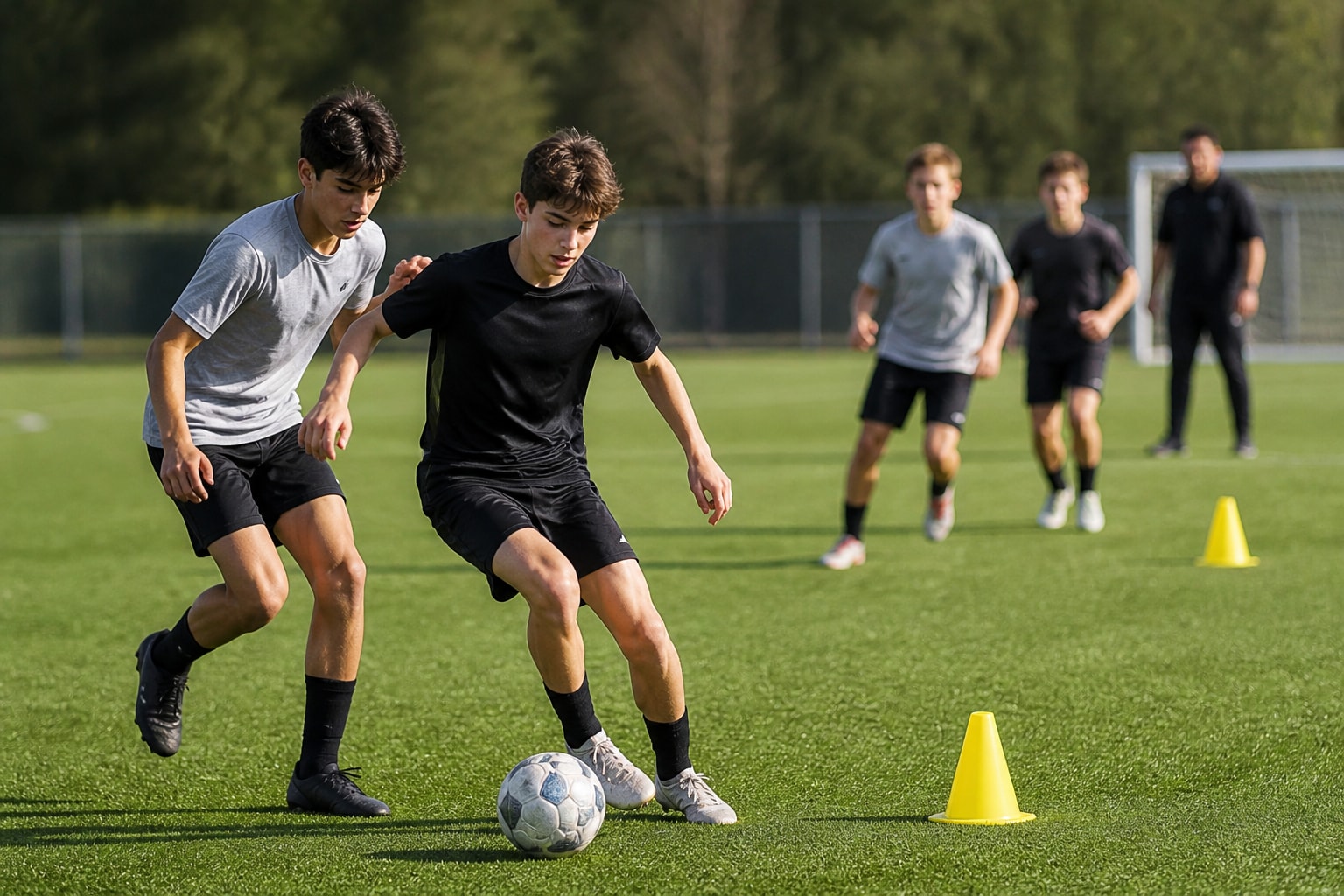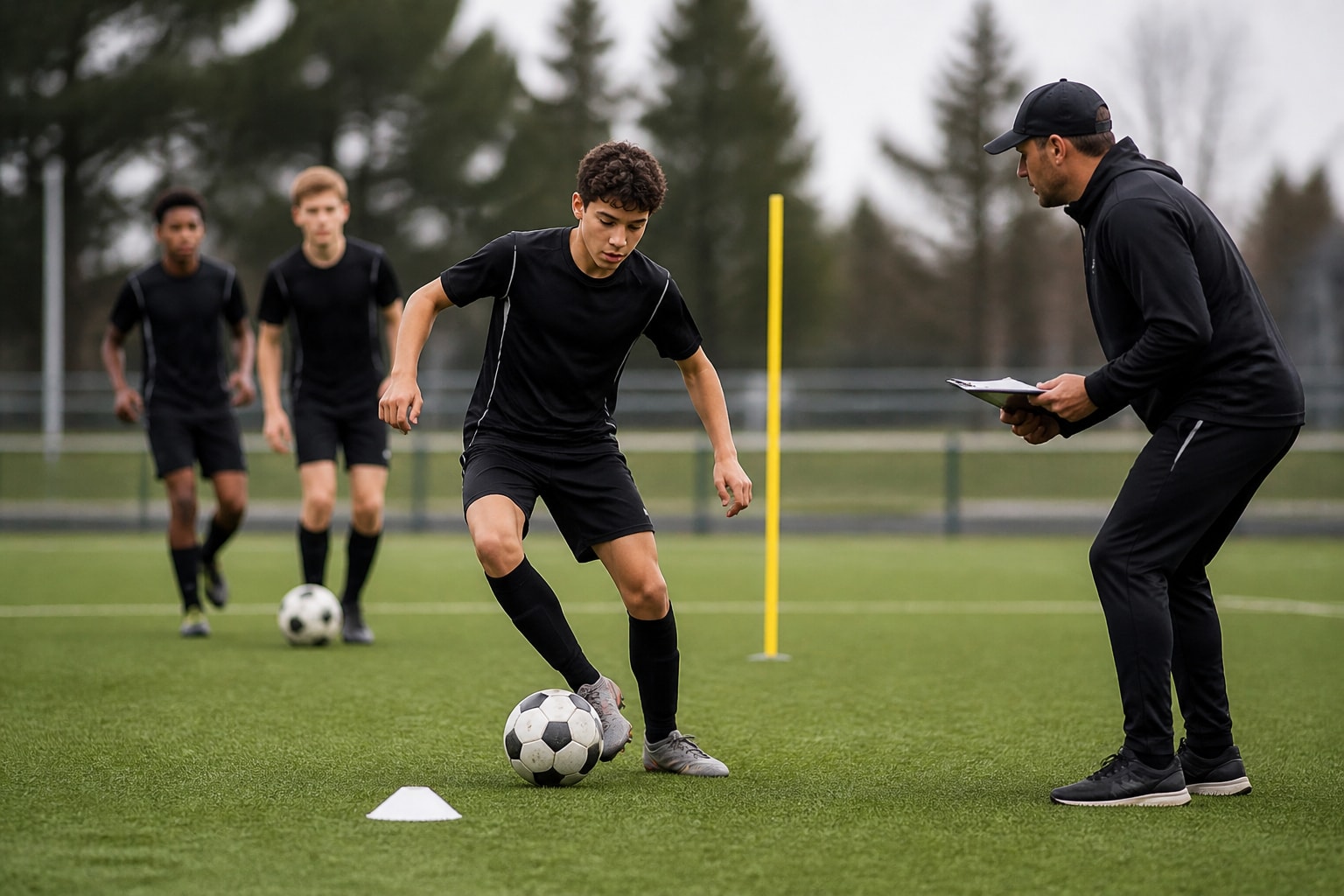
Effective U15 soccer training in Surrey BC combines high-touch technical work, tactical education, age-appropriate physical development and psychological coaching, delivered in small groups by licensed coaches. At 13 and 14, players face the most important transition in their development: the game speeds up, bodies change unevenly, and the gap between recreational and competitive soccer widens. This guide explains what to look for, how to fit extra training around a club schedule, and how to protect your player's health while they develop.
What U15 Soccer Players Need From Training
U15 players need training that builds technical consistency under pressure, teaches them to read the game, supports a changing body and strengthens their mental resilience.
Most serious players at this age already have the basics. The work now is repeating those skills at game speed, with defenders closing quickly and decisions to make before the first touch. Four areas of development should all be present in a quality program:
- Technical: receiving under pressure, passing range, 1v1 moves, finishing and weak-foot development
- Tactical: positioning, pressing triggers, building out from the back, and recognizing space
- Physical: speed, agility, coordination and strength that respect each player's growth stage
- Psychological: confidence after mistakes, focus, leadership and handling competitive selection
A program that covers only one or two of these will leave gaps that surface in tryouts and higher-level matches. Strive Soccer Academy builds its sessions around all four areas, using a European-style training philosophy brought to Surrey. You can read more about how that approach differs from a typical club environment on the what makes our training different page.
Why Small-Group Training Matters at This Age
Small-group training gives each U15 player more touches, more coaching feedback and more decision-making repetitions than a full club practice can offer.
In a typical team practice with many players, an individual may get far fewer touches than in small-sided sessions. In small-sided, high-touch sessions, that number can climb dramatically. Strive Soccer Academy's sessions are designed to be small-sided and high-touch, with an average player-to-coach ratio of 8:1. At that ratio, a coach can correct a body shape error or a poor first touch in the moment rather than after the session.
Small groups also allow players to be placed where they will actually improve. Strive uses skill-based grouping and bio-banding, which matches players by ability and physical maturity rather than birth year alone. This matters enormously at U15, where one player may have already hit a growth spurt while a teammate of the same age has not. Training against appropriately matched peers keeps the challenge productive instead of discouraging. For a deeper look at the format, see small group soccer training in Surrey.

How to Evaluate a U15 Soccer Training Program in Surrey
The best way to evaluate a program is to check coach credentials, group size, player grouping methods and the track record of players who have come through it.
Use this checklist when comparing options:
- Coach licensing. Ask which Canada Soccer licenses the coaching staff hold. Strive's coaches are fully licensed through Canada Soccer, from National A Licenses to Soccer for Life certifications for developing coaches.
- Player-to-coach ratio. Lower is better for feedback quality. An 8:1 ratio allows individual correction that a 20:1 session cannot.
- Grouping method. Programs that group by skill level and physical maturity produce better outcomes than those that group strictly by age.
- Session design. Look for high repetition, game-realistic scenarios and clear development goals, not simply scrimmages.
- Long-term track record. Ask where former players have gone. Strive has developed youth players from the grassroots level for over 20 years, and its trained players have moved into professional academy environments, U SPORTS and NCAA Division I and II scholarships, and overseas trials in Europe.
- Year-round structure. Development compounds when training continues through every season rather than stopping and starting.
Be cautious of any program that promises a fast route to a professional contract. Real development is gradual, and at U15 the goal is building a foundation that holds up at 16, 17 and beyond. Families who want that kind of long view may find the competitive soccer training overview useful.
Fitting Training Around Your Club Schedule
Extra training works best when it complements club practices and matches, not when it duplicates them or adds fatigue without a purpose.
Surrey United Soccer Club's 2026 spring season is scheduled to run from April through June and is open to U6 through U18 players. Registration closes on March 1, 2026 or when capacity is reached, and registrations after March 1 incur a late fee. Many families in the area follow a similar rhythm: fall outdoor league, winter indoor or futsal, then spring outdoor league.
A well-planned year for a committed U15 player looks like this:
| Season | Club Focus | Where Extra Training Adds Most Value |
|---|---|---|
| Fall (outdoor league) | Matches, team tactics | Technical refinement and weak-foot work |
| Winter (indoor / futsal) | Fast-paced small-sided play | Quick decision-making and close control |
| Spring (outdoor league) | Matches, tournament play | Match sharpness and physical readiness |
Strive Soccer Academy runs year-round programming that mirrors this calendar, with fall and spring outdoor leagues and winter indoor and futsal. Players who want to stay sharp on the days between club sessions can look at training outside club practice or the year-round soccer training option. To see current session times, check the youth soccer training schedule.
Why Futsal and Indoor Sessions Suit U15 Players
Futsal and indoor sessions suit U15 players because the smaller space, heavier ball and constant involvement force faster thinking and cleaner technique.
On a futsal court, a player cannot hide for a few minutes between touches. Every pass, turn and shot happens under close pressure, which sharpens the exact skills that matter on a full-size pitch. The heavier ball stays low and does not bounce freely, so sloppy first touches are punished at once and players learn to play with their heads up and their feet close to the ball. A typical game also keeps every player involved in both attack and defense, which builds the habit of scanning for space before the ball arrives. Futsal also rewards creativity in tight spaces, and the close-quarters moves practiced there can transfer to crowded midfield areas outdoors.
Winter is also the natural time to use indoor training, since the outdoor season is paused. Players who stay active through the winter can return to spring matches with a sharper touch and quicker decisions. For a developing U15 player, those months also offer a chance to work on one or two technical priorities without the pressure of weekend results.
Recovery, Sleep and Growth: Protecting the U15 Player
U15 players should treat recovery as part of training, because sleep, load management and early attention to minor injuries determine how much of their development actually sticks. For players moving on to older age groups, our guide to U16 soccer training in Surrey BC covers what changes at that level. Our guide to U17 soccer training in Surrey BC covers the demands of the next age group up.
AboutKidsHealth recommends that teens aged 14 to 17 get 8 to 10 hours of uninterrupted sleep per night. For a player balancing school, club practices, matches and extra sessions, protecting that sleep window is one of the simplest ways to support performance and growth.
A few practical habits help:
- Keep a consistent bedtime on school and match nights alike
- Space intense sessions so a player is not training hard on consecutive days without a lighter day between
- Pay attention to recurring aches in the knees, heels or hips, which are common during growth spurts
- Fuel properly before and after sessions, especially on double-session days
Growth spurts can temporarily affect balance, coordination and flexibility, so a dip in touch quality is not always a sign of regression. If a player has persistent pain, a qualified clinician should assess it. For families seeking sports injury and rehabilitation care, Mountain Health and Performance offers chiropractic, massage and physiotherapy services in North Vancouver.
The Mental Side of U15 Soccer
The psychological game at U15 centers on handling selection pressure, recovering quickly from mistakes and building the confidence to play with the ball under pressure.
This is the age when many players first face real competitive stakes: club team selection, rep tryouts, and the early conversations about high school and college pathways. A player who is technically gifted but afraid to make a mistake will often play too safely to stand out. Good training environments normalize errors as part of learning, and coaches model how to reset after a lost ball or a missed chance.
Parents can reinforce this at home. Ask about what your player tried and learned rather than only the result. Praise effort and decision-making, and keep post-match conversations short and supportive. Over time, players who build this resilience tend to cope better with the step up to higher levels, whether that is a competitive club, an academy environment or a college program.
Choosing Between Group and Private Training
Group training builds game-realistic skills and competitive habits, while private sessions let a player target a specific weakness with undivided coaching attention.
Most U15 players benefit from a blend. Small-group sessions provide the pace and decision pressure of real matches, and a private session can address a particular issue, such as weak-foot finishing, receiving across the body or a goalkeeper's distribution. If your player has one clear area to fix, the 1-on-1 soccer training option offers focused work. Goalkeepers have their own pathway as well, outlined in the soccer goalkeeper training page.
As a starting point, many families choose one small-group session per week alongside club commitments, then adjust based on how their player responds, how they are sleeping and how they feel at school. More is not always better at this age. Consistent quality work beats a packed schedule that leads to fatigue.
Getting Started With Skills Training at Strive
For U15 players who want structured technical development, Soccer Skills Training at Strive Soccer Academy focuses on high-repetition work with licensed coaches in small groups. Players are grouped by skill level and maturity so the challenge fits where they are today. A first session can show where a player stands: how they receive under pressure, how comfortable they are on their weaker foot, and how they respond to coaching corrections mid-drill. That early picture helps the coaching staff place a player in the right group rather than guessing from age alone.
Timing matters for families who also play club soccer. Surrey United's 2026 spring season is scheduled to run from April through June, and its registration deadline is March 1, 2026, with a late fee for registrations after that date. Building a training schedule around those dates, rather than adding sessions after the season has started, makes it easier to judge how a player handles the combined load.
Not every player is ready for this level of commitment. Strive is designed for serious young players and families aiming for competitive, travel or college-track soccer. Families looking only for casual recreational play are better served by a local recreational or introductory program first, then a move to structured training once the interest and commitment grow.
Your next step is to watch your player in a live session and see whether the pace, coaching and grouping suit them. At Strive Soccer Academy, we understand what parents want most for their young athletes: a program that develops skills, builds character and creates real opportunities, which is why we've brought a European-style training philosophy to Surrey, BC. If you are ready to see how Soccer Skills Training fits your U15 player, you can Book a Trial with Strive Soccer Academy and experience a session firsthand.