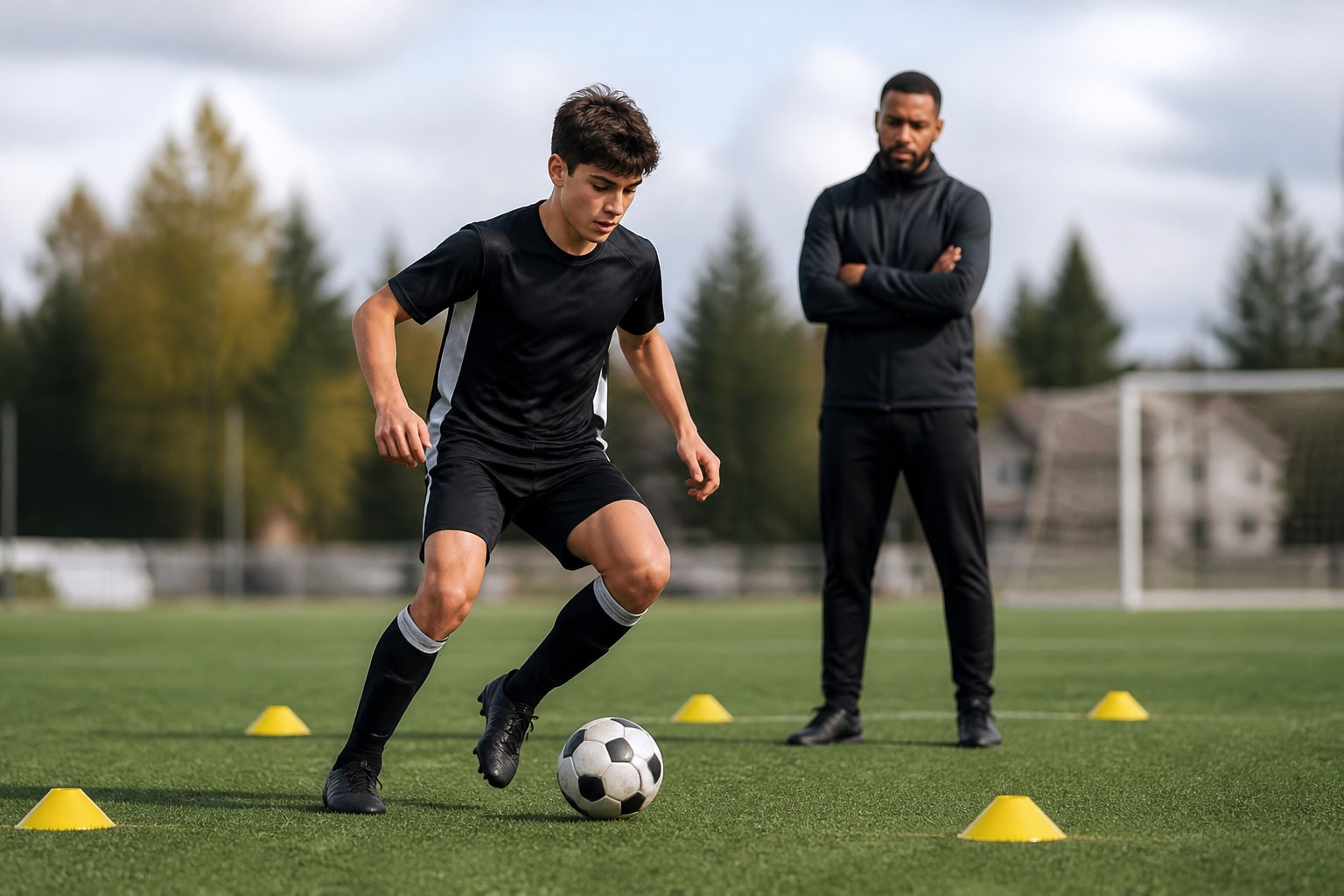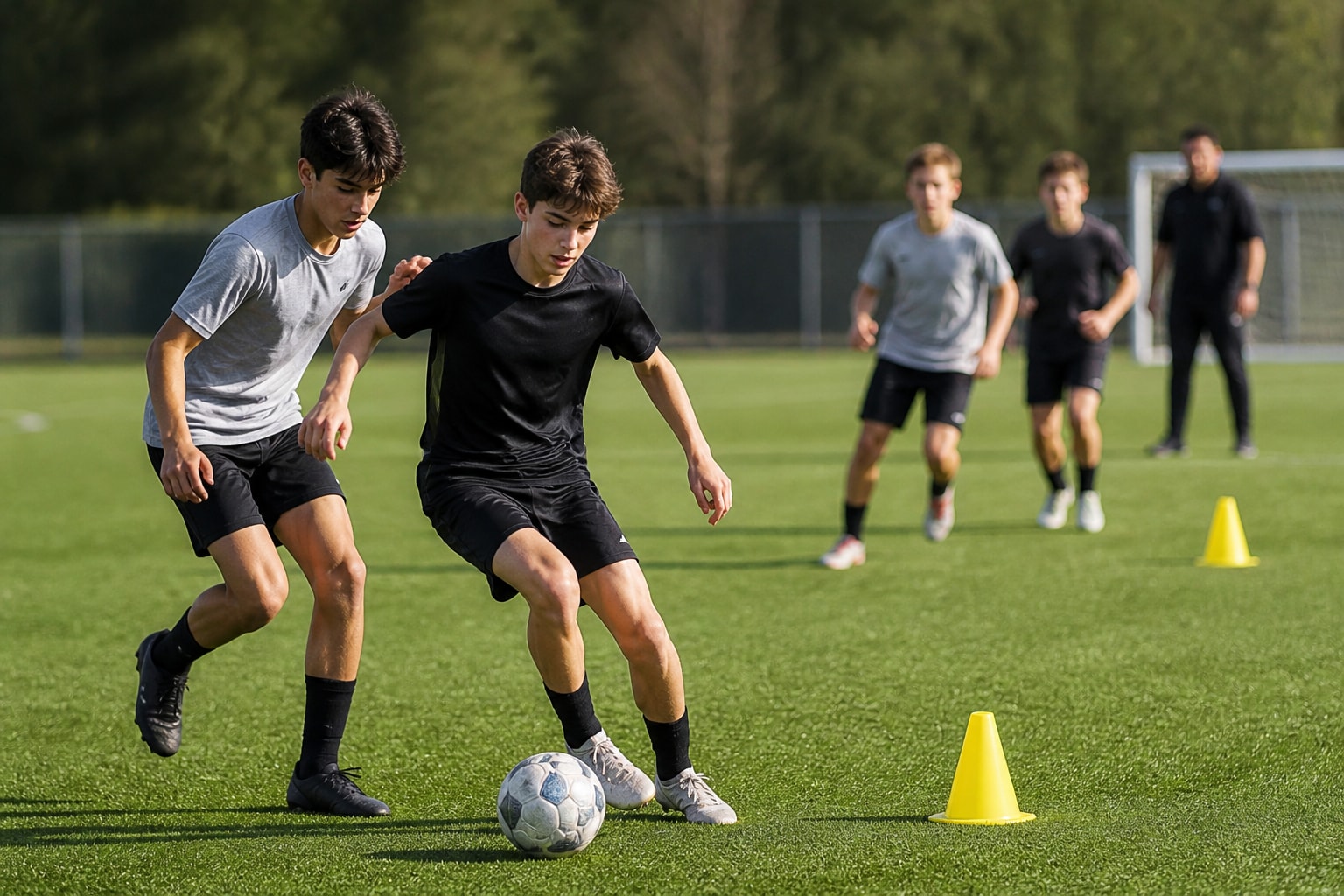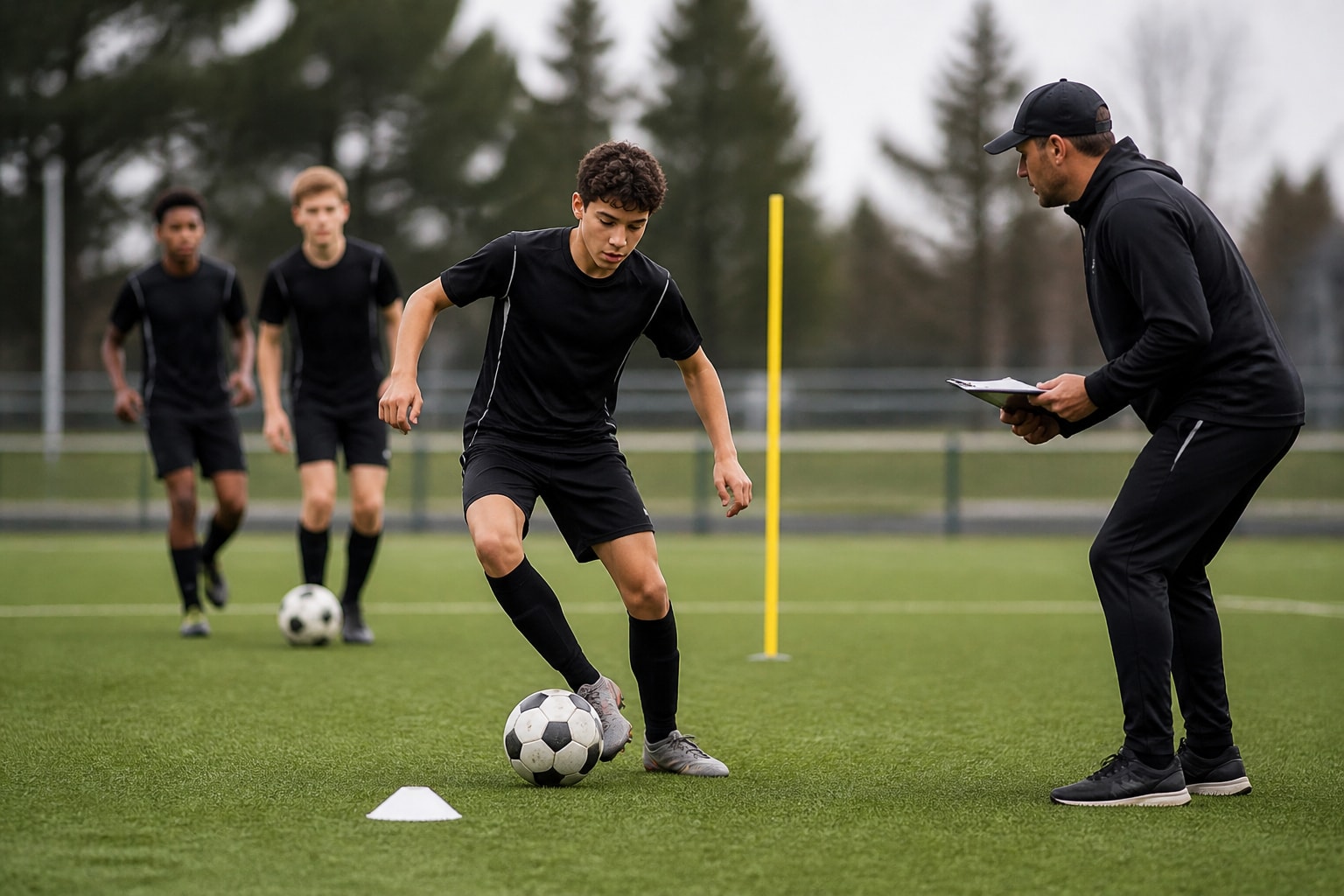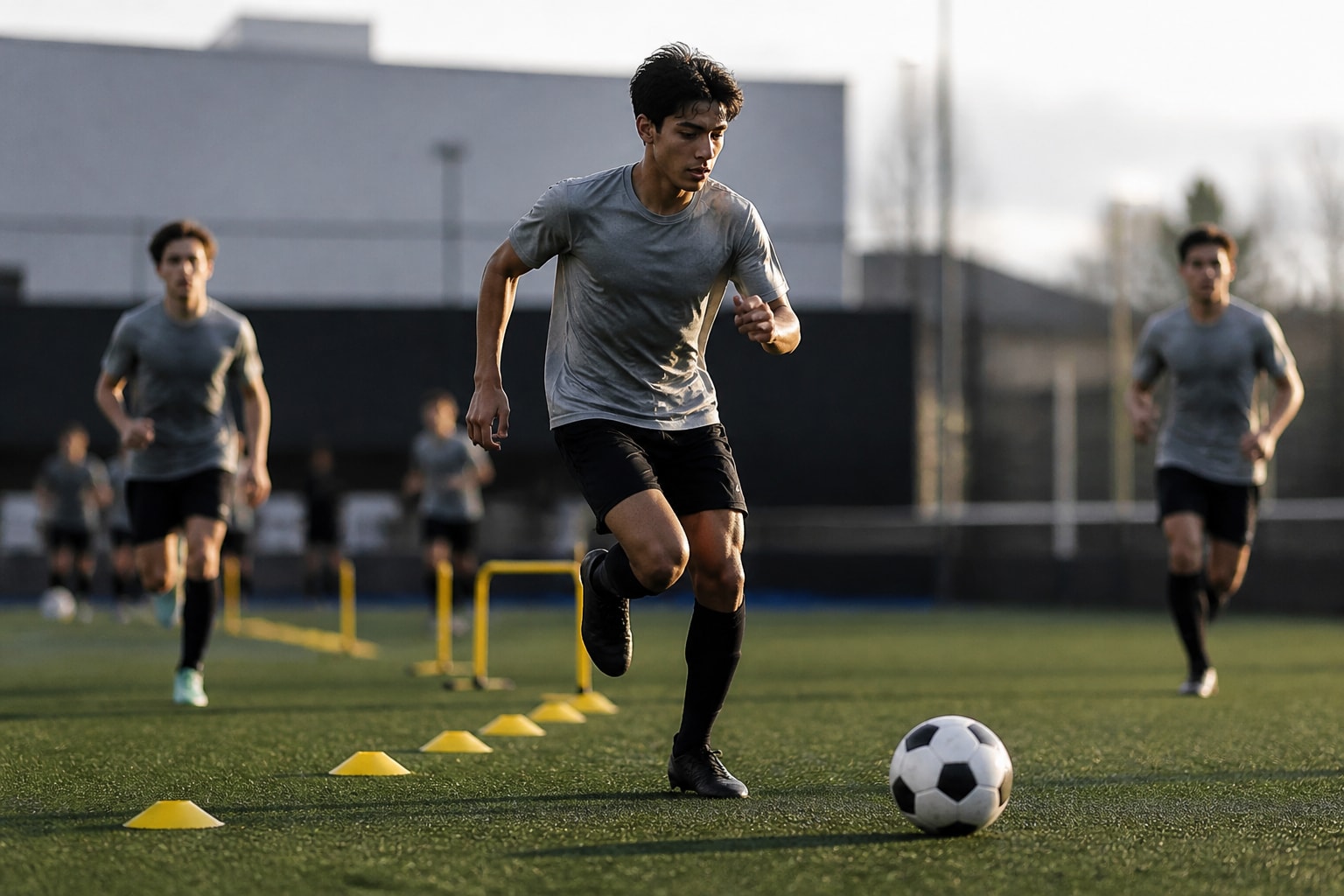
Effective U18 soccer training in Surrey, BC combines small-group technical work, tactical education, age-appropriate physical development and mental coaching, delivered by licensed coaches year-round. For a 16 to 18 year old aiming at a pro academy environment, U SPORTS or NCAA scholarships, the quality of training outside the club schedule often decides how far a player progresses. This guide explains what to look for, how a training year should be structured, and how to protect a player's health while the demands rise.
What U18 Players Need From Training
An U18 player needs training that refines decision-making, speed of play and consistency under pressure, because the basic technical foundation should already be in place. At this age, the gap between a good club player and a college-track player is rarely about whether they can pass or dribble. It is about how well they do those things when a defender closes them down in half a second.
Four areas of growth shape a complete player, and a quality program addresses each one deliberately:
- Technical: first touch under pressure, receiving on the half-turn, passing range, finishing with both feet.
- Tactical: reading space, positioning without the ball, understanding pressing triggers and build-up patterns.
- Physical: speed, strength, resilience and injury prevention, scaled to a body that may still be maturing.
- Psychological: composure, leadership, resilience after mistakes and the discipline to train consistently.
Strive Soccer Academy builds its sessions around these same four pillars, using a European-style training philosophy. That structure matters for U18 players because recruiters and academy coaches evaluate the whole player, not just a highlight reel.
How to Judge U18 Soccer Training in Surrey, BC
When comparing options for U18 soccer training in Surrey, BC, evaluate five things: coaching credentials, group size, training intensity, level-appropriate grouping and a clear pathway beyond the academy. Each can be verified with a few direct questions before a family commits.
Coaching credentials
Ask what licenses the coaching staff hold. Canada Soccer licensing runs from Soccer for Life certifications for developing coaches up to National A Licenses. Strive Soccer Academy's coaches are all fully licensed through Canada Soccer, which gives parents a recognized standard to measure against.
Group size and ball contact
Large groups mean long waits and few repetitions. Small-sided, high-touch sessions put the ball at a player's feet far more often. Strive sessions are built around small-sided, high-touch play with an average 8:1 player-to-coach ratio, a level of individual attention that is difficult to get in a full club practice with a much larger group.
Skill-based grouping and bio-banding
Players at 16 and 17 can differ considerably in physical maturity. Skill-based grouping puts players with similar ability together, while bio-banding accounts for differences in growth and maturity so that a smaller late developer is not overwhelmed. Both approaches keep sessions challenging without being discouraging, and Strive uses them to place players at the right level.
A track record beyond the pitch
Ask where former players have ended up. Strive-trained players have moved into professional academy environments, U SPORTS and NCAA Division I and II scholarships, and overseas trials in Europe. The academy develops youth players from the grassroots level, so many of those athletes were developed over several seasons rather than in a short-term push.

What a Strong Training Session Looks Like
A strong U18 session is built around game-realistic problems, high repetition and immediate feedback, rather than long lines and standing instruction. The best way to evaluate a session is to watch how much time players spend actively engaged with the ball.
A typical well-designed session for this age group moves through these stages:
- Activation and technical warm-up: ball mastery and movement patterns that prepare the body and sharpen touch.
- Technical block: receiving, passing or finishing patterns performed at match speed, with progressions that add pressure.
- Tactical small-sided game: a constrained game, such as 4v4 plus neutrals, that rewards specific decisions like switching play or pressing as a unit.
- Conditioned finishing or transition work: repeated attacking and defending moments that mirror matches.
- Cool-down and reflection: brief coach feedback and one or two individual targets for the week.
Parents can ask to observe a session. A coach confident in the program will welcome that. Watch whether corrections are specific ("open your hips before receiving") rather than general ("be better"), and whether every player is involved throughout.
For families who want to understand how these principles compare with other approaches, what makes our training different at Strive explains the philosophy in more detail.
Structuring a Full Year of Development
Players develop fastest when training continues year-round and shifts focus with the seasons, rather than stopping and restarting around club schedules. A sensible annual structure matches the surface and the competitive calendar.
| Season | Setting | Primary focus |
|---|---|---|
| Fall | Outdoor league | Match application, tactical consistency, fitness maintenance |
| Winter | Indoor and futsal | Tight-space technique, quick decisions, first touch |
| Spring | Outdoor league | Peak performance, showcase readiness, leadership |
| Summer | Skill blocks | Individual weaknesses, strength base, recovery |
Winter futsal and indoor work deserves particular attention. The smaller space and heavier ball demand sharper technique and faster thinking, and many of the best technical players in the world developed through it. Strive offers year-round programming across fall and spring outdoor leagues and winter indoor and futsal, so players can keep a continuous development thread. Parents interested in the seasonal side can read more about year-round soccer training in Surrey and the role of indoor soccer training in a player's winter.
Local facilities support this approach. South Surrey Athletic Park, at 14600 20 Avenue, includes both grass and synthetic sports fields, and the BMO Coastal Soccer Centre there has an artificial-turf surface, giving Surrey players access to varied playing conditions.
Physical Load, Sleep and Recovery
Adding training volume only helps an U18 player if recovery keeps pace with it. Overtraining, poor sleep and inadequate strength work are among the most common reasons a promising player stalls or gets injured.
National guidance gives parents a useful baseline. The Canadian 24-Hour Movement Guidelines recommend that youth ages 5 to 17 accumulate at least 60 minutes of moderate-to-vigorous physical activity daily, with vigorous activity and muscle- and bone-strengthening activities each included at least three days per week. A committed soccer player will easily exceed the 60-minute figure, so the more relevant question is whether the week includes true strength work and genuine rest days.
Sleep is the most underestimated performance tool. AboutKidsHealth notes that teens ages 14 to 17 should get 8 to 10 hours of uninterrupted sleep per night. A player who trains in the evening, studies late and wakes early for school may fall well short of that range.
A practical weekly framework for a serious U18 player:
- Two to three technical or tactical sessions with a development focus
- One to two club practices plus a weekend match
- Two short strength and mobility sessions, focused on single-leg stability, hamstrings and core
- At least one full rest day, with an additional light-recovery day after a match-heavy weekend
- A consistent sleep schedule that protects the 8 to 10 hour range
It is also worth keeping perspective on how unusual this commitment is. Statistics Canada reports that 45.2% of youth ages 12 to 17 met the 60-minutes-per-day benchmark in 2021, up from 42.9% in 2020. Your player is already ahead of the curve. The job now is to channel that activity into structured development rather than simply adding more of it.
The Mental Side of U18 Development
Psychological growth separates players who plateau from those who keep improving, and it can be trained as deliberately as first touch. Between ages 16 and 18, players face selection decisions, school pressure, and competition for roster spots that can test their confidence.
Good coaching builds several habits during this stage:
- Resilience after errors: learning to reset within seconds of a mistake rather than carrying it for a quarter of the match.
- Ownership: setting personal development targets and tracking them without prompting from a parent or coach.
- Leadership: communicating with teammates, organizing the line and setting standards in training.
- Professional habits: arriving prepared, recovering properly and treating every session as an evaluation.
Character matters to recruiters. College coaches and academy staff commonly weigh how an athlete responds to setbacks and instruction. A program that develops character alongside skill gives a player something that does not show up on a stat sheet but strongly influences who gets the offer.
A Single Option for Extra Technical Work
Players who already train with a club often benefit most from a supplementary program that targets individual weaknesses with far more repetition than a team practice allows. Soccer Skills Training at Strive Soccer Academy fits that role, offering small-group, high-touch work with licensed coaches that complements rather than replaces club commitments. For an U18 player, that might mean spending a block of sessions on weak-foot finishing, receiving under pressure or distribution out of the back, then applying it directly in matches.
Connecting Training to College and Academy Pathways
The pathway from U18 training to a scholarship or academy opportunity depends on visible development over time, not a last-minute push. Families who plan early give players the best chance of showing consistent improvement when recruiters are watching.
A sound approach follows a few steps:
- Start the conversation early. Begin around age 15 or 16 by identifying realistic targets: U SPORTS, NCAA Division I or II, or a professional academy environment.
- Build a development record. Keep match footage, training notes and coach feedback so progress is documented.
- Balance academics. Grades determine eligibility and scholarship options as much as soccer ability does.
- Seek honest evaluation. Ask licensed coaches where a player's strengths and gaps sit relative to the level targeted.
- Stay patient with the process. Real pathways are built through sustained work, which is why the academy's approach centres on development rather than shortcuts.
Families looking for a fast-track route to a professional contract without the development work behind it will not find that here. The players who reach the next level typically earn it across multiple seasons of consistent training, and the right program supports that long game.
For younger siblings coming up behind an older player, Strive also offers age-specific programming, such as U16 soccer training and U15 soccer training, so a family can follow a consistent philosophy across the age groups. Those looking at the broader picture of advanced work can also review high-performance soccer training in Surrey.
Questions to Ask Before You Commit
Before enrolling in any U18 soccer training in Surrey, BC, put a short list of direct questions to the program and note how clearly each one is answered. Vague answers are informative on their own.
- What Canada Soccer licenses do your coaches hold?
- What is your typical player-to-coach ratio?
- How do you group players by ability and physical maturity?
- How many touches can a player expect per session?
- What does a full year of programming look like, including winter?
- Where have your former players gone after training with you?
- How do you balance training load with a player's club and school commitments?
For specifics on schedules, group sizes and availability, contact Strive Soccer Academy directly rather than relying on general assumptions.
A practical next step is to watch one training session in person and compare what you see against the checklist above, paying attention to touches per player and the quality of coaching feedback. Strive Soccer Academy's Soccer Skills Training gives committed U18 players small-group, licensed coaching that complements their club season across fall, winter and spring. If you want to see the sessions firsthand and discuss your player's goals, you can book a trial with Strive Soccer Academy and take the first step toward a structured development plan.