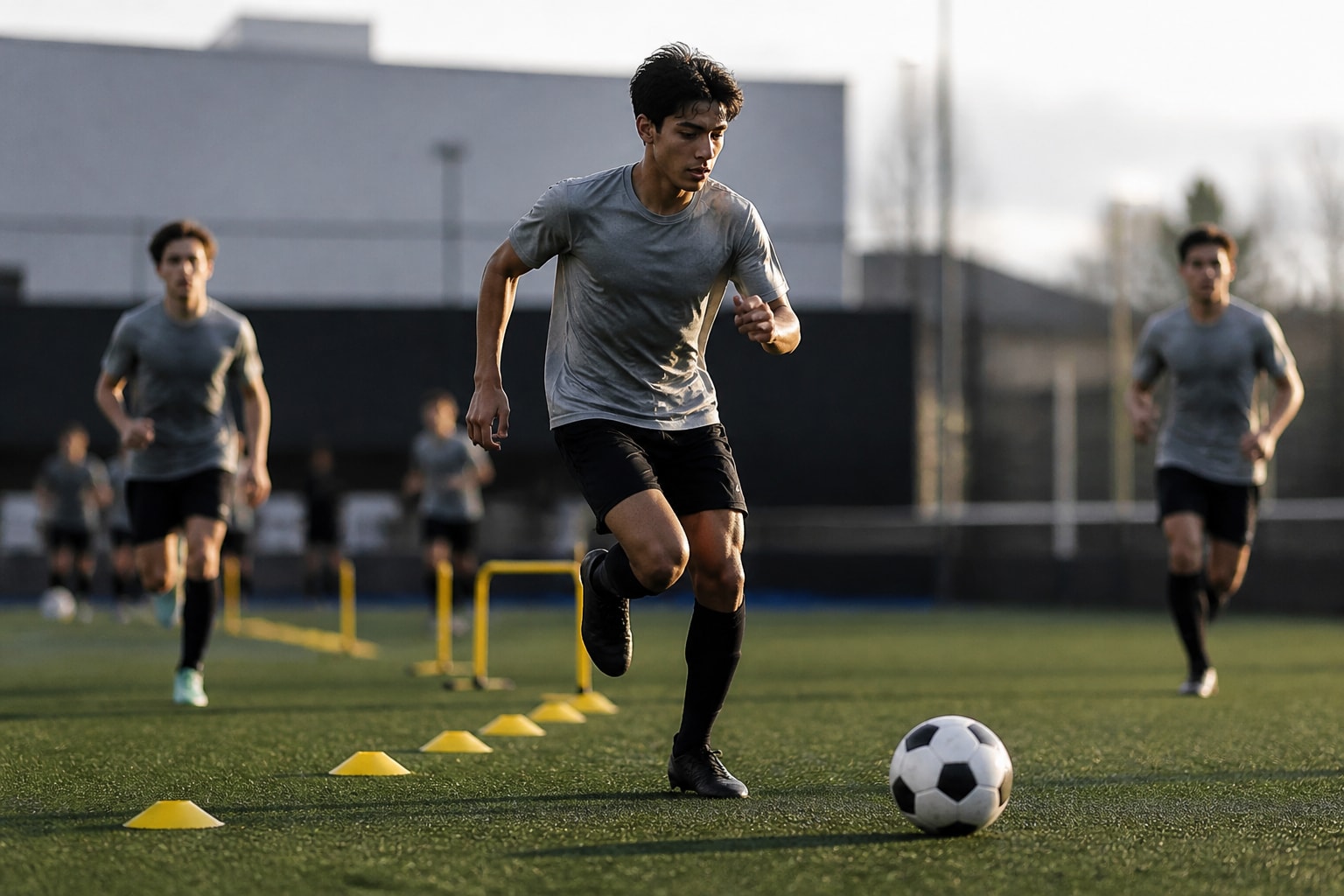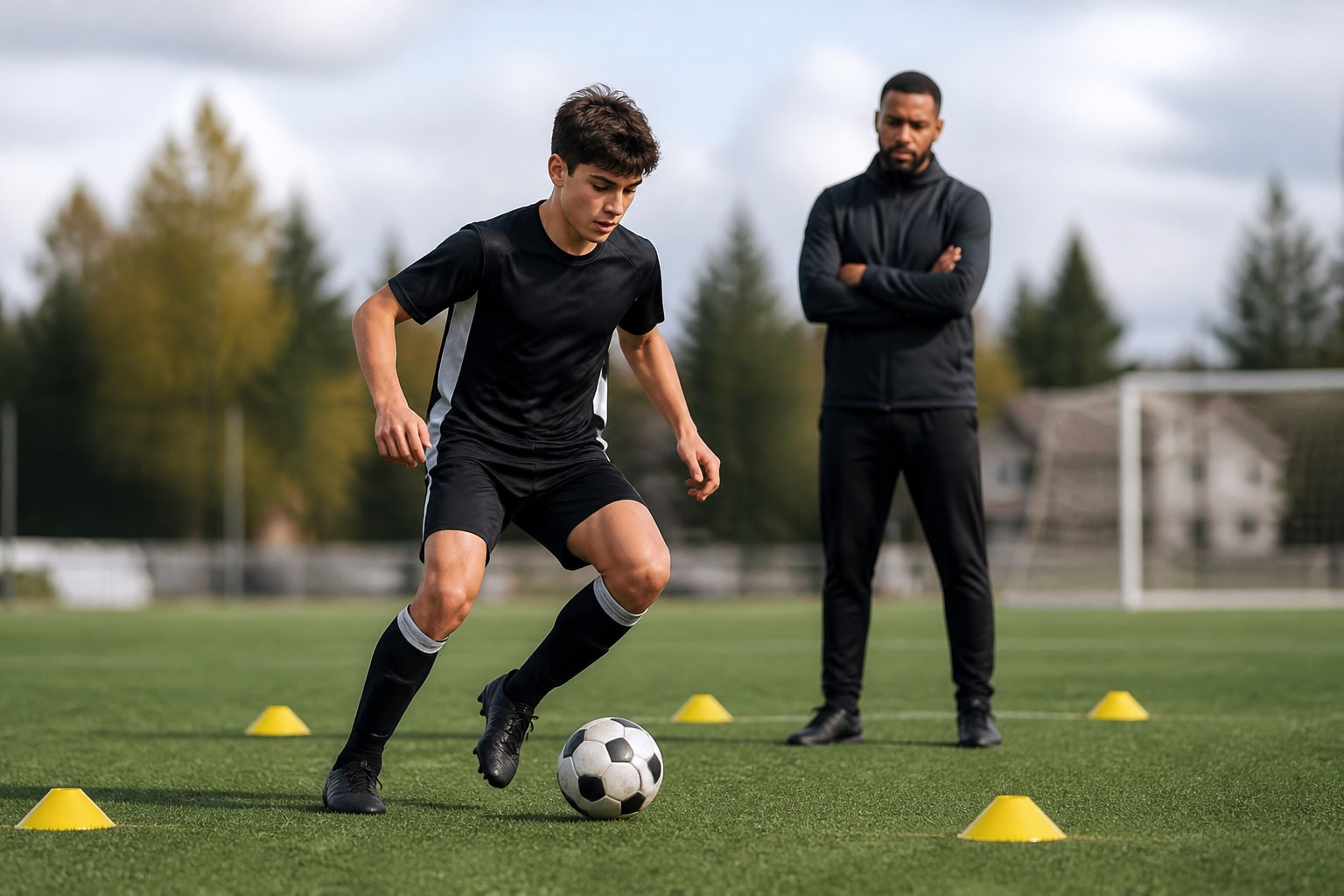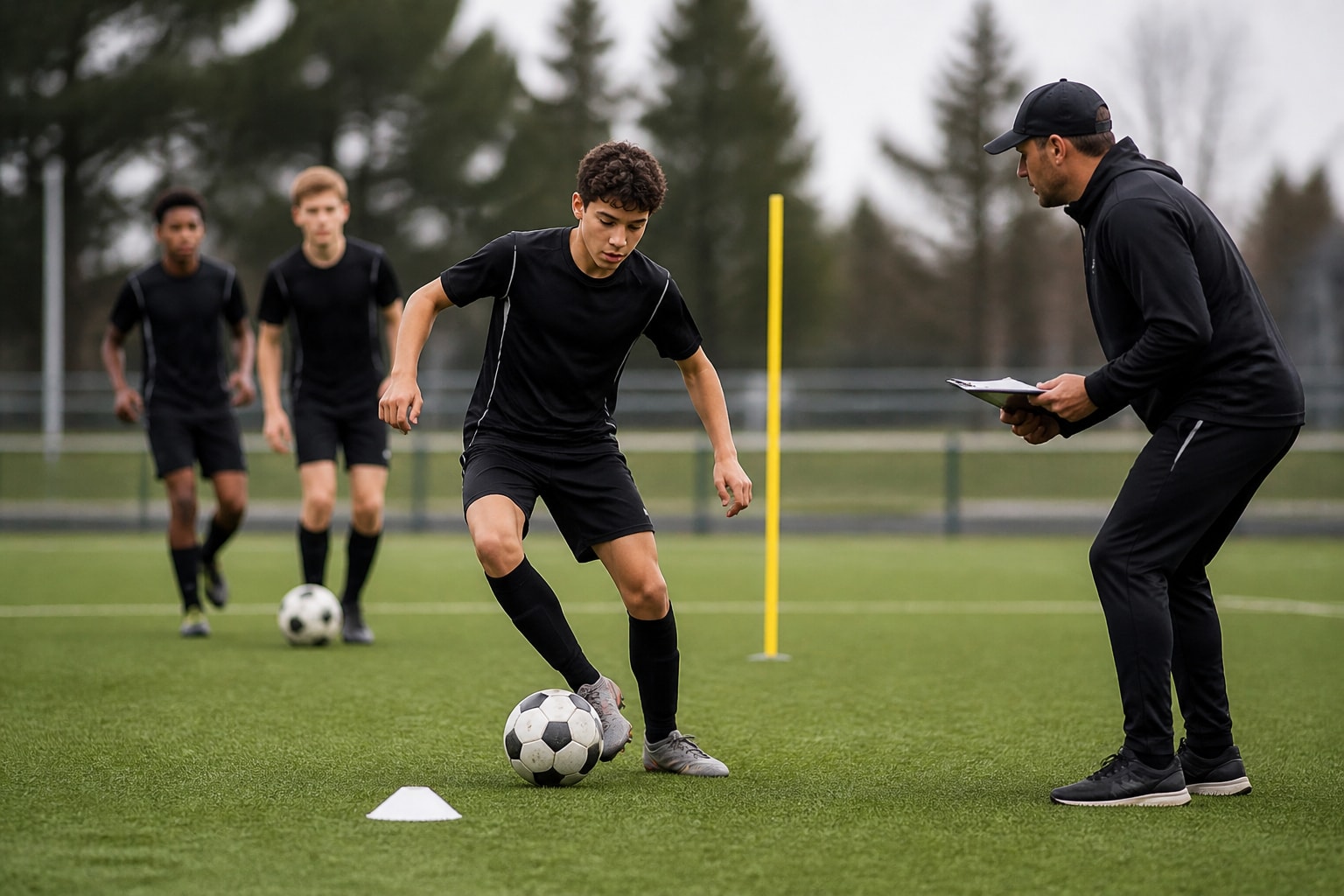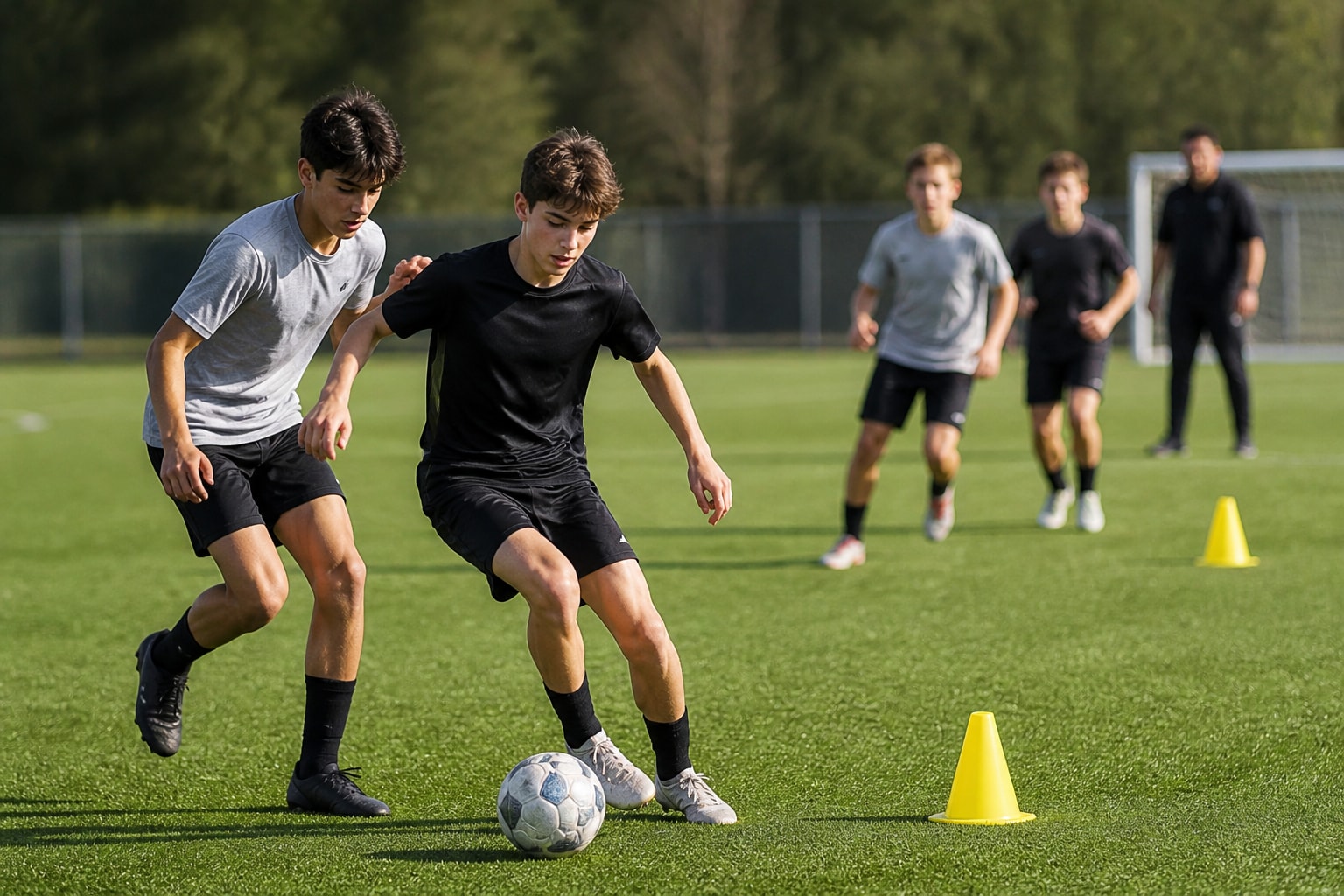
Good U16 soccer training in Surrey BC combines high-repetition technical work, game-realistic tactical coaching, age-appropriate physical development and psychological skills, delivered by licensed coaches to small groups. At 14 to 16, players are shaping the habits, fitness and mindset that decide whether they earn a roster spot on a competitive team, a provincial pathway or a college program. This guide explains what to look for, what to ask, and how to fit extra training around a full club schedule.
What U16 Players Need From Training
U16 players need training that addresses four areas together: technical ability, tactical understanding, physical readiness and mental resilience. A program that covers only one of them leaves a gap that shows up in match play.
Between 14 and 16, the demands of the game change quickly. Matches are faster, spaces are tighter, and coaches expect decisions to be made before the ball arrives. Players who relied on size or speed at U12 or U13 often find those advantages gone, and the ones who keep progressing are those who can receive under pressure, pass with both feet and read the next play early.
Here is what each area looks like at this age:
- Technical: first touch under pressure, passing range, finishing from different angles, and using both feet with confidence.
- Tactical: positioning, pressing triggers, transitions between attack and defense, and understanding a role within a system.
- Physical: speed, change of direction, strength, and the ability to repeat high-intensity efforts across a match.
- Psychological: composure after a mistake, communication, focus across a long season and handling selection decisions.
Strive Soccer Academy builds its sessions on this same four-part framework, rooted in a European-style training philosophy focused on technical, tactical, physical and psychological growth. Players coming up from U14 soccer training can continue developing within the same structure as the demands increase.

How to Judge U16 Soccer Training in Surrey BC
The best way to judge U16 soccer training in Surrey BC is to look at coach qualifications, group size, touch volume and how players are grouped. These four factors predict development far better than a facility's appearance or a program's marketing.
Coach licensing
Ask which Canada Soccer licenses the coaching staff hold. Licensing shows a coach has been trained in session design, player development stages and safe practice. At Strive Soccer Academy, all coaches are fully licensed through Canada Soccer, ranging from National A Licenses to Soccer for Life certifications for developing coaches.
Group size and ratio
Large groups mean long waits and few touches. Strive Soccer Academy averages an 8:1 player-to-coach ratio, which keeps a coach close enough to correct technique in the moment. The same principle applies to any program you consider: ask for the actual ratio, not a range.
Touch volume
Development comes from repetition at game speed. Small-sided, high-touch sessions at Strive are designed to give players a high number of touches per session, a figure worth comparing against any other program's answer. If a provider cannot say how many touches a player gets, the sessions are probably built around waiting.
Grouping by level
Putting a late-developing 15-year-old in a group of early developers, or the reverse, slows both. Strive uses skill-based grouping and bio-banding, so players train against others at a similar ability and physical maturity. Bio-banding matters especially at U16, when growth spurts can vary by several years between players of the same age.
What a Strong Session Looks Like
A strong U16 session moves from a movement-prep warm-up into technical repetition, then into a game-realistic exercise, then a small-sided match that tests the lesson. Every part connects to the next. Players who are a year older will find the next step covered in our U17 soccer training in Surrey BC guide.
A typical structure might run like this:
- Activation warm-up: dynamic movement and ball work that prepares muscles and joints.
- Technical block: passing patterns, receiving on the half-turn, or finishing sequences with high repetition.
- Tactical application: the same skill used in a directional exercise with opponents, such as a 4v2 or 5v3 with a clear objective.
- Small-sided game: conditioned play that rewards the behavior being coached.
- Cooldown and reflection: a short debrief so players can say what they noticed.
The reflection step is easy to cut, yet it develops the psychological side of the game. A player who can explain why a pass worked or failed is learning to make faster decisions in a real match. For more on how sessions are built, the soccer training sessions page outlines the approach.
Injury Prevention Belongs in the Plan
Warm-up quality directly affects how many matches a U16 player misses. Programs that treat the warm-up as a throwaway are ignoring some of the strongest evidence in youth soccer.
A 2024 systematic review published in the Journal of Orthopaedic Surgery and Research covered 11 studies and more than 10,000 young participants from eight countries. It reported substantially fewer overall and severe injuries with the FIFA 11+ Kids program, and found that greater weekly use was associated with greater benefit. A separate 2024 critically appraised review in the International Journal of Athletic Therapy and Training found three high-quality randomized trials in which the program reduced overall youth soccer injury rates, used as a coach-led warm-up at least twice weekly.
Those studies examined the Kids version of the program, designed for younger players, but the principle carries over: a structured, coach-led warm-up done consistently protects players. For a U16 family, three practical steps follow:
- Ask whether the program uses a structured warm-up with strength, balance and landing mechanics, not just jogging and stretching.
- Make sure the warm-up happens before every session, including extra training, not only on match days.
- Treat persistent pain as a reason to see a qualified medical professional rather than something to train through.
Players who train three or four times a week across club and academy sessions have a higher cumulative load, so the quality of preparation matters even more.
Fitting Extra Training Around Club Commitments
Extra training works best when it fills gaps your club session leaves, rather than repeating them. Most club practices at U16 emphasize team shape and match preparation, with limited time for individual repetition.
Think of extra training as the place for individual touches, weak-foot work and position-specific detail. A midfielder who wants to scan and turn faster, or a defender working on passing out of pressure, can spend a full session on that single skill. The page on soccer training outside club practice explains how this complements a team schedule.
A sensible weekly balance for a committed U16 player often looks like this:
| Day type | Purpose | Example |
|---|---|---|
| Club practice | Team tactics and match prep | Shape, set pieces, scrimmage |
| Academy session | Individual technique and decision-making | Small-group technical and tactical work |
| Match day | Competition | League or tournament fixture |
| Rest day | Recovery | Full rest or light mobility |
Rest is part of the plan, not a gap in it. Growth, sleep and school load all affect how much a 15-year-old can absorb. If your player seems flat or is picking up knocks, reduce volume before adding more.
Year-Round Development in Surrey's Climate
Surrey's wet winters make a year-round plan more practical than a seasonal one. Players who stop touching the ball between outdoor seasons often lose sharpness that takes weeks to recover.
Strive Soccer Academy runs programming across the fall and spring outdoor leagues and winter indoor and futsal sessions. Futsal in particular suits U16 players because the smaller ball and tight space force quicker thinking and cleaner technique, which transfer well to the outdoor game. You can read more about year-round soccer training in Surrey and how the seasons connect, or see how indoor soccer training fits the winter months.
For families, a continuous plan also reduces the guesswork. Instead of searching for a new program each season, the player stays with coaches who know their strengths and what they are working on.
Pathways: Competitive Teams, College and Beyond
Training at U16 should be tied to a realistic pathway, whether that means making a top club team, attracting provincial attention, or preparing for college soccer. The honest version of that conversation starts with development, not promises.
Strive Soccer Academy has spent over 20 years developing youth players from the grassroots level. Strive-trained players have gone on to professional academy environments, U SPORTS and NCAA scholarships, and overseas trials in Europe. Those outcomes came through sustained work on fundamentals, which is the message to take from them: no program can shortcut the process. Families looking for a fast route to a professional contract without that development work are not the audience for this kind of training.
For a U16 family with college in mind, a few practical questions help:
- Is the player getting enough quality touches each week, beyond team practice?
- Does the training include video or feedback the player can act on?
- Is the program honest about where the player currently sits and what needs to improve?
If your player is aiming at the highest competitive level, the high-performance soccer training and elite soccer training pages describe how advanced players are challenged.
The Mental Side Parents Can Support
At 15 and 16, confidence often decides performance as much as ability does. Parents can help by changing what they ask after a match.
Instead of opening with the result or the player's goals, try questions that build self-awareness: What did you notice in the first half? What would you do differently next time? Which part of your game felt sharp? This reinforces what coaches teach about composure and reflection, and it keeps the car ride home from becoming a second review by someone who did not see every detail.
Selection setbacks are common at this age. A player left off a roster is not out of the pathway, but how they respond often shapes the next two years. Training environments that normalize effort, feedback and gradual improvement give players a steadier base to recover from disappointment.
Choosing a Program and Taking the First Step
Start by matching the program to your player's current level and goals, then confirm the details directly with the provider. Ask about coaches' licenses, group size, session length, schedule and how progress is communicated.
For players who want focused individual development alongside team play, Soccer Skills Training at Strive Soccer Academy is a strong fit, with licensed coaches, small groups and skill-based grouping. Details such as pricing and session times are best confirmed with the academy directly, so use the youth soccer training schedule or contact page to get current information.
If your player is still brand new to the game or looking only for casual weekend play, a recreational or introductory program will serve them better. U16 training is built for players who are already committed and want structured, higher-level development.
A trial session is the clearest way to see whether a program matches your player. Watch how coaches correct, how many touches each player gets, and whether your player leaves tired in a good way and keen to come back.
Your next step is to pick one weekly gap in your player's schedule, such as individual touches or weak-foot work, and find a session that fills it. At Strive Soccer Academy, we understand what parents want most for their young athletes: a program that develops skills, builds character and creates real opportunities, delivered through a European-style philosophy built on technical, tactical, physical and psychological growth. Our Soccer Skills Training gives committed U16 players the repetition and coaching to match. To see it for yourself, Book a Trial with Strive Soccer Academy and watch your player train with Canada Soccer licensed coaches.