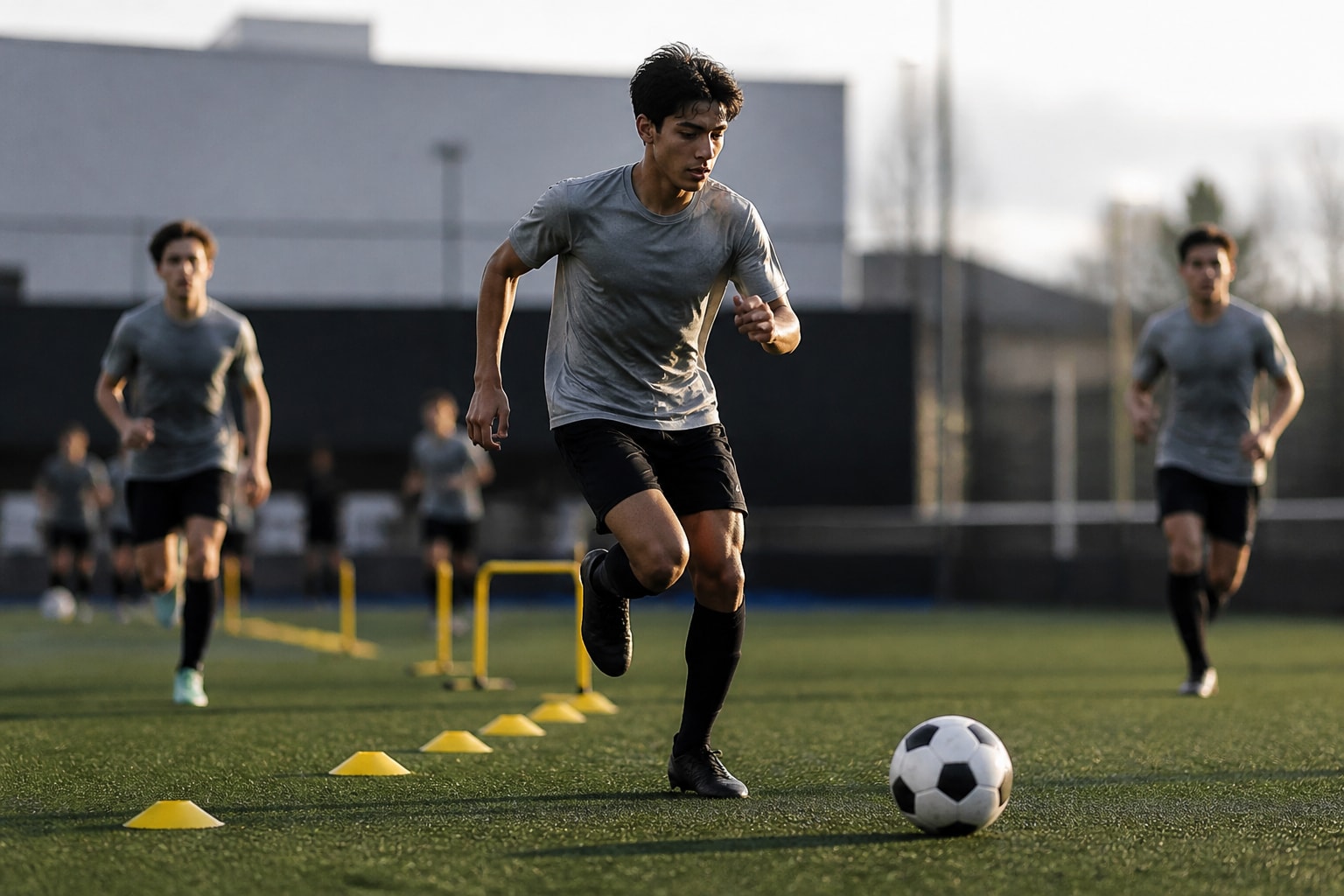
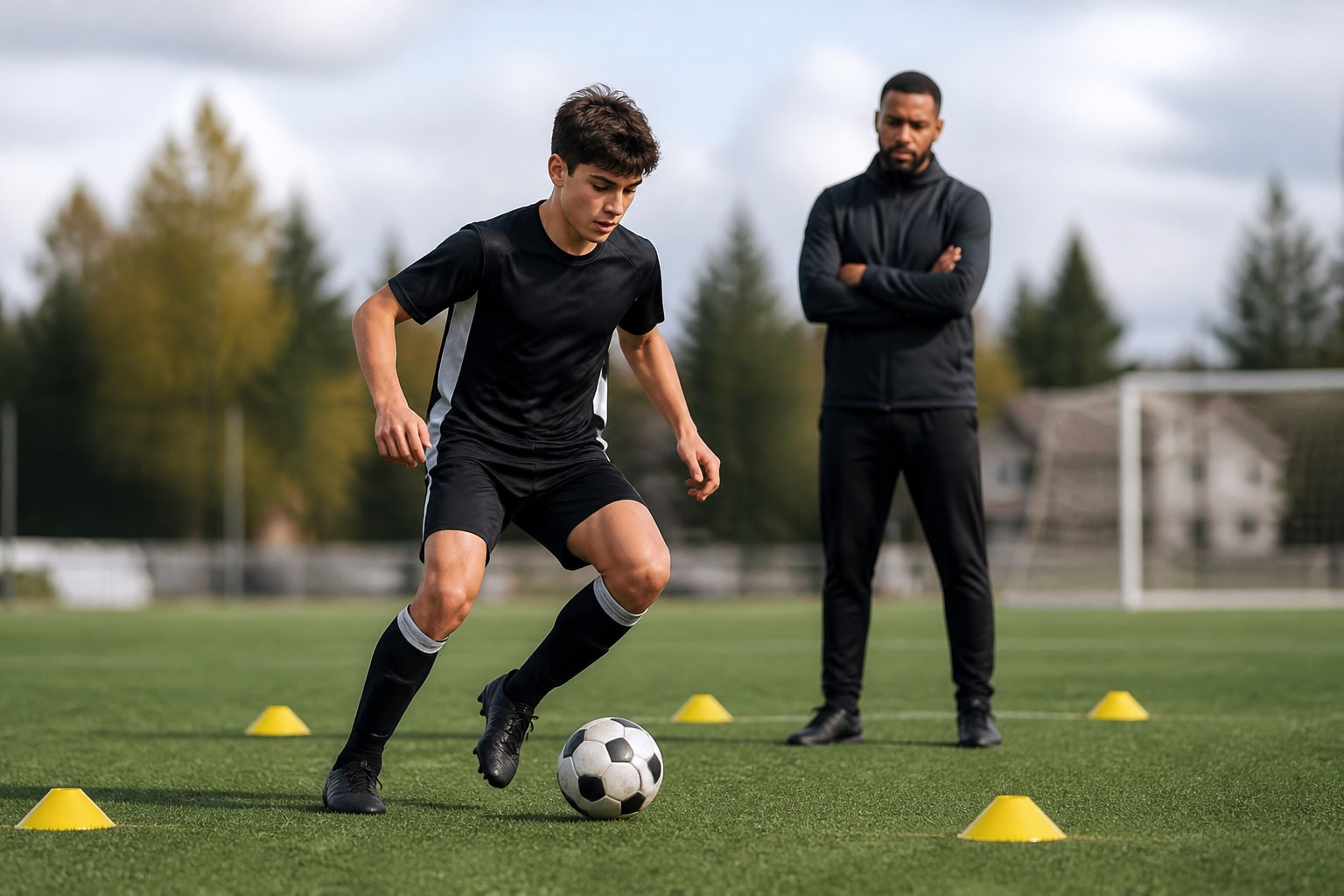
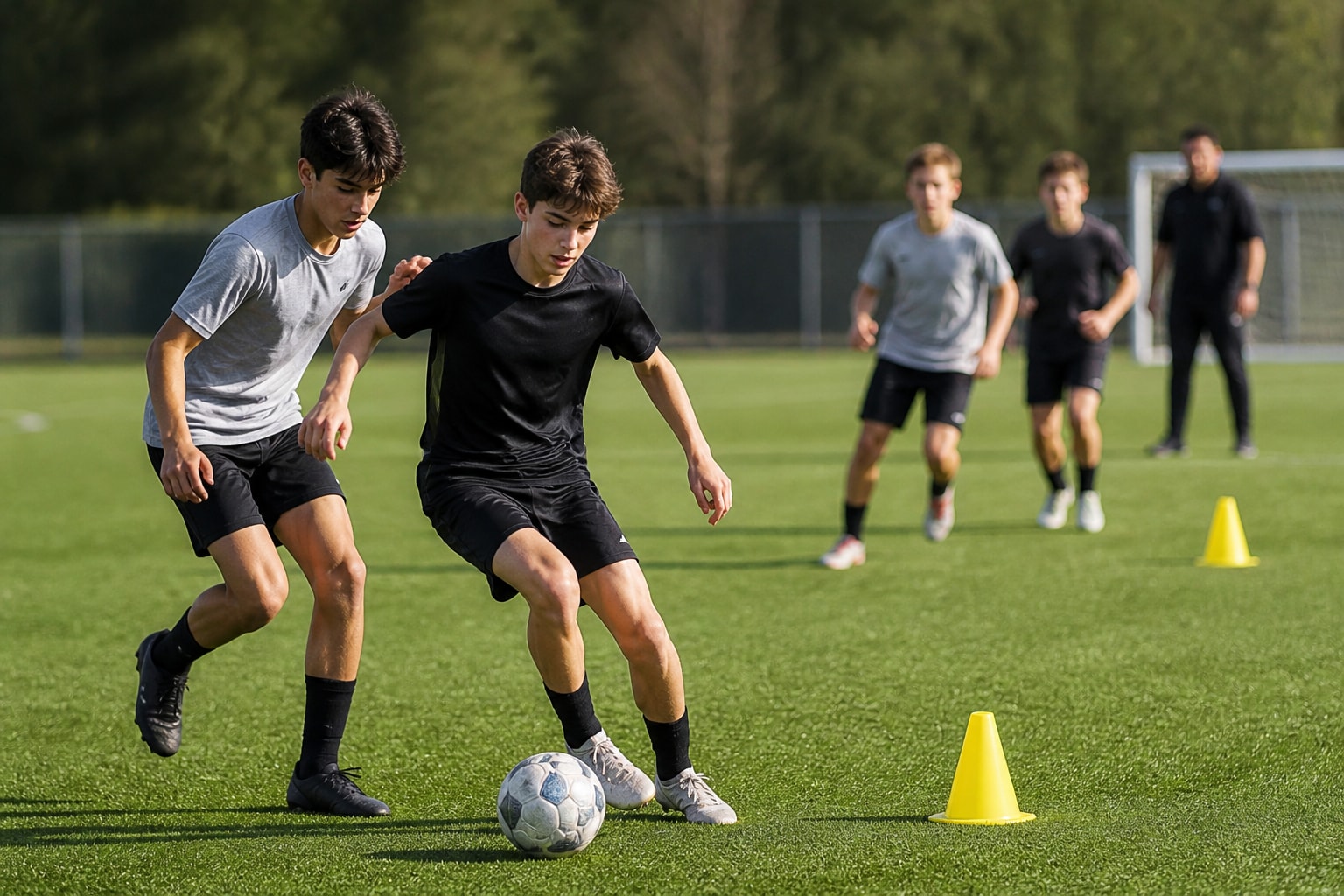
Good U12 soccer training in Surrey, BC combines high-repetition technical work, small groups, licensed coaching and year-round programming, so a committed player keeps developing between club practices and games. At ages 10 to 12, players move from learning the basics to building the habits that carry them into competitive, travel and eventually college-track environments. This guide explains what to look for, what to ask, and how to fit extra training around your child's club schedule.
What U12 Players Need From Training
A U12 player needs three things most: a large volume of quality touches, coaching that matches their level, and room to grow technically, tactically, physically and psychologically at the same time.
Ages 10 to 12 are often called the golden window for skill acquisition. Players have the coordination to master complex movements, and they are old enough to understand why a technique matters. A club practice with 16 to 20 players and one or two coaches rarely allows enough individual repetition to take advantage of this window.
Development at this age sits on four pillars:
- Technical: first touch, dribbling under pressure, passing with both feet, finishing.
- Tactical: scanning before receiving, finding space, understanding shape in 7v7 and 9v9 formats.
- Physical: agility, balance, coordination and age-appropriate strength work.
- Psychological: confidence, resilience after mistakes, focus and a willingness to compete.
Strive Soccer Academy builds its programming around these four areas, using a European-style training philosophy brought to Surrey. The aim is a rounded player, not just a player who can perform a few tricks in isolation.

How to Evaluate U12 Soccer Training in Surrey BC
The best way to evaluate U12 soccer training in Surrey BC is to measure it against four concrete criteria: coach qualifications, group size, touches per session and how players are grouped.
Coach qualifications
Ask what licenses the coaches hold. Canada Soccer's coaching pathway runs from Soccer for Life certifications for developing coaches up to National A Licenses. At Strive Soccer Academy, all coaches are fully licensed through Canada Soccer, across that full range.
Player-to-coach ratio
Individual feedback is the core of skill development. Strive averages an 8:1 player-to-coach ratio, which allows coaches to correct a body position or a weak-foot habit in the moment rather than from across the field. As a rule, if a session cannot give your child regular one-on-one coaching moments, the repetitions are probably not being corrected.
Touches per session
Technical growth follows repetition. Strive's small-sided, high-touch sessions deliver 1,000 to 2,000 touches per session. Compare that with a typical scrimmage-heavy practice, where a player may touch the ball only a few dozen times in a stretch of play.
Grouping method
Mixed-ability groups tend to bore the strongest players and overwhelm the newest ones. Look for skill-based grouping. At U12, also ask about bio-banding, which groups players by physical maturity as well as age. Two 11-year-olds can differ by several inches and a year or more of physical development, and bio-banding lets each one train at the right challenge level. Strive uses both skill-based grouping and bio-banding.
What a Strong U12 Session Looks Like
A strong U12 session moves from individual ball mastery into small-sided games with a clear coaching focus, and it keeps every player active throughout.
A typical structure looks like this:
- Technical warm-up (10 to 15 minutes): each player has a ball, working on close control, turns and passing patterns.
- Skill focus (15 to 20 minutes): one theme, such as receiving on the back foot or beating a defender one-on-one, practiced at increasing pressure.
- Small-sided game (20 to 25 minutes): 3v3 or 4v4 formats where the session's theme must appear in live play.
- Reflection (5 minutes): players explain what they tried and what they would change.
Small-sided games matter because every player is involved in every phase of play. In a 4v4, each player faces far more decisions per minute than in a full 9v9 match. The reflection step builds the psychological side of the game, teaching players to assess their own performance rather than waiting for a coach to do it.
Parents who want to see how this type of work is structured can review the technical soccer training approach used at Strive, or the tactical training for youth that builds on it.
Outdoor, Indoor and Futsal: Training All Year
Surrey's climate means a serious U12 player needs a plan for both dry-weather and wet-weather months, and the best plans use outdoor fields in fall and spring and indoor or futsal environments in winter.
Year-round work prevents the long gaps that erode technical gains. Strive runs programming across fall and spring outdoor leagues and winter indoor and futsal. Futsal in particular suits this age group: the smaller, heavier ball and tight space force quicker decisions and cleaner touches, and those habits transfer directly to the outdoor game.
Surrey's field infrastructure supports this kind of schedule. The City of Surrey operates 18 synthetic turf fields that are open year-round for sports, which gives families reliable options when natural grass is unplayable. Surrey's synthetic turf fields are open year-round for sports, so families can look to the city's listings for venues that suit their training plans.
For more detail on seasonal options, see Strive's pages on outdoor soccer training in Surrey and indoor soccer training in Surrey.
Understanding field closures
Wet weather affects grass fields in Surrey for much of the year, so it helps to know how closures work. The city says sports fields are inspected weekly, and the field-status report is updated by 3 p.m. on Thursdays for weekend play. Its guidance states that grass fields with standing water or soft, muddy areas should be closed. A "Club Discretion" status leaves the decision to club officials, typically less than 24 hours before play. Checking the report on Thursday, and confirming with your club on game day, avoids wasted trips.
Extra Training Alongside Your Club Schedule
Extra training works best when it fills gaps that club practice cannot, rather than adding more of the same.
Club sessions are built for team organization: formations, set pieces, match preparation. Individual technical development often gets less time. A dedicated skills program covers the difference, and it is most valuable when the player's weaknesses are specific. A midfielder who struggles to receive under pressure, or a winger who only uses one foot, benefits from targeted repetition that a team practice cannot provide.
Consider these questions before adding sessions:
- Is my child's technical level holding back their performance in matches?
- Does my child receive enough individual feedback at club?
- Is there a stretch of the year, such as winter, when training drops off?
- Can my child sustain the added load without fatigue or loss of enthusiasm?
Strive's Soccer Skills Training is designed for players who want this kind of focused technical work in a small-group setting. Families who want a closer look at how outside sessions complement club commitments can read about soccer training outside club practice in Surrey.
Managing load at ages 10 to 12
More is not always better. Players this age are growing, and rest matters. Aim for one to three structured sessions per week in total, outside of matches, and watch for warning signs such as persistent soreness, declining enthusiasm or slipping school performance. Short, high-quality sessions tend to produce more progress than long, tiring ones.
Heading Guidelines and Player Safety
Parents of U12 players should know that Canada Soccer's current guidance limits heading at this age. Canada Soccer's Safe Soccer page summarizes its 2025 youth-heading guidelines as age-based, with restrictions on heading at younger ages. For a U12 player, ask any program how it applies the current guidelines, and confirm the coaching staff is familiar with them. A program that treats heading as a core U12 drill is out of step with national guidance. In practice, a well-run session at this age replaces heading work with other ways of developing aerial skill: juggling with the feet and thighs, controlling a ball dropped from the hands, and practicing chest and thigh control. Ask the coach what the plan is if a ball is played in the air during a small-sided game, and whether players are taught to let it drop and control it with the body. Parents can also check the club's rules for matches, since training and competition should follow the same approach. If the answers are vague, that is a reason to ask for the program's written policy before enrolling.
Skill-Based Pathways: What Comes After U12
Training at U12 is preparation for the stages that follow, when selection becomes more competitive and the gap between recreational and committed players widens.
U13 brings the move to full-sized formats in many leagues, along with more physical play and more demanding tryouts for competitive and academy teams. Players who have built strong technique and decision-making by U12 handle these transitions with far less stress. They can focus on tactics and fitness because the basics are automatic.
Strive has over 20 years of experience developing youth players from the grassroots level, and Strive-trained players have gone on to professional academy environments, U SPORTS and NCAA Division I and II scholarships, and overseas trials in Europe. Those outcomes come from sustained development work across many years, not from a single season. Parents with a long-term view may find the high-performance soccer training and competitive soccer training pages useful for understanding how younger training connects to older pathways.
This guide is written for families whose child already plays seriously and wants structured, high-level development. Players who only want casual recreational soccer, or families expecting a shortcut to a professional contract without sustained development work, are better served by recreational or introductory programs.
Questions to Ask Before You Enroll
Asking specific, factual questions is the fastest way to separate substantive programs from marketing.
- What Canada Soccer licenses do your coaches hold?
- What is the average player-to-coach ratio?
- How many touches does a player get per session?
- How do you group players: by age only, or by skill and physical maturity?
- What does the year look like across fall, winter and spring?
- How do you apply Canada Soccer's heading guidelines?
- How will you communicate progress to parents?
For details on session formats, scheduling, pricing and availability, contact the program directly rather than relying on general descriptions. The youth soccer training schedule page is a practical starting point for Strive families.
Finding U12 Soccer Training Near You in Surrey
Surrey is a large city, and the commute matters when a child trains several times per week. Families in different parts of the city can look for programs close to home or school to keep the routine sustainable. A practical way to judge distance is to time the drive at the hour your child would actually travel, since a 20-minute trip at midday can double during weekday rush hour. Training on a Thursday evening is a very different commitment from a Saturday morning session, so match the schedule to your family's week before you commit to a location. Venue surface also affects reliability. Surrey operates 18 synthetic turf fields that are open year-round for sports, and a program that books turf or indoor space is less likely to cancel in wet weather than one that depends on grass.
Strive serves players across the city and nearby communities, with dedicated pages for youth soccer training in Fleetwood, Newton and South Surrey. Families with a younger sibling may also want to look at U10 soccer training in Surrey, which follows the same development philosophy at an earlier stage. Families planning further ahead can read our guide to U14 soccer training in Surrey BC for what changes at that age.
The simplest next step is to watch your child in a live session and see how they respond to small-group coaching, since a trial reveals more than any description. Strive's Soccer Skills Training gives committed U12 players high-touch, licensed coaching built around technical, tactical, physical and psychological growth. When you are ready to see it firsthand, you can Book a Trial with Strive Soccer Academy and let your child experience the training for themselves.