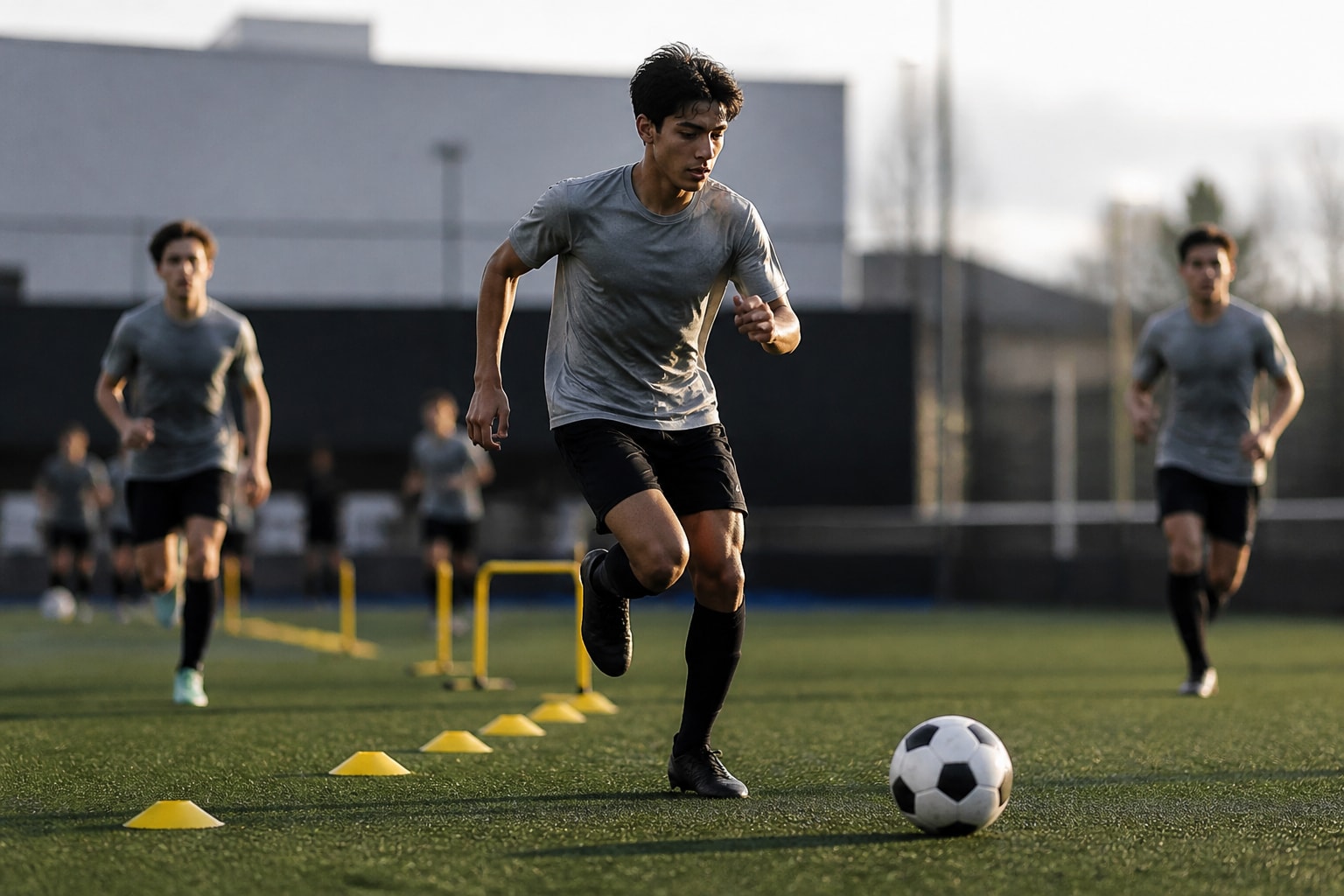
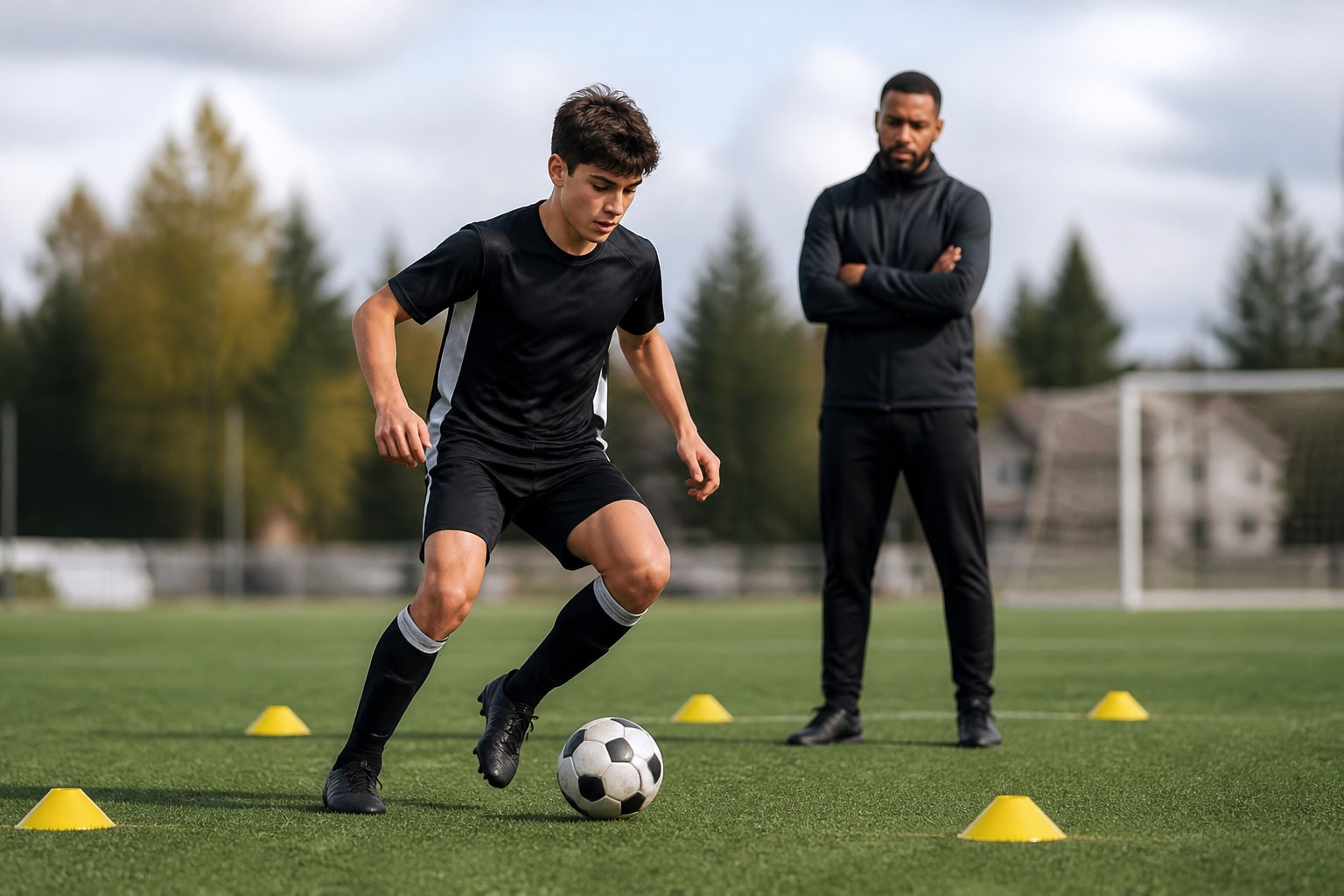
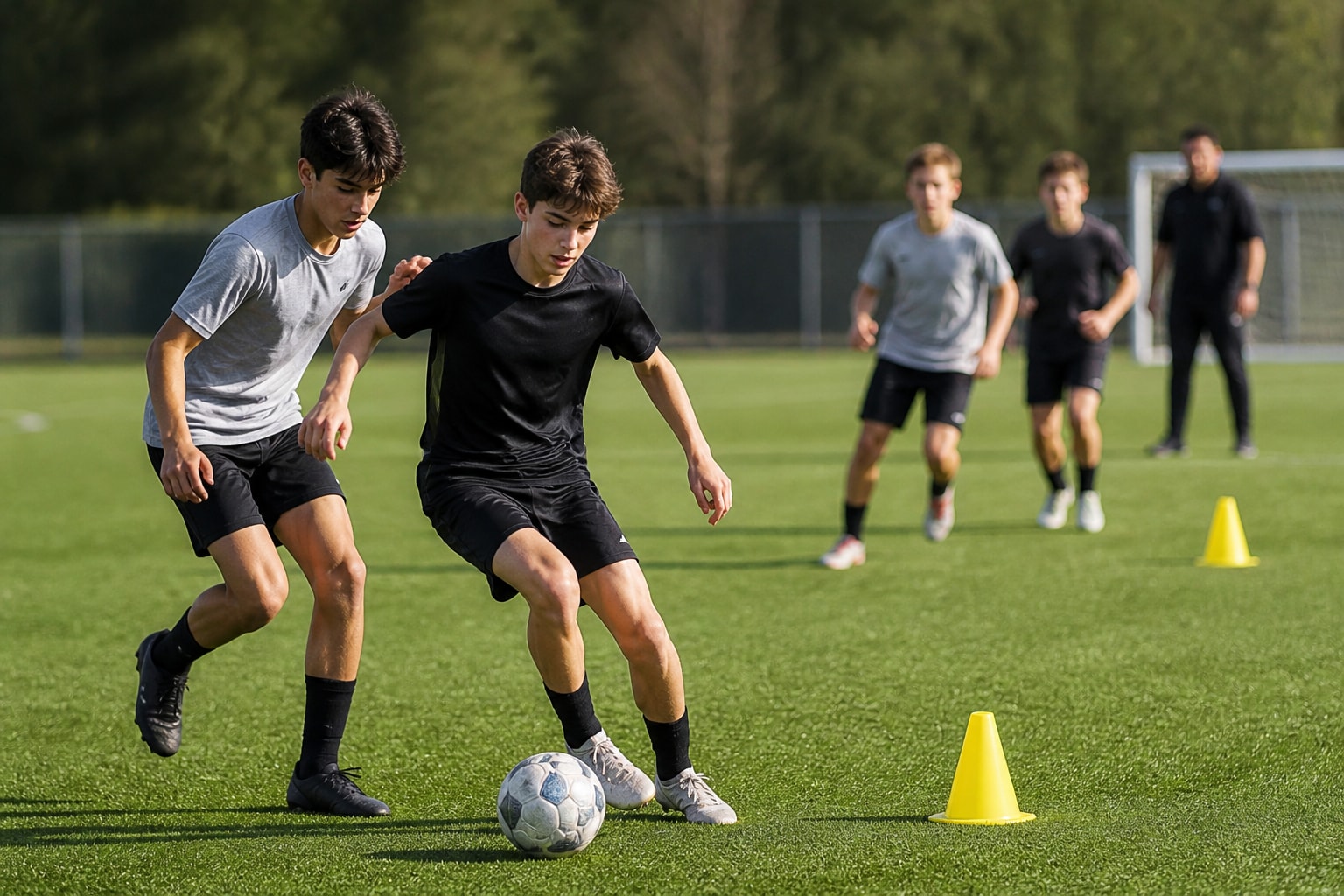
The best u14 soccer training in Surrey BC combines small groups, licensed coaching, a high number of touches per session and a development plan that covers technical, tactical, physical and psychological growth. At 13 and 14, players face bigger fields, faster play and the first real selection decisions, so the quality of training outside the team practice often decides who keeps progressing. This guide explains what U14 players need, how to judge a program and how to build a training week that supports long-term goals.
What U14 Players Actually Need From Training
U14 players need training that shifts from learning individual skills to applying them under pressure, in tighter spaces and at game speed. The U14 age group typically moves onto a larger field and a full 11v11 format, which exposes any weakness in first touch, scanning and decision-making.
Four areas of development matter at this stage:
- Technical: receiving, passing, dribbling and finishing with both feet, under time and space pressure.
- Tactical: understanding positioning, pressing triggers, build-up patterns and how to read the game before the ball arrives.
- Physical: coordination, speed, strength and injury prevention while the body is changing quickly.
- Psychological: confidence, resilience after mistakes, focus and the ability to handle competition for places.
A program that trains only one of these areas leaves gaps. A player with excellent technique who cannot read the game stalls at selection level. A fast, strong player with a weak first touch loses the ball in tight midfield areas.
Strive Soccer Academy builds its sessions around all four areas, using a European-style philosophy brought to Surrey. You can see how this approach differs from a typical club environment on the page covering what makes our training different.
The Growth Spurt Factor: Why Bio-Banding Matters at 13 and 14
Bio-banding groups players by biological maturity rather than only by birth year, which matters most at U14 because players born in the same year can differ by several years in physical development. One player may already be shaving while a teammate has not yet begun a growth spurt. Standard age-group training can reward the early developer for size alone and discourage a later developer who may have more technical or tactical ability.
This has real consequences for a player's confidence and development path. Late developers often get less playing time and fewer touches in large-group sessions. Early developers can rely on strength and speed instead of building the technical and decision-making habits they will need once everyone catches up.
Strive Soccer Academy uses skill-based grouping and bio-banding so players train at the right level for their stage of development. For a parent, the question to ask any program is simple: how do you group players, and what happens when a player's growth outpaces or lags behind the group?

How to Evaluate U14 Soccer Training in Surrey BC
A strong program for U14 soccer training in Surrey BC shows its quality through coach credentials, group size, touch volume and a clear development structure. Use these criteria when you compare options.
Coach Licensing and Experience
Ask which Canada Soccer licenses the coaching staff hold. Licensing tells you the coach has completed formal education in player development, session design and age-appropriate methodology. At Strive Soccer Academy, all coaches are fully licensed through Canada Soccer, ranging from National A Licenses to Soccer for Life certifications for developing coaches. The academy also brings more than 20 years of experience developing youth players from the grassroots level.
Group Size and Coach Ratio
Group size determines how many touches and how much feedback your child receives. Large sessions with one coach and 20 players mean long waits and little correction. Strive averages an 8:1 player-to-coach ratio, which allows individual feedback during the session rather than only at the end. Our page on small group soccer training in Surrey explains how this format works.
Touches Per Session
Repetition builds technique. Strive's small-sided, high-touch format is designed to deliver a high volume of touches per session, a volume that is difficult to reach in a full-team practice with one ball per several players. Ask any program you consider how many touches a player gets in a typical session.
A Clear Development Structure
Look for a program that can explain what a player will work on across a season and why. Random drills without progression do not build a player. A structured program connects each session to a technical, tactical, physical or psychological objective.
Training That Builds Game Intelligence, Not Just Technique
At U14, tactical understanding separates players who plateau from those who keep moving up. Clean technique matters, but a player who cannot decide quickly where to pass, when to dribble or where to position after losing the ball will struggle at a competitive level.
Good tactical training for this age includes:
- Small-sided games (3v3, 4v4, 5v5) that force constant decisions.
- Positional play, where players learn spacing, angles and support.
- Transition work: what to do in the first three seconds after winning or losing the ball.
- Scanning habits, so the player looks around before receiving.
Small-sided games work because every player is involved in every phase of play. In an 11v11 match, a midfielder may touch the ball a few dozen times. In a 4v4 session, the same player touches it far more often and faces a decision with almost every touch.
Parents who want to understand how this applies to older youth can read about tactical soccer training for youth in Surrey BC for more detail on how the academy teaches game understanding.
Building a Weekly Training Plan Around Club Soccer
Extra training should add to a player's club commitments, not compete with them or push the weekly load too high. A U14 player on a competitive team typically has two club practices and one match each week. Supplemental training works best as one or two additional sessions focused on individual technique and decision-making that a team practice cannot cover.
A balanced week might look like this:
| Day | Activity | Focus |
|---|---|---|
| Monday | Club practice | Team tactics and shape |
| Tuesday | Rest or light home work | Recovery, ball mastery |
| Wednesday | Club practice | Match preparation |
| Thursday | Extra technical session | Individual skill and touches |
| Friday | Rest | Recovery |
| Saturday | Match | Competition |
| Sunday | Optional second session or rest | Depends on load |
Adjust the plan based on how your child responds. Signs of overload include persistent fatigue, declining performance, irritability and complaints of joint pain. If these appear, reduce volume before adding anything new.
Strive Soccer Academy offers year-round programming across fall and spring outdoor leagues and winter indoor and futsal, so a player can keep a consistent development routine through the whole calendar. The pages on year-round soccer training in Surrey and training outside club practice explain how supplemental sessions fit alongside a club schedule.
Our Soccer Skills Training service is built for players who want structured technical work beyond their regular team commitments.
Sleep, Screen Time and Recovery: The Off-Field Work That Shows Up on the Field
Recovery is a training variable, and at U14 it often limits progress more than the number of sessions a player attends. A 14-year-old who trains hard but sleeps poorly will recover slowly, concentrate less and carry a higher risk of injury.
The Canadian 24-Hour Movement Guidelines, published by the Canadian Society for Exercise Physiology, recommend 8 to 10 hours of uninterrupted sleep per night for ages 14 to 17. A player who goes to bed late after an evening session, then wakes early for school, may fall short of that range several nights a week. Parents can protect sleep by scheduling training at times that leave room for dinner, homework and a consistent bedtime.
The same guidelines recommend no more than two hours per day of recreational screen time for children and youth aged 5 to 17. For a busy athlete, this is a useful boundary: late-night gaming or scrolling cuts into the sleep that drives physical recovery and mental focus.
Practical habits that support recovery:
- Set a consistent bedtime and wake time, including weekends.
- Keep phones out of the bedroom overnight.
- Eat a meal with protein and carbohydrates within a couple of hours after hard sessions.
- Build one full rest day into each week.
- Tell the coach when your child is carrying fatigue or a minor knock.
Position-Specific and Goalkeeper Development
Many U14 players begin to specialize in a position, and training should reflect that without narrowing development too early. Players at this age benefit from learning more than one role, since a defender who understands attacking movement and a forward who understands defensive shape both make better decisions.
Where a player has a clear position focus, targeted work helps. Center backs can train line-breaking passes and one-on-one defending. Wingers can work on beating a defender and delivering the ball under pressure. Midfielders can train receiving on the half-turn and switching play.
Goalkeepers need specialized coaching that field-player sessions cannot provide: handling, footwork, positioning, distribution and communication. If your child plays in goal, look for dedicated goalkeeper training rather than hoping the position gets attention in a general session.
For players who want individual attention on specific weaknesses, private soccer training in Surrey offers a one-to-one format.
Training Locations and Seasons in Surrey
Surrey's weather shapes the training calendar. Fall and spring outdoor seasons give players grass or turf time on full-size surfaces, while the wet winter months push training indoors. Indoor and futsal training is not a compromise: the smaller space and heavier ball demand quicker thinking and cleaner technique, which transfers directly to outdoor play.
Players who train only outdoors for part of the year lose touch volume during the winter. Futsal and indoor sessions keep repetition high through the wet months, and many professional academies use futsal for exactly this reason. Read more about indoor soccer training in Surrey to see how winter programming works.
Location matters for consistency. A program that is easy to reach after school is a program your child will attend regularly. Families in different parts of the city can look at options for youth training in Newton, Fleetwood and South Surrey.
What the Pathway Looks Like: From U14 to College and Beyond
U14 is the stage where long-term pathways start to take shape, though no program can promise a particular outcome. Players who keep developing technically, tactically, physically and mentally through these years put themselves in position for competitive club teams, high school and college opportunities and, for some, professional academy environments.
Strive-trained players have gone on to professional academy environments, U SPORTS and NCAA Division I and II scholarships, and overseas trials in Europe. These outcomes follow from years of consistent development work rather than a short-term intensive program. Families looking for a shortcut to a professional contract without that development work are not a fit for this approach. Players who are a year older can read our guide to U16 soccer training in Surrey BC for what the next age group demands.
For parents of players who are serious about competing, a few steps keep the pathway open:
- Keep technical training consistent across the whole year, including winter.
- Track your child's progress against clear goals, such as weak-foot passing or defensive positioning.
- Encourage playing up in training or matches when the player is ready, and use bio-banding to avoid mismatches in physical size.
- Protect academics, since college recruiters look at grades alongside soccer ability.
- Keep soccer enjoyable. Burnout at 14 ends more pathways than a lack of talent.
The page on competitive soccer training in Surrey BC outlines how the academy supports players aiming for higher levels, and the dedicated U14 soccer page describes the age-group offering directly.
Questions to Ask Before You Commit
Before enrolling your child in any U14 program, ask direct questions and expect clear answers.
- What Canada Soccer licenses do your coaches hold?
- What is the average player-to-coach ratio?
- How many touches does a player get in a typical session?
- How do you group players, and do you account for physical maturity?
- How does the program fit around club practices and matches?
- What does a typical season of progression look like?
- What are the costs and schedule? (For Strive Soccer Academy, check the youth soccer training schedule or the contact page rather than assuming details.)
A program confident in its methods will welcome these questions. Vague answers about group size or coaching credentials are a signal to keep looking.
The simplest next step is to watch your child in a session and compare the touch volume, coach feedback and group size against the checklist above. If you want to see that format in practice, Strive Soccer Academy offers Soccer Skills Training built around small groups, licensed coaches and a development plan that covers the technical, tactical, physical and psychological sides of the game. Families in Surrey who want structured, high-level development for a committed U14 player can Book a Trial with Strive Soccer Academy and see how the training fits their child.