For young soccer players dreaming of competing at the collegiate level, scholarships soccer opportunities represent more than just financial assistance. They're a gateway to elite athletic training, quality education, and life-changing experiences. As the landscape of college athletics continues to evolve in 2026, understanding how soccer scholarships work has become essential for families planning their athlete's future. With proper preparation, strategic training, and knowledge of the recruitment process, talented players can turn their passion into meaningful educational funding.
Understanding Soccer Scholarship Fundamentals
The world of scholarships soccer operates differently than many parents initially expect. Unlike popular sports such as football or basketball, soccer is classified as an "equivalency sport" at most collegiate levels. This designation means coaches distribute their scholarship budgets across multiple players rather than offering full-ride scholarships to individual athletes.
According to comprehensive scholarship data, NCAA Division I men's soccer programs receive 9.9 scholarships to divide among their roster, while women's programs receive 14. Division II programs work with even smaller budgets: 9 scholarships for men and 9.9 for women. These numbers reveal an important truth about scholarships soccer: full-ride opportunities are exceptionally rare, and most student-athletes receive partial funding.
Division-Specific Scholarship Distribution
The structure of scholarships soccer varies significantly across NCAA divisions. Division I programs compete at the highest level and typically offer the most substantial athletic funding. Division II schools balance athletics with academics and regional competition, providing moderate scholarship support. Division III institutions do not offer athletic scholarships but frequently provide generous academic and need-based financial aid packages.
Key differences across divisions:
- Division I: Highest competition level, 9.9 scholarships (men), 14 scholarships (women)
- Division II: Regional competition focus, 9 scholarships (men), 9.9 scholarships (women)
- Division III: No athletic scholarships, robust academic and merit-based aid available
- NAIA: Alternative to NCAA, 12 scholarships (men and women)
- NJCAA: Junior college pathway, varying scholarship availability by division
The men’s soccer scholarship landscape has shifted notably in recent years. With rosters averaging 25-30 players and limited scholarship funds, most athletes receive between 20-50% of their costs covered through athletic scholarships alone. Smart families combine athletic funding with academic scholarships, grants, and other financial aid to create comprehensive packages.
Eligibility Requirements for Scholarships Soccer
Securing scholarships soccer opportunities requires meeting strict academic and athletic standards. The NCAA has established minimum academic benchmarks that all prospective student-athletes must achieve, regardless of their skill level on the field.
For NCAA Division I and II eligibility, athletes must complete 16 core courses in high school across English, math, science, and social studies. The minimum GPA requirement sits at 2.3 for Division I and 2.2 for Division II, calculated exclusively from these core courses. Additionally, students must achieve qualifying SAT or ACT scores that correspond with their GPA on a sliding scale.
Academic Performance Timeline
| Grade Level | Key Actions | Scholarship Impact |
|---|---|---|
| Freshman | Focus on core courses, maintain strong GPA | Establishes academic foundation |
| Sophomore | Continue core courses, prepare for standardized tests | Builds transcript strength |
| Junior | Take SAT/ACT, register with NCAA Eligibility Center | Critical recruitment year begins |
| Senior | Finalize transcripts, complete amateurism certification | Scholarship offers formalized |
Beyond academic requirements, amateur status must be preserved throughout high school. Players cannot accept payment for playing soccer, sign with agents, or participate in professional trials without jeopardizing their eligibility. Understanding these rules protects scholarships soccer opportunities from preventable mistakes.
International students pursuing scholarships soccer in the United States face additional considerations. They must demonstrate English proficiency through TOEFL or equivalent exams, have their transcripts evaluated by approved credential services, and understand visa requirements for student-athletes. The international recruitment process has become increasingly competitive, with talented players from around the world seeking American collegiate opportunities.
The Soccer Recruitment Process
Earning scholarships soccer awards requires proactive engagement in the recruitment process. College coaches typically begin evaluating prospective players during their sophomore year of high school, though serious recruitment conversations intensify during junior year.
Creating visibility is the first critical step. Players need high-quality highlight videos showcasing their technical abilities, tactical understanding, game intelligence, and physical attributes. These videos should be 3-5 minutes long, feature recent competition footage, and highlight the player's best moments in game situations.
Building Your Recruitment Profile
Essential components of a strong recruitment package:
- Professional highlight video with game footage
- Complete athletic resume including statistics and achievements
- Academic transcript demonstrating NCAA eligibility
- Contact information for current coaches who can provide references
- Competition schedule so college coaches can attend matches
Attending showcase tournaments and college ID camps provides direct exposure to college coaches. These events allow players to demonstrate their abilities in competitive environments while coaches evaluate talent for their programs. The investment in quality tournaments often proves worthwhile for serious scholarship candidates.
Communication with college coaches follows specific NCAA regulations. Coaches can initiate contact at different times depending on the division and the athlete's grade level. Understanding these contact periods helps families navigate the recruitment timeline effectively and respond appropriately to coaching interest.
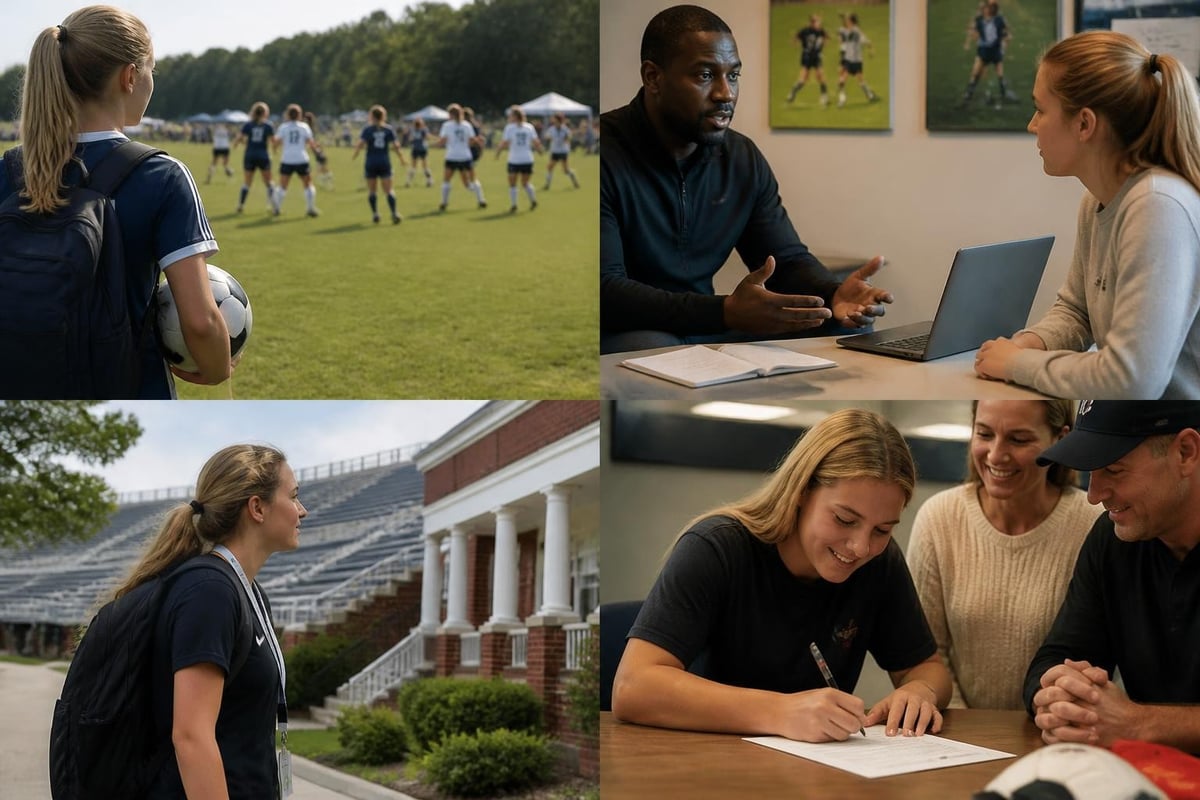
Playing for a recognized club or academy significantly enhances scholarships soccer prospects. College coaches have established relationships with reputable programs and trust their player development standards. At Strive Soccer Academy, our European-style training philosophy prepares athletes for the technical and tactical demands of collegiate soccer while building the character traits coaches seek in recruits.
Types of Financial Aid Beyond Athletic Scholarships
While athletic scholarships soccer funding forms the foundation for many student-athletes, smart families maximize their financial packages by combining multiple funding sources. The total cost of attendance at American universities ranges from $20,000 to $80,000 annually, making comprehensive financial planning essential.
Academic scholarships reward strong classroom performance and standardized test scores. Many universities offer automatic merit scholarships based on GPA and test score thresholds. For example, a student with a 3.8 GPA and 1350 SAT might qualify for $15,000 in annual academic funding, which stacks with athletic scholarships to cover a substantial portion of costs.
According to detailed scholarship breakdowns, international students can access specific funding opportunities designed to attract global talent. These international grants can range from $5,000 to $25,000 per year and combine with athletic and academic awards to create compelling overall packages.
Scholarship Stacking Strategy
| Funding Type | Average Amount | Requirements | Can Combine? |
|---|---|---|---|
| Athletic Scholarship | $8,000-$35,000 | Performance, coach offer | Yes |
| Academic Merit | $5,000-$20,000 | GPA, test scores | Yes |
| International Grant | $5,000-$25,000 | Non-US citizenship | Yes |
| Need-Based Aid | Varies | FAFSA submission | Yes |
| Departmental Awards | $1,000-$5,000 | Major-specific | Yes |
Need-based financial aid comes from federal, state, and institutional sources. Families complete the Free Application for Federal Student Aid (FAFSA) to determine eligibility for grants, work-study programs, and subsidized loans. Even families with moderate incomes often qualify for some need-based support.
Private scholarships from community organizations, corporations, and foundations provide additional funding opportunities. The comprehensive approach to securing funding includes researching hundreds of smaller scholarships that, when combined, can contribute thousands of dollars toward college costs.
Maximizing Your Scholarship Potential
Developing as a complete player increases scholarships soccer opportunities substantially. College coaches evaluate prospects across multiple dimensions, not just athletic ability. They seek players who demonstrate leadership, coachability, mental toughness, and character both on and off the field.
Technical skill development remains paramount. Players must master fundamental techniques including first touch, passing accuracy, shooting mechanics, dribbling in tight spaces, and defensive positioning. High-level technical ability separates scholarship candidates from recreational players in coaches' evaluations.
Critical development areas for scholarship consideration:
- Technical mastery: Ball control, passing range, finishing ability
- Tactical intelligence: Reading the game, positioning, decision-making speed
- Physical conditioning: Speed, endurance, strength, injury prevention
- Psychological resilience: Mental toughness, focus, leadership, coachability
- Academic excellence: GPA maintenance, standardized test preparation
The tactical understanding distinguishes good players from great ones. College soccer operates at a sophisticated tactical level, requiring players to understand formations, recognize patterns, make quick decisions, and adapt to different systems. Training that emphasizes tactical development alongside technical skills creates more attractive scholarship candidates.
Physical preparation cannot be overlooked. The speed and intensity of collegiate soccer demands exceptional fitness levels. Players should develop their aerobic capacity, sprint speed, strength, and injury resilience throughout their high school years. Programs like Soccer High Performance Training provide the high-intensity environment necessary to prepare for college-level competition.

Navigating the Commitment Process
When scholarships soccer offers arrive, families face important decisions that will shape the athlete's next four years. Understanding the commitment timeline and evaluation criteria helps make informed choices that align with both athletic and academic goals.
Official visits provide crucial opportunities to evaluate programs. NCAA rules allow Division I prospects five official visits, where the university covers transportation, accommodation, and meals. These visits reveal team culture, coaching philosophy, facility quality, academic support systems, and the overall campus environment.
Evaluating Scholarship Offers
Comparing multiple scholarship offers requires looking beyond the dollar amount. A larger athletic scholarship at a lower-ranked academic institution might provide less overall value than a smaller athletic award combined with academic merit aid at a prestigious university.
Questions to ask when evaluating offers:
- What is the total financial package including all scholarship types?
- Is the athletic scholarship renewable annually or guaranteed for four years?
- How does the program's playing style match my strengths?
- What academic support exists for student-athletes?
- What is the team's graduation rate and academic reputation?
The distribution of soccer scholarships reveals that verbal commitments often occur during junior year, though official signing happens during senior year. Understanding this timeline helps families manage expectations and make timely decisions.
Written scholarship agreements detail the terms, conditions, and renewal requirements. Athletes should carefully review these documents with their families and potentially legal advisors. Key elements include scholarship amount, duration, renewal criteria, injury protection, and release provisions if circumstances change.
National Signing Day for soccer typically falls in early February for seniors committing to Division I or II programs. This formal signing of the National Letter of Intent binds both the athlete and university to a one-year renewable scholarship agreement. The moment represents the culmination of years of development, training, and recruitment efforts.
Strategic Planning for Scholarship Success
Families pursuing scholarships soccer opportunities benefit from starting the process early and approaching it strategically. The most successful recruitment journeys begin with realistic self-assessment, clear goal-setting, and systematic execution of a comprehensive plan.
Creating a target school list involves balancing athletic fit, academic match, financial considerations, and personal preferences. Most recruiting experts recommend identifying 15-20 schools across different competitive levels to ensure options throughout the process. This list should include reach schools (highly competitive), target schools (realistic matches), and safety schools (strong likelihood of admission and funding).
Research each program's scholarship history and funding patterns. Some schools consistently offer larger packages to out-of-state or international students, while others focus their resources on in-state talent. The detailed scholarship information available online helps families identify programs most likely to provide substantial support.
Monthly Planning Timeline
| Time Period | Key Activities | Focus Areas |
|---|---|---|
| Freshman Year | Build academic foundation, join competitive club | Grades, technical skills |
| Sophomore Year | Maintain GPA, create highlight video, attend ID camps | Visibility, development |
| Junior Year | Contact coaches, take standardized tests, attend showcases | Active recruitment |
| Senior Fall | Official visits, compare offers, maintain eligibility | Decision-making |
| Senior Spring | Sign NLI, finalize transcripts, prepare for transition | Commitment, preparation |
Building relationships with college coaches requires persistence and professionalism. Initial contact should include a brief introduction email with relevant statistics, academic information, and a link to highlight footage. Follow-up communication maintains interest without becoming excessive or annoying.
Maintaining academic eligibility throughout the recruitment process protects hard-earned opportunities. A strong junior year academically can open doors, while senior year grade drops can jeopardize scholarships soccer offers already extended. Consistent academic performance demonstrates the discipline and work ethic coaches value.
Working with recruiting services or consultants can provide valuable guidance, though families should carefully evaluate the cost-benefit ratio. Some services offer comprehensive support including video production, coach outreach, and scholarship negotiation. Others provide limited value at high cost. The community-based scholarship programs offer alternative pathways worth exploring.
Financial Planning and Return on Investment
Understanding the true cost of college athletics helps families make sound financial decisions. While scholarships soccer funding reduces expenses, student-athletes often face additional costs beyond tuition, room, and board.
Hidden costs include travel to and from campus, personal equipment not provided by the team, summer training expenses, academic tutoring, and social activities with teammates. These expenses can add $2,000-$5,000 annually to the budget, requiring careful financial planning.
The return on investment extends beyond immediate financial savings. Student-athletes develop time management skills, leadership abilities, resilience, and professional networks that provide career advantages after graduation. The value of these intangible benefits often exceeds the scholarship dollar amount over a lifetime.
Long-term benefits of soccer scholarships:
- Access to quality education with reduced debt burden
- Elite athletic training and competition experience
- Professional network through teammates, coaches, and alumni
- Character development through challenges and adversity
- Career opportunities in coaching, sports management, and related fields
Comparing the net cost after scholarships helps families make informed decisions. A school offering $20,000 in scholarships with a total cost of $60,000 might be more expensive than a school offering $15,000 in scholarships with a total cost of $35,000. Understanding net cost rather than scholarship amount prevents costly mistakes.
Planning for all four years matters because scholarship amounts can change. While many programs honor their initial offers, others reduce funding after the first year or fail to increase scholarships to match rising tuition costs. Asking coaches about their renewal policies and historical patterns provides clarity about long-term expectations.
Preparing for the College Transition
Successfully transitioning from youth soccer to the collegiate level requires physical, mental, and tactical preparation. The jump in competition quality, training intensity, and time demands challenges even the most talented scholarship recipients.
Pre-college conditioning programs help incoming freshmen arrive ready to compete. Many college programs provide summer training protocols months before arrival on campus. Following these programs demonstrates commitment while building the fitness foundation necessary for success.
Mental preparation involves understanding the student-athlete lifestyle. Balancing 20 hours of weekly athletic commitments with full-time academic coursework, social life, and personal well-being requires exceptional time management and discipline. Setting realistic expectations prevents freshman year burnout and disappointment.
Learning the tactical systems and playing style of your future program accelerates integration into the team. Watching game footage, understanding formation preferences, and studying the current roster helps incoming players identify where they fit and how they can contribute immediately.
Building relationships with future teammates before arriving on campus eases the social transition. Many programs facilitate group chats or social media connections allowing incoming recruits to connect with current players. These relationships provide support systems during the challenging adjustment period.
The development pathway from youth academy training through high school excellence to college scholarships requires dedication, strategic planning, and comprehensive player development. Programs emphasizing technical mastery, tactical intelligence, physical conditioning, and psychological strength prepare athletes for the demands of collegiate competition and scholarship opportunities.
Securing scholarships soccer opportunities transforms talented players' futures by combining athletic passion with educational access and financial support. The journey requires early preparation, consistent development across all aspects of the game, strong academic performance, and strategic engagement with the recruitment process. At Strive Soccer Academy, we prepare young athletes for these opportunities through our European-style training philosophy that develops the technical, tactical, physical, and psychological skills college coaches seek. Our fully licensed coaches understand what it takes to compete at the next level and build programs that create real pathways to collegiate success.