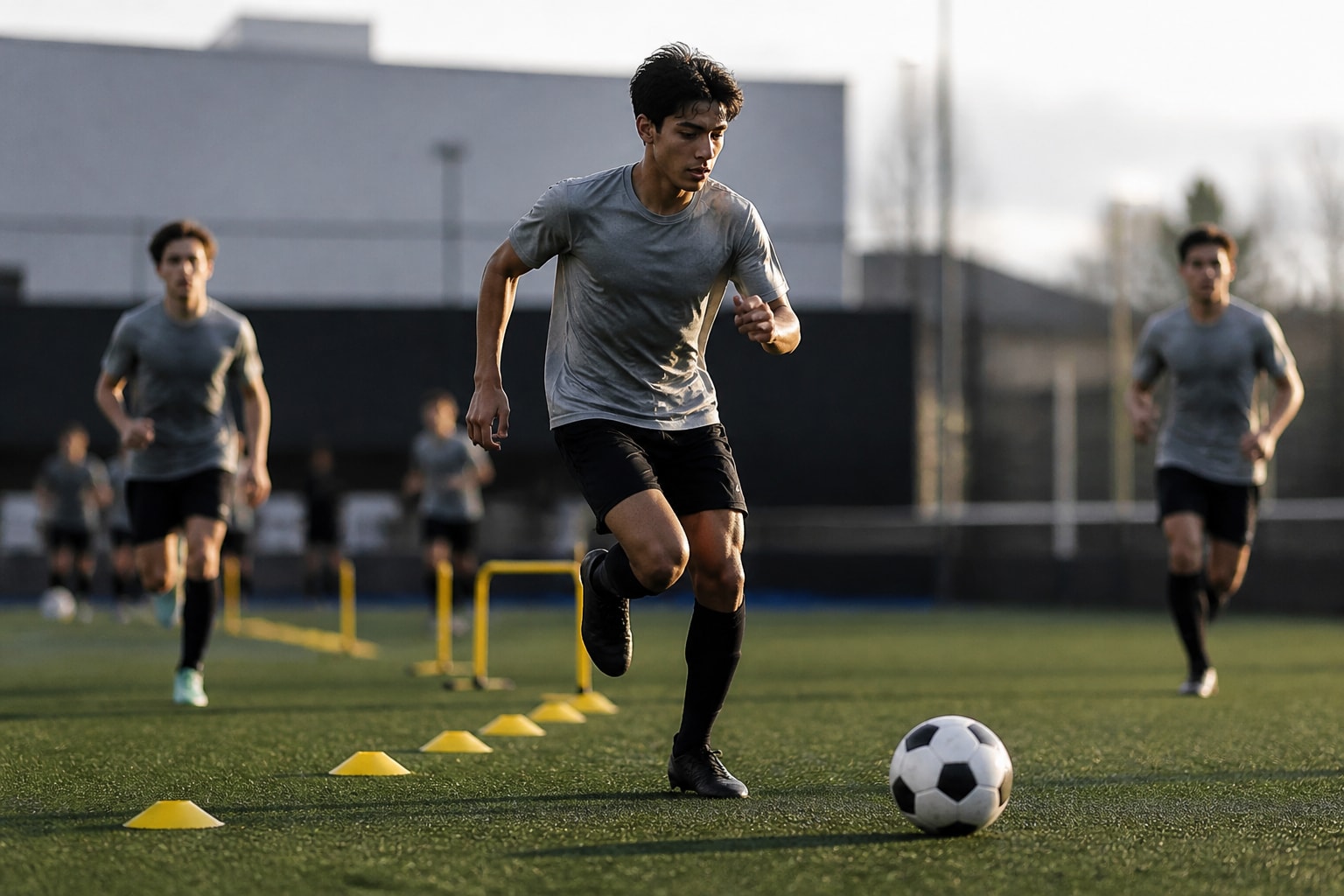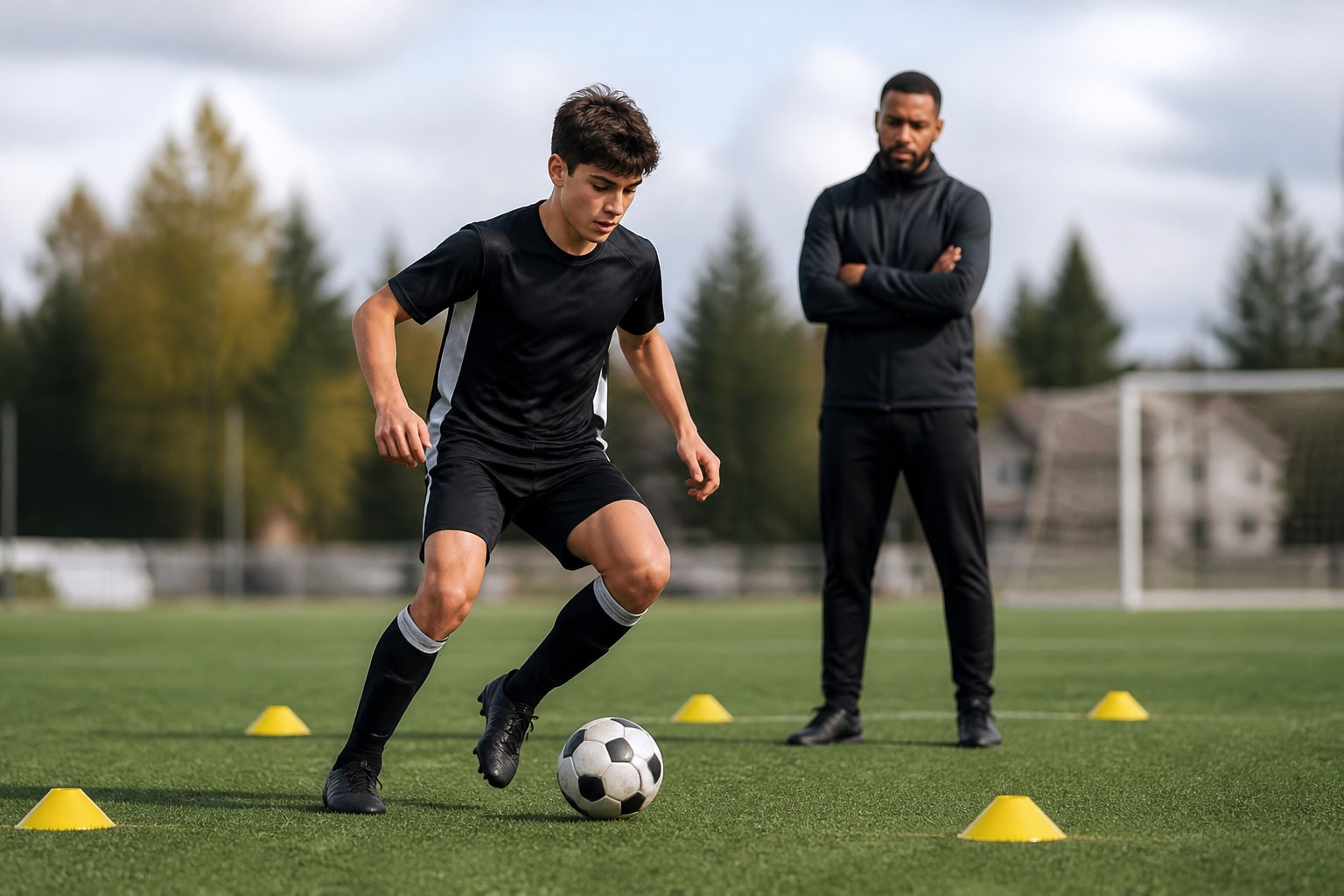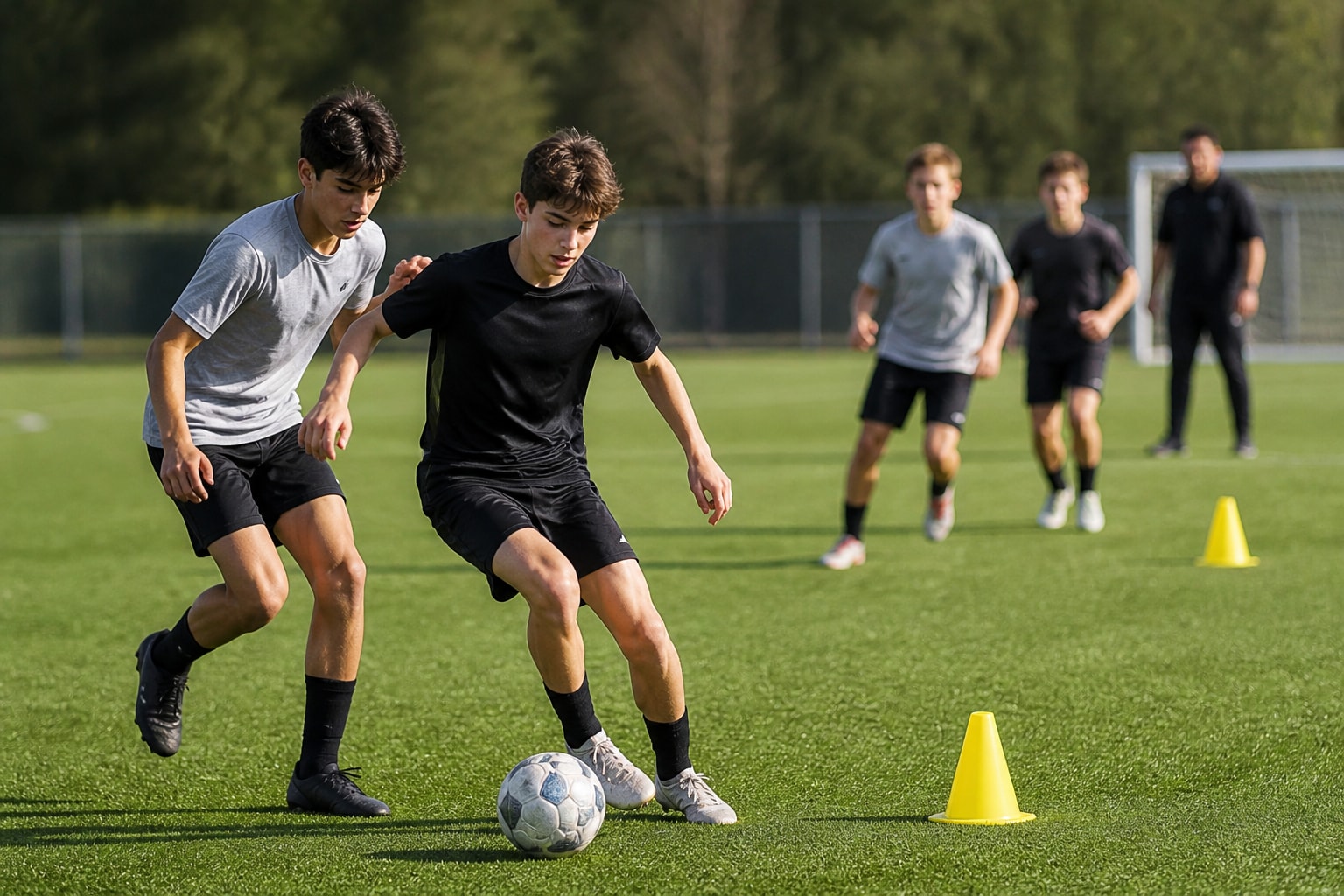
Good U9 soccer training in Surrey BC puts a ball at your child's feet as often as possible, uses small groups, and teaches technique before tactics or results. At eight or nine, players are in a prime window for building coordination and close control, so the quality of coaching and the number of touches per session matter more than league tables or tournament medals.
This guide explains what the U9 age group needs, how to judge a program, what a strong session looks like, and how to fit extra training around a club schedule in Surrey.
What U9 Players Need From Training
U9 players need frequent touches on the ball, simple decisions in small spaces, and coaching that builds confidence alongside skill. Canada Soccer's grassroots soccer framework reflects this approach, emphasizing enjoyment, participation, and technical foundations over early specialization.
At this stage, development rests on four areas that remain relevant through every later age group:
- Technical: dribbling, passing, receiving, and striking the ball with both feet.
- Tactical: early awareness of space, support, and when to pass or take on a defender.
- Physical: agility, balance, coordination, and running mechanics rather than conditioning drills.
- Psychological: willingness to try difficult skills, recover from mistakes, and compete without fear.
A U9 program that spends most of its time on lines, laps, and long explanations is not serving these needs. Children this age learn through repetition in game-like settings, with brief instruction and plenty of movement.
Is Age 9 Too Late to Start Soccer?
No, age 9 is not too late to start soccer, but a player who begins at that age will progress fastest in a structured program that builds fundamentals deliberately. Technical skills such as first touch and balance are still highly trainable at this age, and a motivated child can close a surprising amount of ground within a few seasons.
The important distinction is between starting soccer and starting competitive soccer. A child new to the game benefits from an introductory or recreational setting first. Families whose child already plays regularly and wants a serious pathway are better placed to look at structured development training, which is the focus of this guide.
How to Evaluate U9 Soccer Training in Surrey BC
The most reliable way to evaluate U9 soccer training in Surrey BC is to check five things: coach qualifications, group size, touches per session, how players are grouped, and whether the program runs beyond a single season.

Coach Qualifications
Ask which Canada Soccer licenses the coaching staff hold. Qualifications range from entry-level Soccer for Life certifications up to National A Licenses, and a program should be able to tell you who will actually be on the field with your child, not only who designed the curriculum.
Group Size and Ratio
Smaller groups mean more feedback and more touches. A small ratio of players per coach allows a coach to correct technique individually, which is difficult when a single coach is responsible for a large group.
Touches Per Session
A useful session keeps every player active. Small-sided activities give each player far more touches in a session than scrimmages with long waits between involvements.
Grouping by Skill and Maturity
Same-age groups can hide large differences in ability and physical development. Programs that group by skill level, and use bio-banding to account for differences in growth and maturity, keep players challenged without overwhelming them.
Year-Round Structure
Skills fade without regular practice. A program that connects fall and spring outdoor play with winter indoor or futsal training gives children continuity through the whole year, which suits a climate like Surrey's where wet winters limit outdoor field time.
What a Strong U9 Training Session Looks Like
A strong U9 session runs about an hour, moves quickly between short activities, and keeps every child involved from the first minute to the last. The structure below is a reasonable benchmark for what to look for when you watch a session or ask a coach to describe one.
- Ball-mastery warm-up (10 minutes): Each player has a ball and works on dribbling patterns, turns, and sole touches. No waiting in lines.
- Technical activity (15 minutes): A focused skill such as passing and receiving on the back foot, practiced in pairs or trios with coaches correcting form.
- Small-sided game or tactical task (20 minutes): 3v3 or 4v4 formats with small goals, where every player touches the ball constantly and makes frequent decisions.
- Finishing or fun competition (10 minutes): Shooting, relay challenges, or skill games that reward effort and creativity.
- Short reflection (5 minutes): Two or three coaching points and one thing each player did well.
Notice what is missing: long lectures, fitness running, and elimination games that sideline the weakest players first. These are common in poorly designed youth sessions and slow development.
Where to Put Your Weakest Player
In a U9 game or drill, your weakest player should not be hidden in a low-involvement position. At this age, every child should rotate through different roles, including attacking and defending, because variety builds the broadest skill base and keeps confidence intact.
Placing a struggling player at the back or on the wing where the ball rarely arrives makes the gap wider over time. Better options include pairing the player with a patient teammate in drills, using small-sided games where touches are guaranteed, and setting individual targets such as completing a certain number of successful passes. Skill-based grouping in training addresses the same issue structurally, so each child works at a level where progress is achievable.
Local Options and Availability in Surrey
Surrey offers several routes for U9 players, including community clubs, summer camps, and academy-style training, and each serves a different purpose. Understanding the differences helps you build a plan instead of relying on one setting to do everything.
| Option | Typical purpose | What to confirm |
|---|---|---|
| Community or club teams | Weekly practice and games | Team availability, coach credentials, practice-to-game ratio |
| Summer camps | Short bursts of skill work in July and August | Age groupings, coach qualifications, schedule |
| Academy training | Structured, year-round technical development | Ratios, grouping method, licensed coaching, multi-season programming |
Spots in club programs can be limited. Club spots can be limited, so checking registration information early in the season saves disappointment. Local organizations often run shorter, age-specific summer offerings, so it is worth asking which age brackets a camp covers. You can also browse Surrey Football Club’s listing on SkimScout for schedule and location details.
Adding Academy Training Alongside Club Soccer
Academy training works best as a complement to club soccer, not a replacement, because a club provides games and team belonging while an academy provides concentrated individual development. Most club practices at U9 serve large groups and must cover team organization, which leaves limited time for individual technique.
Families who want more technical work can look at extra soccer training for kids in Surrey or soccer training that runs outside club practice. The goal is to add touches and coaching attention without overloading a young player's week.
For parents of players who want a structured pathway, Strive Soccer Academy offers Soccer Skills Training built on a European-style philosophy covering the technical, tactical, physical, and psychological areas of development. Sessions are small-sided and high-touch, with skill-based grouping and bio-banding so each player trains at the right level. With more than 20 years developing youth players from the grassroots, the academy has seen Strive-trained players move into professional academy environments, U SPORTS and NCAA scholarships, and overseas trials in Europe. Those outcomes come from long-term development, not from early specialization, which is why the same principles apply from U9 onward.
If your child trains in a specific part of the city, local pages cover youth soccer training in Fleetwood, Newton, and South Surrey.
Balancing Training Load and Field Conditions
At U9, more training is not automatically better, and a sensible weekly load is two to three structured soccer touchpoints, including games, with at least one full rest day. Overuse concerns are less about injury at this age and more about burnout, so enjoyment is a useful signal. A child who still asks to go to practice is usually on a healthy schedule.
Surrey's weather adds a practical consideration. Natural-grass fields need rest periods as part of field maintenance, which means closures during wet months can happen. Programs with indoor or futsal options keep training consistent through winter, and futsal in particular develops quick decision-making and close control that transfer directly to outdoor play. A look at year-round soccer training in Surrey shows how seasonal programming can be organized.
Warning Signs in a U9 Program
A U9 program is a poor fit when it prioritizes winning over learning, and several signs make this visible within a session or two.
- Standings, rankings, or results dominate the coach's feedback.
- The same strongest players receive most of the playing time and attention.
- Players spend long stretches standing in lines or waiting for a turn.
- Coaches cannot name their licenses or describe a development plan.
- Children are pushed into positional specialization, such as a permanent goalkeeper or striker, before age 10.
- Training intensity is high but feedback is low, leaving players tired and unsure what to improve.
Programs that avoid these patterns tend to produce players who are technically sound, confident, and still enjoying the game at 12 and 14, which is when many young players drop out of the sport.
FAQ
What is the best youth soccer club?
The best youth soccer club is the one that matches your child's current level and goals, with licensed coaches, small groups, and a clear development plan. Visit a session, ask about coach qualifications and ratios, and compare how much time players spend touching the ball versus waiting. Rankings matter far less than the quality of daily coaching.
What are the 5 W's in soccer?
The 5 W's are usually who, what, when, where, and why, applied to a decision on the field: who is open, what is the best option, when to pass or dribble, where the space is, and why a choice works. For U9 players, the idea is simplified into looking up before receiving the ball and choosing the open teammate or space. Coaches build this habit gradually through small-sided games.
Start by watching one trial session and checking the coach's license, the player-to-coach ratio, and how many touches each child gets. If you want that structure for your U9 player, Strive Soccer Academy builds its Soccer Skills Training around small groups, licensed coaches, and skill-based grouping, and you can Book a Trial with Strive Soccer Academy to see how a session runs for your child.