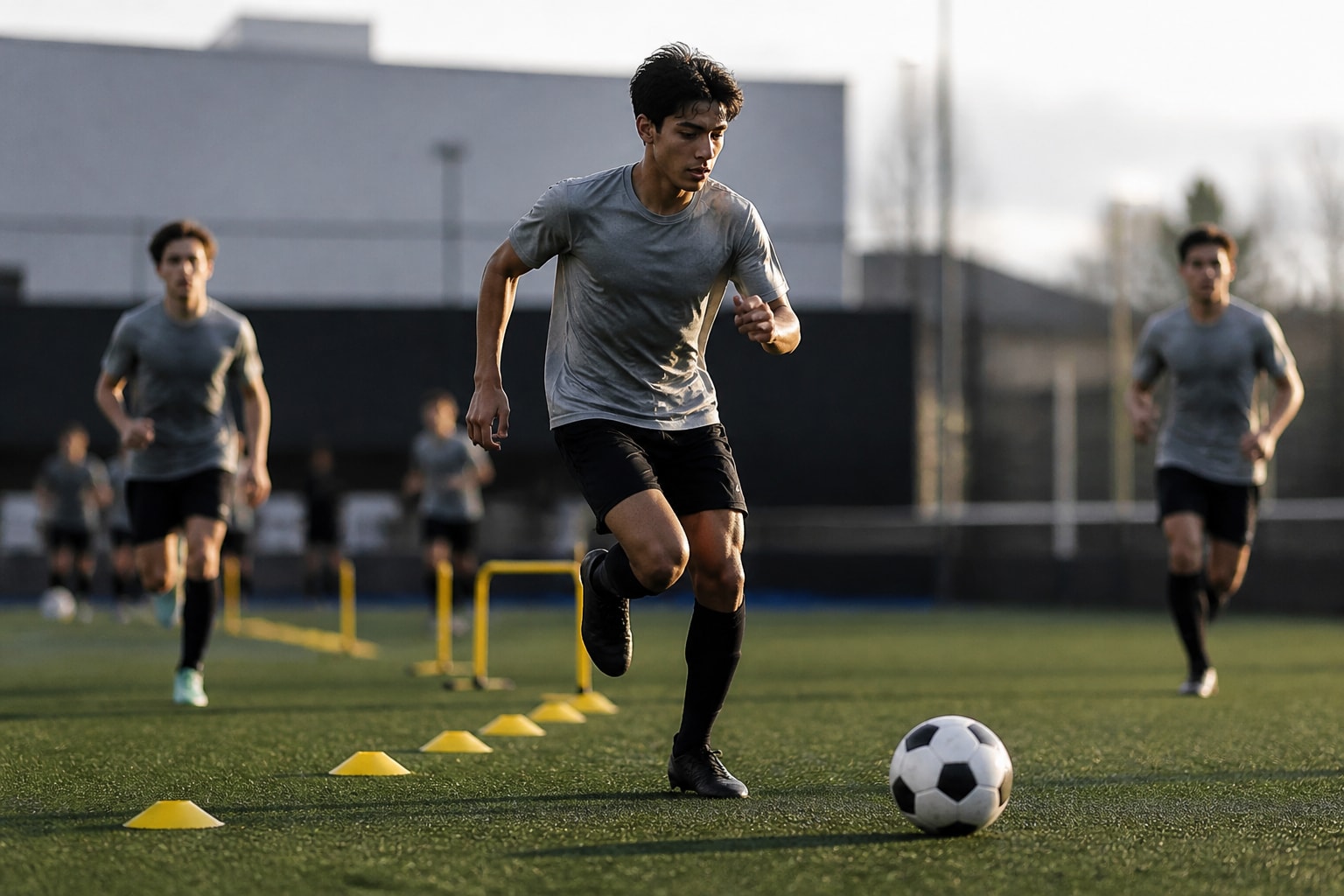
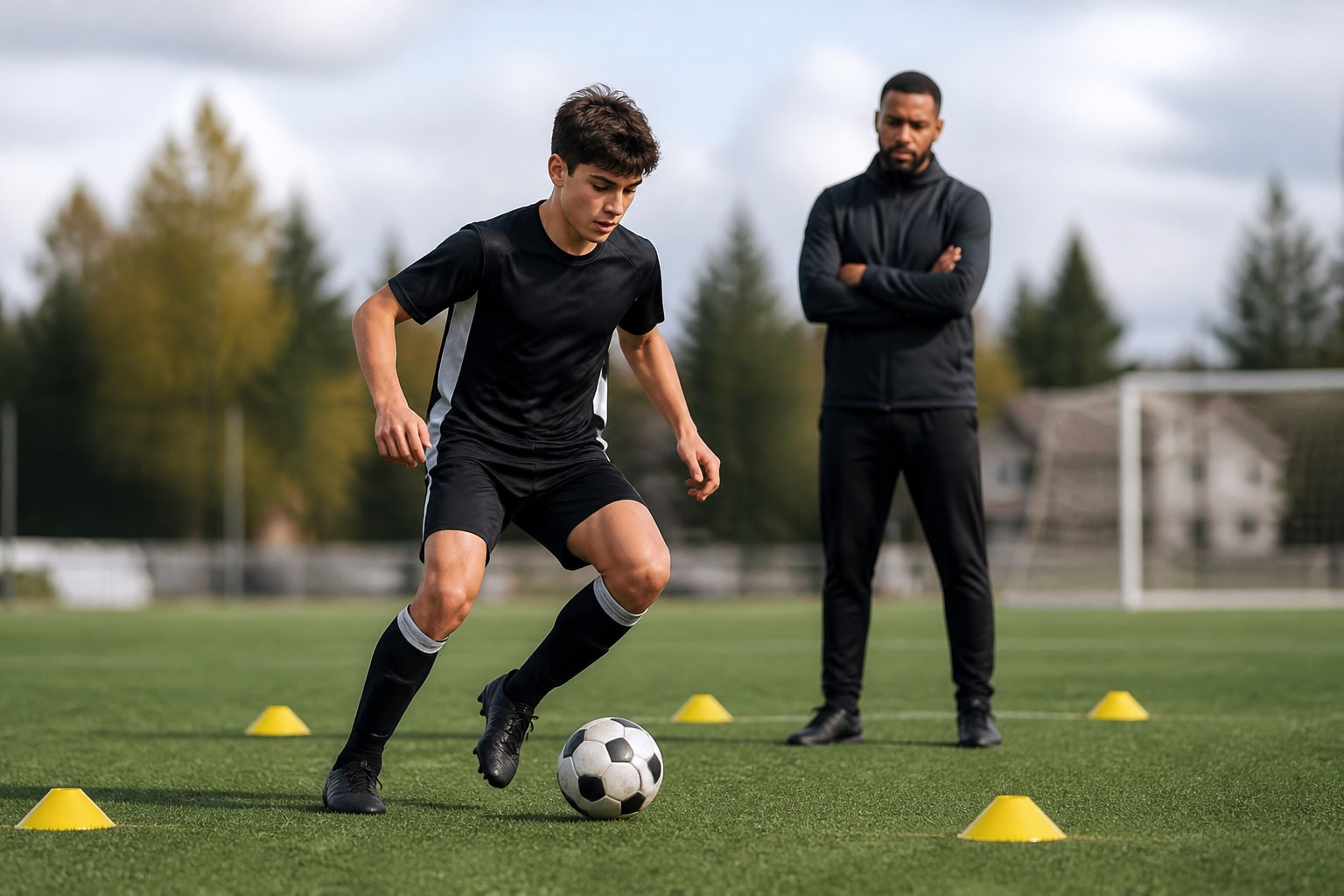
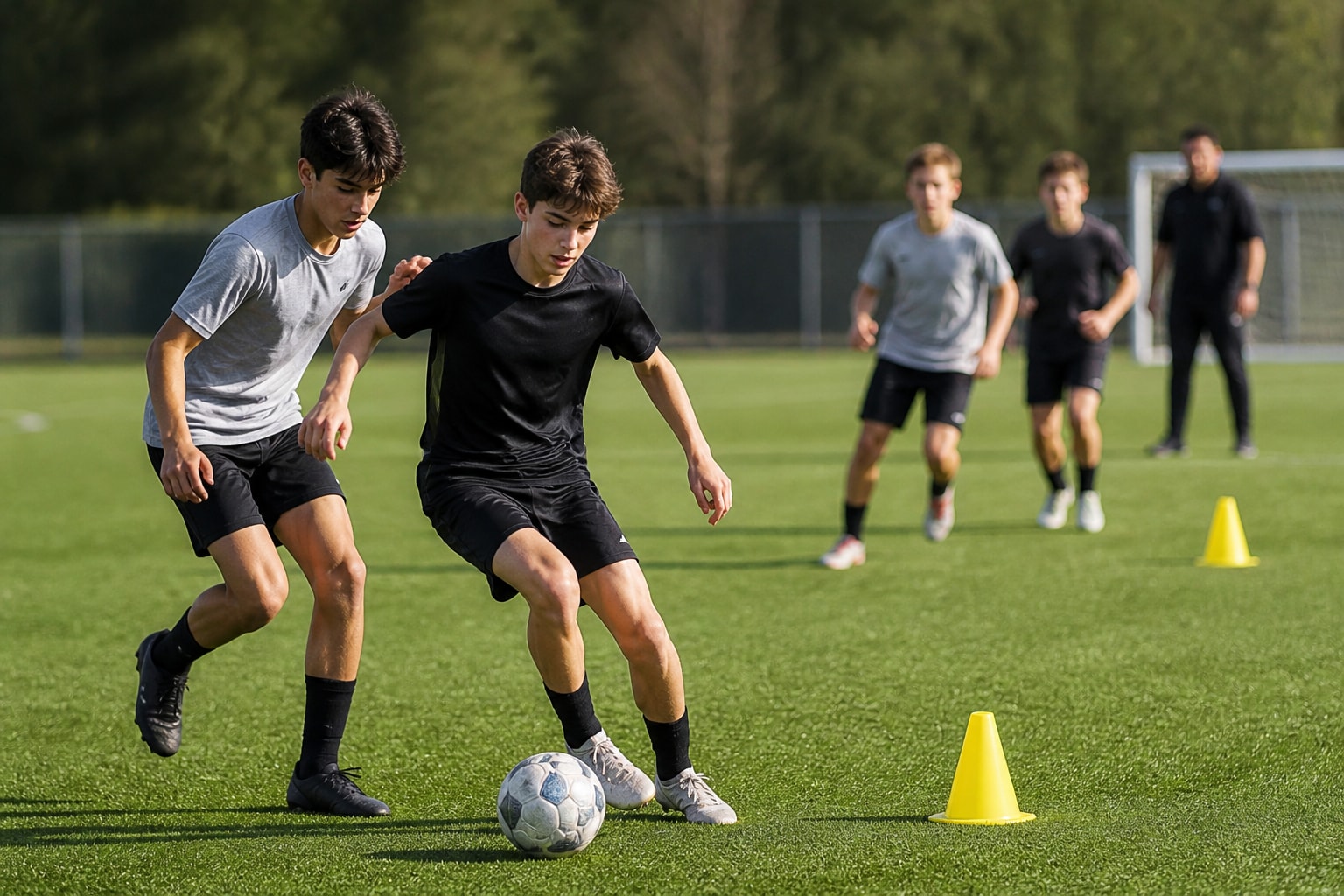
Good U8 soccer training in Surrey, BC puts a ball at a child's feet as often as possible, in small groups, with licensed coaches who teach technique through games rather than lectures. For committed families, the goal at this age is not wins or rankings. It is building comfort on the ball, a love of the game, and the habits that make later competitive soccer possible.
This guide explains what a serious U8 program should look like, how the Surrey soccer calendar works, and how to add training beyond club practice without overloading a young player.
What U8 Soccer Training in Surrey, BC Should Actually Teach
A strong U8 program teaches players to control, pass, dribble and shoot with both feet, and it does so through repetition in small, game-like settings. At ages six and seven, children are building coordination and confidence, so the quantity and quality of touches matter far more than formations or positions.
Four areas shape player growth at every age: technical, tactical, physical and psychological. At U8, the weighting looks like this:
- Technical: The dominant focus. Ball mastery, first touch, dribbling under pressure, and basic passing and striking technique.
- Tactical: Simple concepts introduced through play, such as finding open space, looking up before receiving, and the idea of attacking and defending as a team.
- Physical: Agility, balance, coordination and running mechanics, developed through movement games rather than conditioning drills.
- Psychological: Willingness to try skills, handle mistakes, listen to a coach and enjoy competing.
Strive Soccer Academy builds its approach on all four of these areas, applying a European-style training philosophy in Surrey. For a seven-year-old, that translates into sessions where technical work is the backbone and the other three areas are woven in naturally.

How the Surrey Youth Soccer Calendar Works for U8 Families
Most Surrey clubs run a long fall season and a spring season, which leaves limited windows for extra development. Surrey FC's registration page lists its fall season as September to March and notes that registration status and availability may be limited. Checking dates early matters, because spots in club programs can fill before the season begins.
A typical U8 week inside a club involves one or two practices and a weekend game. That is a sensible load for this age, but it rarely delivers enough individual touches to accelerate technical growth. Club practices often have large groups, and a single coach may run a session for a dozen or more children.
This is the gap that supplementary training fills. Programs such as year-round soccer training in Surrey, BC are designed to continue development across the fall and spring outdoor seasons and through the winter, when indoor and futsal training keeps players active. Strive Soccer Academy runs this kind of year-round programming, so a child's development does not pause when the outdoor season ends.
Why Touches Per Session Matter More Than Anything Else
The number of times a young player touches the ball in a session is the most reliable early indicator of training quality. A child who receives 1,000 to 2,000 touches in a session develops control and confidence far faster than one who spends the same hour waiting in a line or standing in a large scrimmage.
Strive Soccer Academy structures its sessions around small-sided, high-touch training, aiming for a high number of touches per child. That volume is achievable only when groups are small and every player has a ball.
When you observe a session, count how often an individual child is actively involved. Some quick signals:
- Are most players moving and touching a ball at all times, or are many standing in lines?
- Do activities change every few minutes to hold attention at this age?
- Is the coach giving short, specific feedback to individual players?
- Are games small enough, such as 3v3 or 4v4, that everyone stays involved?
Small-sided formats are a recognized approach in youth development precisely because they multiply decisions and touches for each child. For parents choosing between options, session design tells you more than a program's marketing language.
Coach Qualifications and Ratios: What to Ask Before You Register
The two most useful questions a parent can ask are who is coaching and how many players each coach is responsible for. Coach credentials and group size directly shape how much attention your child receives.
In Canada, coaching qualifications are issued through Canada Soccer, and the licensing pathway runs from community-level courses up to the National A License. At Strive Soccer Academy, all coaches are fully licensed through Canada Soccer, ranging from National A Licenses to Soccer for Life certifications for developing coaches. Smaller player-to-coach ratios allow a coach to notice a child's technique and correct it in the moment.
Consider asking any program you evaluate:
- What licenses do the coaches hold, and through which governing body?
- What is the typical player-to-coach ratio at U8?
- How are players grouped: by age only, or by ability and development stage?
- Does the program have a clear curriculum, or does each coach improvise?
- How long has the program been developing young players?
Experience counts at this age. Strive Soccer Academy has spent years developing youth players from the grassroots level, which means its approach to U8 development comes from long observation of how children progress.
Skill-Based Grouping and Bio-Banding at Young Ages
Grouping players by ability and physical development, rather than birth year alone, gives each child the right level of challenge. Two seven-year-olds can differ dramatically in size, coordination and soccer experience, and a mismatch can leave one child overwhelmed and another bored.
Strive Soccer Academy uses skill-based grouping and bio-banding so players train at the right level. Bio-banding groups children by physical maturity rather than strictly by age, which helps ensure that growth differences do not distort development or confidence.
For parents, the practical benefit is simple. A child who is placed correctly receives challenges that stretch but do not defeat them, and that balance is what keeps a young player eager to return. You can read more about what makes training different at Strive Surrey Soccer Academy if you want to see how these principles shape the sessions.
Adding Extra Training Without Overloading a U8 Player
The right amount of extra training for a U8 player is usually one focused session per week alongside club commitments, with plenty of unstructured play and rest. Young athletes need variety, recovery and time to simply be children.
Sleep is a strong reason to keep schedules sensible. Young children need substantial nightly rest, and the Canadian 24-Hour Movement Guidelines set out sleep recommendations for children. Late evening sessions that push bedtime back can undermine the very development a family is paying for, so scheduling matters as much as content.
A balanced approach for a committed U8 family might include:
- One club practice and one game per week as the base.
- One small-group technical session focused on individual skill.
- Free play with a ball at home or at the park, which builds creativity.
- At least one or two full rest days.
- A second sport or active hobby to develop general athleticism.
If your child already trains with a club and you want to build on that, soccer training outside club practice in Surrey, BC explains how supplementary sessions can complement team commitments rather than compete with them.
Group Sessions, Small Groups and Private Training: Choosing the Format
For most U8 players, small-group training offers the best balance of touches, peer interaction and cost, while private sessions are better suited to a specific technical focus. At this age, children learn a great deal from watching and competing against one another, so entirely individual work can feel isolating.
Here is a quick comparison of the main formats:
| Format | Strength at U8 | Consideration |
|---|---|---|
| Small-group training | High touches, peer learning, fun competition | Group size and grouping method matter |
| Private (1-on-1) training | Individual attention on a specific skill | Fewer game-like decisions |
| Large club practice | Team habits, social connection | Fewer touches per child |
A good fit often combines formats over time. A child might train with a club team for team play, attend small-group soccer training in Surrey, BC for focused technical work, and add occasional private training if a particular skill needs attention. Strive Soccer Academy offers Soccer Skills Training for players who want structured, high-touch development, and its small-sided approach suits the way young players learn best.
Signs a Program Fits a Committed Young Player
A program fits a committed young player when the child leaves tired, smiling and eager to return, and when parents can see measurable technical progress over a few months. Enthusiasm and skill growth are the two best indicators at this age.
Watch for these positive signs:
- Your child tries new moves in games and does not fear mistakes.
- Touches with the weaker foot become more confident.
- The coach communicates clearly about what each player is working on.
- The environment is demanding but encouraging, never harsh.
- Players are challenged at their own level rather than being pushed into unsuitable groups.
Be cautious about programs that promise rapid professional pathways for six- and seven-year-olds. Development at this age is long-term, and genuine opportunities come from years of sound technical foundations. Over time, that groundwork is what supports advancement. Some players trained at Strive have gone on to professional academy environments and college or university opportunities, outcomes that reflect sustained development rather than shortcuts.
This kind of long-view development also asks something of parents. Patience, consistent attendance and a supportive tone on the sideline all contribute. The research-backed habits of good sleep, varied play and manageable schedules protect a young player's enjoyment so that the commitment lasts into the teenage years, when competitive soccer training in Surrey, BC becomes more relevant.
Questions to Ask on a Trial Session
A trial session is the best way to judge a program, so arrive with specific questions and observe how the coach and the group respond. Treat it as a chance to check your priorities against what actually happens on the field.
Before the session, write down what you want to learn. Afterward, ask the coach:
- What technical skills will my child work on over the next few months?
- How will progress be communicated to parents?
- How are players grouped, and how would my child be placed?
- What does a typical week and season look like?
Then observe quietly from the sideline. Note whether your child is engaged, whether the coach knows each player's name, and whether corrections are given with patience. A program that welcomes questions and explains its reasoning is usually one that has thought carefully about development.
Start by writing down your child's current strengths and the two skills you most want to see improve, then use that list to guide a trial session. Strive Soccer Academy's Soccer Skills Training pairs licensed Canada Soccer coaches with small, skill-grouped sessions built around high touch counts, and the coaching team can help you find the right starting group. To see the training in person, you can Book a Trial with Strive Soccer Academy and let your child experience a session before you commit.