
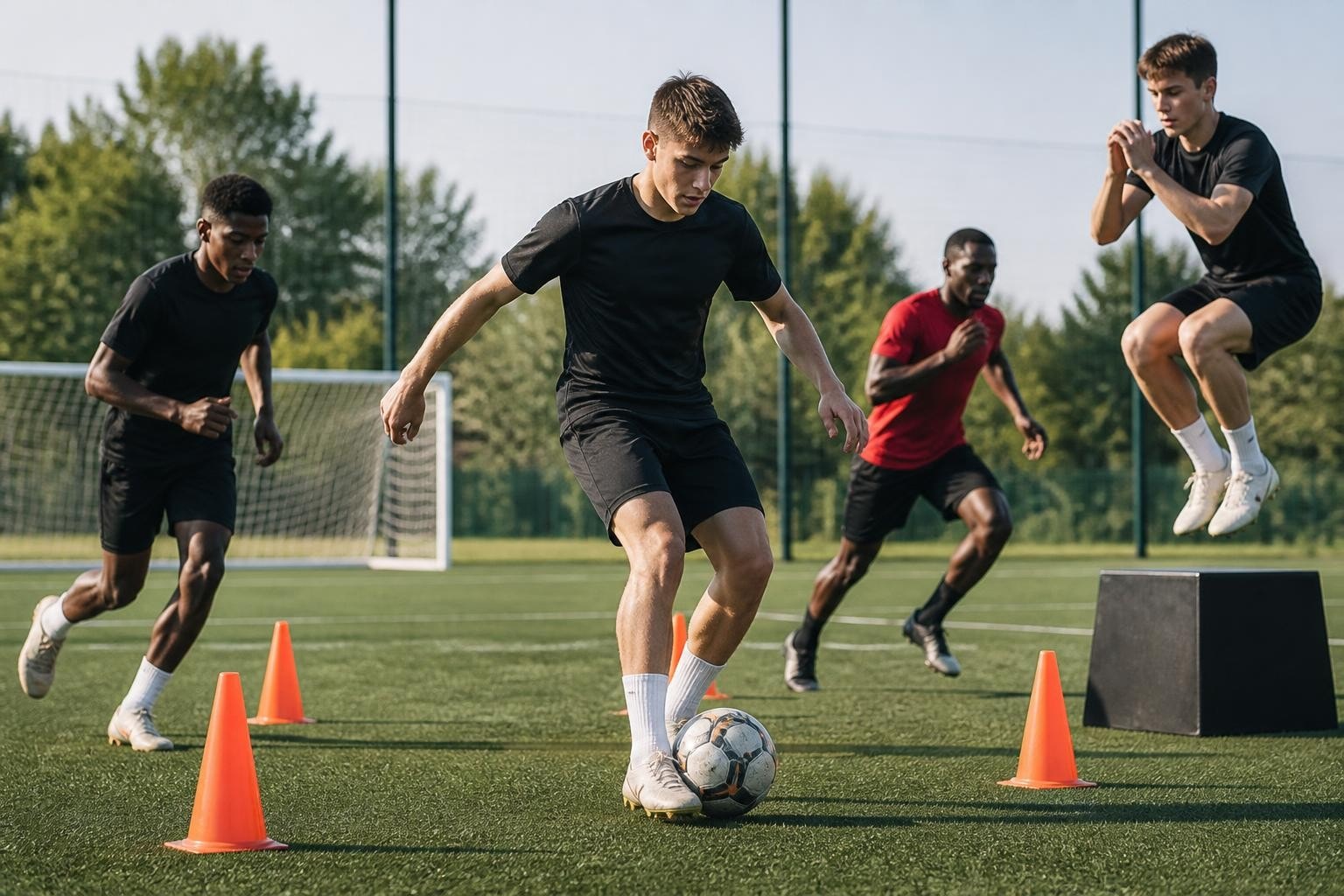
Building elite soccer players requires more than just running drills and scrimmaging. A well-designed training program systematically develops every dimension of the game through carefully structured sessions that target specific skills, fitness components, and mental attributes. Whether you're coaching youth players or refining a competitive team's performance, understanding how to construct effective soccer training routines separates good programs from exceptional ones. The best academies worldwide follow proven frameworks that balance technical mastery, tactical intelligence, physical preparation, and psychological resilience, creating complete players ready for higher levels of competition.
The Foundation of Effective Soccer Training Routines
Modern soccer training routines are built on the concept of periodization, which divides the training calendar into distinct phases with specific objectives. Each phase addresses different aspects of player development while maintaining a cohesive progression throughout the season.
Understanding the Four Pillars of Player Development
Every comprehensive training program must address four interconnected areas that determine player success on the pitch. Technical development focuses on ball mastery, first touch, passing accuracy, and shooting mechanics. Tactical training builds decision-making skills, positional awareness, and understanding of game systems. Physical conditioning develops speed, endurance, strength, and agility. Psychological preparation cultivates mental toughness, focus, and confidence under pressure.
These pillars don't exist in isolation. The most effective soccer training routines integrate multiple elements within single sessions, creating realistic game scenarios that challenge players holistically. Research shows that position-specific training demands vary significantly, requiring coaches to tailor routines based on whether they're developing central midfielders, wingers, or defenders.

Structuring Weekly Training Schedules
The weekly training schedule serves as the operational blueprint for player development. Professional academies typically organize sessions across five to six days, with each day targeting specific developmental priorities.
A balanced weekly structure might include:
- Day 1: Technical skills and individual ball work
- Day 2: Tactical training and small-sided games
- Day 3: Physical conditioning and strength work
- Day 4: Position-specific drills and set pieces
- Day 5: Full-team tactics and match preparation
- Day 6: Recovery or light technical work
- Day 7: Rest or match day
Recovery deserves equal attention to training intensity. Studies on post-match recovery strategies demonstrate that proper recovery protocols significantly impact subsequent performance, particularly for youth athletes whose bodies are still developing.
Sample Session Structure
Every individual training session should follow a logical progression that prepares players physically and mentally while maximizing skill acquisition. The standard 90-minute session breaks down into distinct phases, each serving a specific purpose in the learning process.
| Session Phase | Duration | Purpose | Example Activities |
|---|---|---|---|
| Warm-up | 10-15 min | Injury prevention, activation | Dynamic stretching, light jogging, ball touches |
| Technical | 20-25 min | Skill development | Passing patterns, dribbling circuits, shooting drills |
| Tactical | 25-30 min | Game understanding | Positional play, transition scenarios, pressing schemes |
| Small-sided games | 20-25 min | Integration | 4v4, 5v5, 6v6 with specific rules |
| Cool-down | 5-10 min | Recovery, reflection | Static stretching, hydration, coach feedback |
This framework ensures that soccer training routines address multiple developmental needs within a single session while maintaining player engagement and preventing mental fatigue.
Technical Training Routines
Technical excellence forms the foundation of elite soccer performance. Players who master fundamental skills can execute tactics effectively and maintain composure under pressure.
Ball Mastery and First Touch Development
Daily ball work should be non-negotiable in youth development programs. Repetition builds muscle memory, transforming conscious movements into automatic responses during matches. Effective technical routines incorporate progression from isolated skill work to pressure situations.
Progressive technical development follows this sequence:
- Stationary ball work: Players practice manipulating the ball with all surfaces of both feet
- Movement patterns: Skills are performed while jogging, changing direction, or accelerating
- Passive pressure: Partners provide light defensive presence without full challenges
- Active pressure: Defenders attempt to win the ball, replicating match conditions
- Game integration: Skills are applied in small-sided games with tactical objectives
The UEFA performance insights provide excellent examples of how professional clubs break down match situations into trainable components, particularly for 1v1 scenarios that require both technical skill and tactical awareness.
Passing and Receiving Circuits
Passing accuracy determines possession maintenance and attacking fluidity. Well-designed passing routines challenge players to execute under time pressure, spatial constraints, and defensive interference.
Rondo variations remain the gold standard for developing passing skills in tight spaces. These circle drills force players to make quick decisions, communicate effectively, and maintain composure when pressed. Advanced variations include directional rondos where players must play forward when possible, or position-specific rondos that replicate in-game formations.
Tactical Training Implementation
Understanding the game mentally separates good players from great ones. Tactical training routines teach players to read situations, anticipate opponent movements, and make intelligent decisions that benefit the team.
Small-Sided Games for Tactical Development
Small-sided games represent the most effective method for developing tactical understanding while maintaining technical demands. These modified matches create more touches, decisions, and problem-solving opportunities than full 11v11 formats. Many programs now incorporate small-sided games as the cornerstone of their training philosophy.
Different formats serve distinct tactical objectives:
| Format | Primary Focus | Key Learning Outcomes |
|---|---|---|
| 3v3 | Attacking transitions, individual defending | Quick decision-making, 1v1 skills, support angles |
| 4v4 | Possession, shape maintenance | Passing patterns, defensive organization, width |
| 5v5 | Positional play, combination sequences | Third-man runs, overloads, switching play |
| 7v7 | Team tactics, pressing schemes | Compact defending, counter-attacking, set pieces |
Coaches should manipulate field dimensions, goals, and rules to emphasize specific tactical concepts. For example, requiring three consecutive passes before shooting encourages possession-based play, while awarding bonus points for counter-attack goals promotes quick transitions.
Position-Specific Tactical Work
Modern soccer demands specialized knowledge based on playing position. Defenders must understand pressing triggers and defensive shape, midfielders need superior scanning habits and third-man movement, while forwards require clinical finishing and pressing coordination.
Soccer training sessions that incorporate position-specific modules allow players to develop expertise in their roles while understanding how different positions interconnect. The UEFA technical reports offer valuable insights into how elite clubs structure these specialized training blocks based on actual match analysis.
Physical Conditioning Routines
Athletic development provides the physical foundation that allows technical and tactical skills to shine during matches. Comprehensive soccer training routines must address multiple fitness components through periodized programming.
Speed and Agility Development
Soccer demands explosive acceleration, rapid direction changes, and sustained high-intensity efforts. Speed training should emphasize the first five yards, as most game-critical sprints cover short distances with multiple changes of direction.
Effective agility work includes:
- Linear sprints: 5-20 yard accelerations from various starting positions
- Multi-directional movements: T-drills, shuttle runs, zig-zag patterns
- Reactive agility: Response to visual or auditory cues, partner movements
- Sport-specific patterns: Sprint-to-ball drills, defensive slides, attacking runs
Programs should integrate agility work with technical elements whenever possible. A conditioning program for soccer that combines speed drills with ball work ensures athletes develop both raw athleticism and soccer-specific movement patterns.
Strength and Power Training
Contrary to outdated beliefs, properly designed strength training enhances youth soccer performance without hindering skill development. Research demonstrates that age-appropriate resistance training improves shooting power, jumping ability, and injury resilience.
Plyometric training protocols have shown particular effectiveness for developing explosive power in soccer players. These exercises include box jumps, bounding sequences, and medicine ball throws that translate directly to on-field actions like heading, shooting, and acceleration.
For adolescent players, maturation-specific considerations become critical when designing strength programs. Younger athletes benefit from bodyweight exercises and fundamental movement patterns before progressing to loaded resistance training.
The ACSM position statements provide evidence-based guidelines for incorporating strength and conditioning principles into youth athletic programs, ensuring safety while maximizing developmental benefits.
Psychological Training Components
Mental skills often receive insufficient attention in youth soccer programs despite their profound impact on performance. Complete soccer training routines cultivate psychological resilience alongside physical and technical abilities.
Building Confidence Through Deliberate Practice
Confidence emerges from mastery, which requires thousands of successful repetitions. Training environments must balance challenge with achievability, pushing players beyond comfort zones while ensuring enough success to maintain motivation.
Progressive overload applies to psychological development just as it does to physical conditioning. Players should face gradually increasing pressure, from unopposed drills to passive defenders to full-speed competition. This progression builds confidence incrementally rather than overwhelming players with excessive challenge.
Decision-Making Under Pressure
Game-day performance hinges on making correct decisions under time pressure, physical fatigue, and competitive stress. Training must replicate these conditions to prepare players mentally.
Chaos training introduces unpredictable elements that force rapid adaptation:
- Changing rules mid-game
- Adding numerical advantages or disadvantages
- Modifying field dimensions during play
- Introducing multiple balls simultaneously
- Setting tight time constraints for objectives
These methods, often employed in high-performance environments like soccer camps, accelerate decision-making development by forcing players to process information quickly and adjust strategies on the fly.
Periodization and Season Planning
Strategic planning across the entire season ensures that players peak at the right moments while avoiding overtraining and burnout. Soccer training routines must vary systematically throughout pre-season, in-season, and post-season phases.
Pre-Season Foundation Building
The pre-season phase establishes the physical and technical foundation for the competitive season. This period typically spans 6-8 weeks and emphasizes:
- General fitness development: Building aerobic base, general strength, movement quality
- Technical refinement: Intensive skill work without competitive pressure
- Tactical introduction: Teaching systems, patterns, and team principles
- Team chemistry: Developing communication and cohesion
Training volume remains high during pre-season, with multiple sessions daily in some programs. However, intensity should increase gradually to prevent injury and allow adaptation.
In-Season Maintenance and Peak Performance
Once competition begins, training routines shift toward maintaining fitness levels, refining tactics, and preparing for specific opponents. Session intensity may decrease slightly, but quality and specificity increase dramatically.
Weekly schedules during the competitive season revolve around match days, with workload carefully managed to ensure players arrive at games fresh yet prepared. Recovery becomes paramount, with lighter technical sessions following matches and higher-intensity work positioned midweek when players have maximum recovery time.
Recovery and Regeneration Periods
Strategic recovery periods prevent physical and mental burnout while allowing adaptation to training stress. Youth players particularly benefit from planned downtime, as their developing bodies require more recovery than adult athletes.
Active recovery sessions might include:
- Low-intensity technical work with minimal running
- Pool recovery and aquatic exercises
- Flexibility and mobility training
- Sport psychology sessions
- Video analysis without physical activity
Integrating Game Intelligence
The gap between training and competition narrows when soccer training routines incorporate game-realistic scenarios that demand authentic decision-making. Effective coaches design exercises that present players with the same problems they'll encounter in matches.
Creating Training-to-Match Transfer
Skills mastered in isolated drills don't automatically transfer to match situations unless training progressively bridges that gap. The transfer spectrum moves from closed (predictable, unopposed) to open (unpredictable, contested) environments.
For optimal transfer, training should include:
- Constraint-based games: Modified rules that encourage specific behaviors
- Position-specific scenarios: Realistic situations players will face in their roles
- Transition moments: Rapid switches between attack and defense
- Overload situations: Numerical advantages that teach quick exploitation
Age-Appropriate Program Design
Developmental stage dramatically influences how soccer training routines should be structured. What works for 16-year-olds can be counterproductive for 8-year-olds, requiring coaches to understand age-appropriate practices.
Youth Development Considerations
Younger players (ages 6-12) learn primarily through play and exploration rather than rigid instruction. Training for this age group should emphasize:
- Maximum ball touches: Every player constantly engaged with a ball
- Fun and variety: Games and activities that maintain engagement
- Fundamental movements: Running, jumping, balancing, coordination
- Creativity encouragement: Freedom to try new skills without fear
At Strive Soccer Academy, we recognize that effective youth soccer training must balance structure with creativity, providing guidance while allowing individual expression.
Adolescent and Elite Development
Older players (ages 13-18) can handle more sophisticated tactical concepts, higher training volumes, and specialized physical development. Their training should incorporate:
| Component | Youth Focus (6-12) | Adolescent Focus (13-18) |
|---|---|---|
| Technical | Basic skills, creativity | Refinement, execution under pressure |
| Tactical | Simple concepts, positions | Complex systems, game management |
| Physical | General movement, coordination | Specialized strength, sport-specific conditioning |
| Psychological | Enjoyment, basic focus | Mental toughness, competitive mindset |
Monitoring and Progression
Effective soccer training routines include systematic monitoring to track development and adjust programming based on objective data. Modern technology enables precise measurement of both physical and technical metrics.
Performance Tracking Methods
GPS tracking systems measure distance covered, sprint counts, acceleration profiles, and high-intensity running during training and matches. This data reveals whether physical preparation aligns with game demands and identifies players needing additional conditioning work.
Technical assessments evaluate passing accuracy, first-touch success rates, dribbling effectiveness, and shooting precision through standardized tests performed periodically throughout the season. Tracking these metrics quantifies improvement and identifies weaknesses requiring focused attention.
Adjusting Training Based on Feedback
Data only creates value when it informs decision-making. Coaches should regularly review performance metrics and adjust soccer training routines accordingly. If GPS data shows a player's sprint capacity declining, additional speed work becomes necessary. If technical assessments reveal poor passing under pressure, rondo intensity should increase.
Player feedback also provides critical insights that numbers cannot capture. Regular conversations about training difficulty, enjoyment, and perceived progress help coaches calibrate session design to optimize both development and engagement.
Effective soccer training routines systematically develop technical skills, tactical understanding, physical capacity, and mental strength through periodized programming that balances intensity with recovery. By integrating proven methodologies from elite clubs worldwide while tailoring approaches to individual developmental needs, coaches create comprehensive programs that transform potential into performance. At Strive Soccer Academy, we combine European training principles with licensed coaching expertise to deliver complete player development across all four pillars, preparing young athletes not just for their next game, but for long-term success in soccer and life.


