
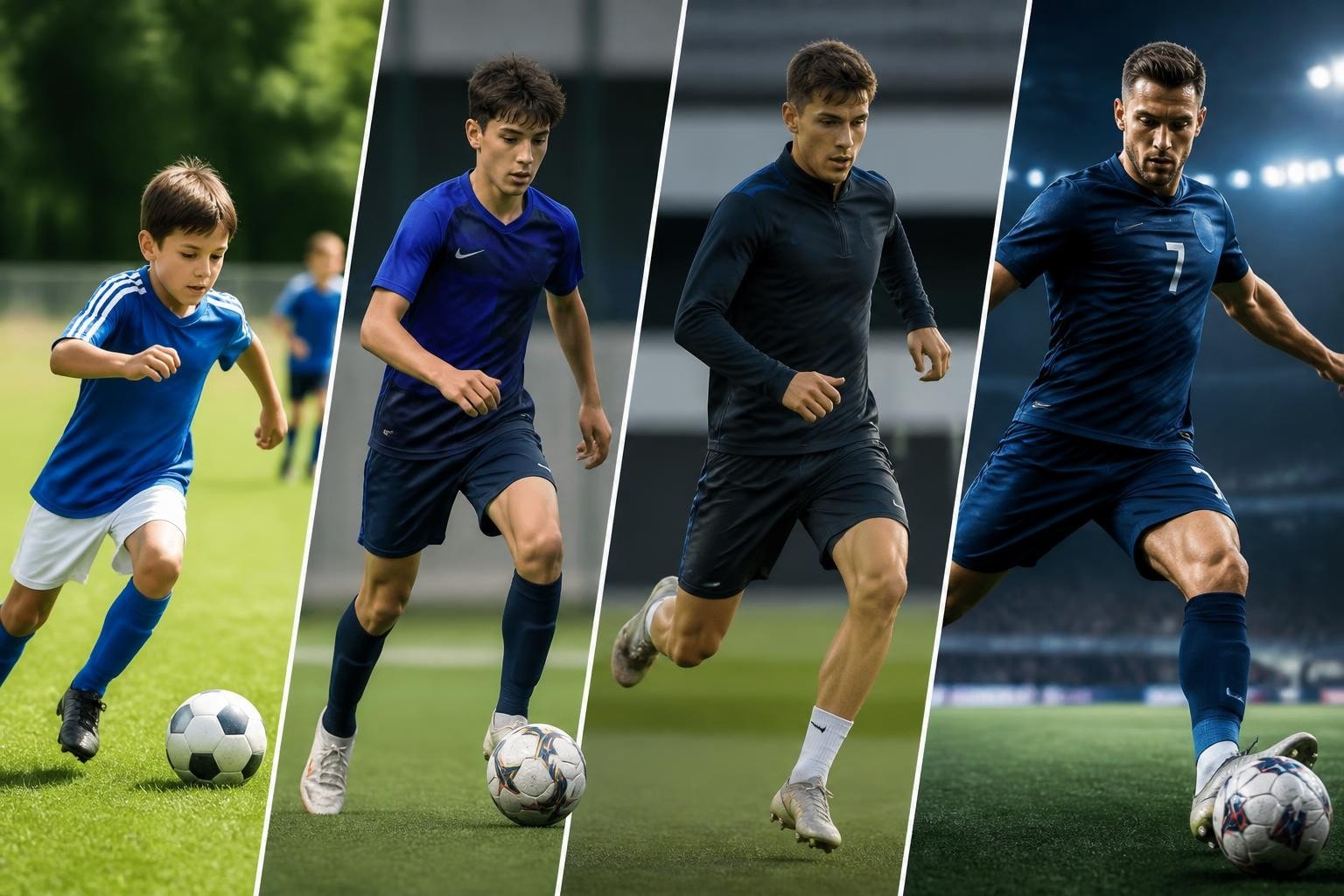
Every player's soccer journey is unique, yet most follow recognizable patterns of growth and development. From the first time a child kicks a ball to the moment they compete at elite levels, this pathway involves deliberate training, strategic decision-making, and holistic development across multiple dimensions. Understanding the stages and key elements of this progression helps parents, coaches, and players themselves make informed choices that maximize potential while maintaining the joy and passion that drew them to the game in the first place.
The Foundation Years: Building Love for the Game
The earliest phase of any soccer journey centers on discovery and play. Between ages four and eight, young players develop fundamental movement skills and basic ball familiarity through unstructured play and simple activities. This stage is not about creating elite athletes but about fostering enthusiasm and building a broad athletic base.
Research consistently shows that early multi-sport participation produces better long-term outcomes than premature specialization. Studies on early sports specialization demonstrate that young athletes who sample multiple sports develop more comprehensive movement patterns, reduce overuse injury risk, and maintain higher motivation levels through adolescence.
During these foundation years, parents should prioritize:
- Exposure to various physical activities and sports
- Fun, game-based learning environments
- Positive coaching relationships
- Social interaction and teamwork
- Minimal emphasis on winning or competitive results
The technical focus remains simple: running with the ball, basic dribbling, and shooting. Tactical understanding is virtually non-existent at this stage, which is developmentally appropriate. Physical development emphasizes coordination, balance, and fundamental movement patterns rather than sport-specific conditioning.

The Development Stage: Learning the Game's Language
Between ages nine and twelve, the soccer journey enters a critical development window. Players begin understanding tactical concepts, refining technical skills, and developing the cognitive abilities that separate recreational players from those pursuing competitive pathways. Modern coaching approaches emphasize age-appropriate session design that balances skill acquisition with game intelligence.
Technical refinement accelerates during this period. Players work on dominant and non-dominant foot development, first touch under pressure, passing accuracy across various distances, and ball manipulation in tight spaces. Quality repetition matters more than volume at this stage.
Tactical Awareness Emerges
The cognitive capacity to read the game develops significantly between nine and twelve. Players begin understanding:
- Positional responsibilities and spacing
- When to pass versus when to dribble
- Defensive shape and pressing triggers
- Transition moments between attack and defense
- Basic patterns of play and combination sequences
Training environments should provide structured freedom where players encounter game-realistic problems and develop solutions through guided discovery. Coaches facilitate learning rather than dictating every action, allowing young players to develop decision-making capacity that will serve them throughout their soccer journey.
| Development Area | Age 9-10 Focus | Age 11-12 Focus |
|---|---|---|
| Technical | Two-footed fundamentals, close control | Speed of execution, technical variety |
| Tactical | Basic positioning, team shape | Pattern recognition, transition play |
| Physical | Coordination, agility, speed | Introduction to conditioning concepts |
| Psychological | Effort, enjoyment, resilience | Goal-setting, self-evaluation |
The Role of Competitive Play
Appropriate competition becomes increasingly important during the development stage. Games provide the context where skills transform into performance. However, the competitive environment must match the developmental needs of the age group.
Grassroots participation research highlights how access and opportunity shape trajectories. Families face varying barriers including financial costs, transportation challenges, and geographic availability of quality programs. Creating an inclusive soccer journey requires addressing these systemic obstacles while maintaining high training standards.
Adolescence: The Critical Transition Period
The teenage years represent the most complex and consequential phase of any soccer journey. Physical maturation varies dramatically between individuals, creating temporary advantages and disadvantages that complicate talent identification. Players who mature earlier often dominate age-group competition, while late developers possess potential that won't manifest for years.
The relative age effect significantly influences selection decisions. Players born in the first quarter of the selection year enjoy consistent advantages in size, strength, and coordination compared to those born later in the same year. This effect compounds over time as early-born players receive more coaching attention, better training opportunities, and psychological confidence from success.
Technical Mastery and Specialization
Between thirteen and sixteen, serious players refine position-specific skills while maintaining technical versatility. Modern talent identification approaches increasingly value adaptable players who can perform multiple roles rather than narrow specialists who excel in only one position.
Position-specific technical development includes:
- Defenders: 1v1 defending, ball distribution range, aerial ability
- Midfielders: Scanning habits, passing under pressure, transition speed
- Forwards: Finishing variety, movement timing, pressing intensity
Even with specialization, maintaining broad technical capacity ensures players can adapt as their soccer journey evolves. Many successful professionals changed positions multiple times during their development.
Physical Development and Injury Prevention
Adolescence brings rapid physical changes that require careful management. Growth spurts temporarily disrupt coordination and movement patterns. Training loads must account for individual biological age rather than chronological age to prevent overuse injuries.
UEFA’s medical research provides evidence-based guidelines for youth player workload management, injury screening protocols, and return-to-play progressions. Proper physical development during the teenage years establishes the foundation for long-term athletic performance.
Strength and conditioning becomes increasingly important, but programming must respect developmental stages. Pre-pubescent players benefit from bodyweight exercises and movement quality. Post-pubescent athletes can progressively incorporate resistance training with proper technique and supervision.
The Psychological Crucible
Mental and emotional development often determines who continues their soccer journey beyond adolescence. Players face increasing pressure from coaches, parents, peers, and themselves. Selection decisions create winners and losers, success and disappointment.
Building psychological resilience requires:
- Teaching growth mindset principles
- Normalizing failure as part of learning
- Developing emotional regulation skills
- Creating autonomy and ownership
- Maintaining perspective on outcomes
The best development environments challenge players while providing unconditional support. Coaches and parents must separate performance from worth, results from effort, and short-term outcomes from long-term development.
The Advanced Development Phase: Preparing for Elite Performance
Between seventeen and twenty-one, the soccer journey reaches a critical juncture. Players either transition toward professional or collegiate pathways, or they recognize that their highest level will be amateur or semi-professional. Both outcomes represent success if aligned with individual goals, abilities, and circumstances.
Technical refinement never stops, but execution speed and decision-making quality become differentiators. Elite players process information faster, recognize patterns earlier, and execute skills under greater pressure than their peers. This gap often appears subtle but produces dramatically different outcomes.
Tactical Sophistication and Game Intelligence
Advanced players demonstrate comprehensive understanding of:
- Multiple tactical systems and formations
- Opponent-specific game planning
- In-game adjustments and problem-solving
- Leadership and communication roles
- Professional habits and standards
For those exploring opportunities to develop advanced skills, exposure to high-intensity training environments accelerates tactical growth. Challenging sessions that replicate competitive demands prepare players for the next level.
| Tactical Component | Developing Player | Advanced Player |
|---|---|---|
| Decision Speed | Recognizes after the moment | Anticipates before the moment |
| Pattern Recognition | Familiar situations only | Novel situations quickly |
| Communication | Reactive instructions | Proactive organization |
| Adaptability | One system comfortably | Multiple systems fluently |
Physical Performance and Athletic Development
The late teenage years allow for maximum physical development. Training programs can safely increase volume, intensity, and specificity. Speed, power, endurance, and strength all reach trainable peaks during this window.
However, physical dominance alone rarely sustains an elite soccer journey. The most successful players combine athletic capacity with technical excellence and tactical intelligence. One-dimensional athletes plateau while well-rounded players continue improving.
Professional Pathway Realities
Very few players reach professional levels. Global talent development research suggests approximately one percent of youth academy players eventually sign professional contracts. Understanding these odds helps players and families maintain realistic expectations while pursuing ambitious goals.
Alternative pathways provide meaningful soccer journeys beyond professional ranks. College soccer, semi-professional leagues, and high-level amateur competition offer fulfilling experiences for talented players who don't reach the elite tier.
The Role of Coaching Quality Throughout the Journey
Coaching expertise profoundly influences every stage of the soccer journey. Licensed, knowledgeable coaches understand age-appropriate development, create effective learning environments, and build positive relationships that keep players engaged long-term.
The coaching quality gap separates average programs from exceptional ones. Credentials matter, but application of knowledge matters more. The best coaches combine technical expertise with communication skills, emotional intelligence, and genuine care for player development beyond soccer.
Programs like those at Strive Soccer Academy employ fully licensed coaches who understand the four pillars of player development: technical, tactical, physical, and psychological. This comprehensive approach ensures young athletes receive age-appropriate training that builds both immediate skills and long-term potential.
What Quality Coaching Looks Like
Effective coaches demonstrate several consistent characteristics:
- Clear, age-appropriate session objectives
- Progressive activity design that builds complexity
- Frequent, specific feedback on performance
- Differentiation for varying ability levels
- Positive emotional climate with high standards
- Continuous professional development and learning
Parents evaluating programs should observe sessions, ask about coaching credentials, and assess whether the environment balances challenge with support. The right coaching relationship can transform a soccer journey while the wrong one can end it prematurely.
Balancing Development with Education and Life Skills
The soccer journey never occurs in isolation. Academic responsibilities, family relationships, social development, and personal interests all compete for time and energy. Successfully navigating these competing demands requires intentional planning and clear priorities.
Academic performance should never be sacrificed for athletic pursuits. Education provides security and opportunity regardless of soccer outcomes. The mental skills developed through academic challenge translate directly to on-field problem-solving and decision-making.
Time Management and Life Balance
Young athletes benefit from learning organizational skills early. Balancing training, competition, schoolwork, recovery, and social time requires discipline and planning. Parents and coaches should teach these skills rather than managing every detail for players.
Successful long-term development includes:
- Scheduled recovery and rest periods
- Protected family and social time
- Academic support during heavy competition schedules
- Recognition that burnout threatens the entire journey
- Understanding that life experiences enhance athletic performance
The Modern Soccer Journey: Data, Technology, and Innovation
Contemporary player development increasingly incorporates technology and data analysis. Video review, GPS tracking, biomechanical assessment, and performance analytics provide insights that previous generations never accessed.
Advanced methodological approaches in talent identification now include machine learning algorithms that analyze performance patterns across thousands of variables. While these tools offer value, they supplement rather than replace expert human evaluation.
Technology as a Development Tool
Smart application of technology enhances the soccer journey through:
- Video analysis for tactical understanding
- Wearable devices for workload monitoring
- Performance tracking for goal-setting
- Skill development apps for technical practice
- Communication platforms for coach-player feedback
However, technology should never replace fundamental coaching, human relationships, or the simple joy of playing the game. The best programs integrate technological tools within comprehensive development philosophies rather than allowing data to drive every decision.
Individual Pathways Within Universal Principles
While this article describes common stages and patterns, every soccer journey reflects individual circumstances, abilities, and goals. Some players accelerate through stages while others develop more gradually. Late bloomers achieve success that early developers never reach. Non-linear pathways prove just as valid as traditional progressions.
The most important principle is meeting each player where they are and facilitating their next step forward. Comparison to others creates unnecessary pressure and distorts the development process. Personal growth and improvement matter more than relative standing at any given moment.
Parents and coaches should regularly assess whether the current environment supports the individual player's needs. Sometimes progress requires changing teams, coaches, or competitive levels. Other times it requires patience and trust in the process.
The soccer journey encompasses far more than technical skills or tactical knowledge. It's a comprehensive development process that shapes character, builds resilience, teaches life skills, and creates lasting memories regardless of the ultimate competitive level achieved. Every stage offers valuable lessons and growth opportunities when approached with the right mindset and support structures. If you're seeking a development environment that honors this holistic approach while maintaining elite training standards, Strive Soccer Academy provides European-style training focused on technical, tactical, physical, and psychological growth. Our fully licensed coaches create the foundation for young players to reach their full potential both on and off the field.


