
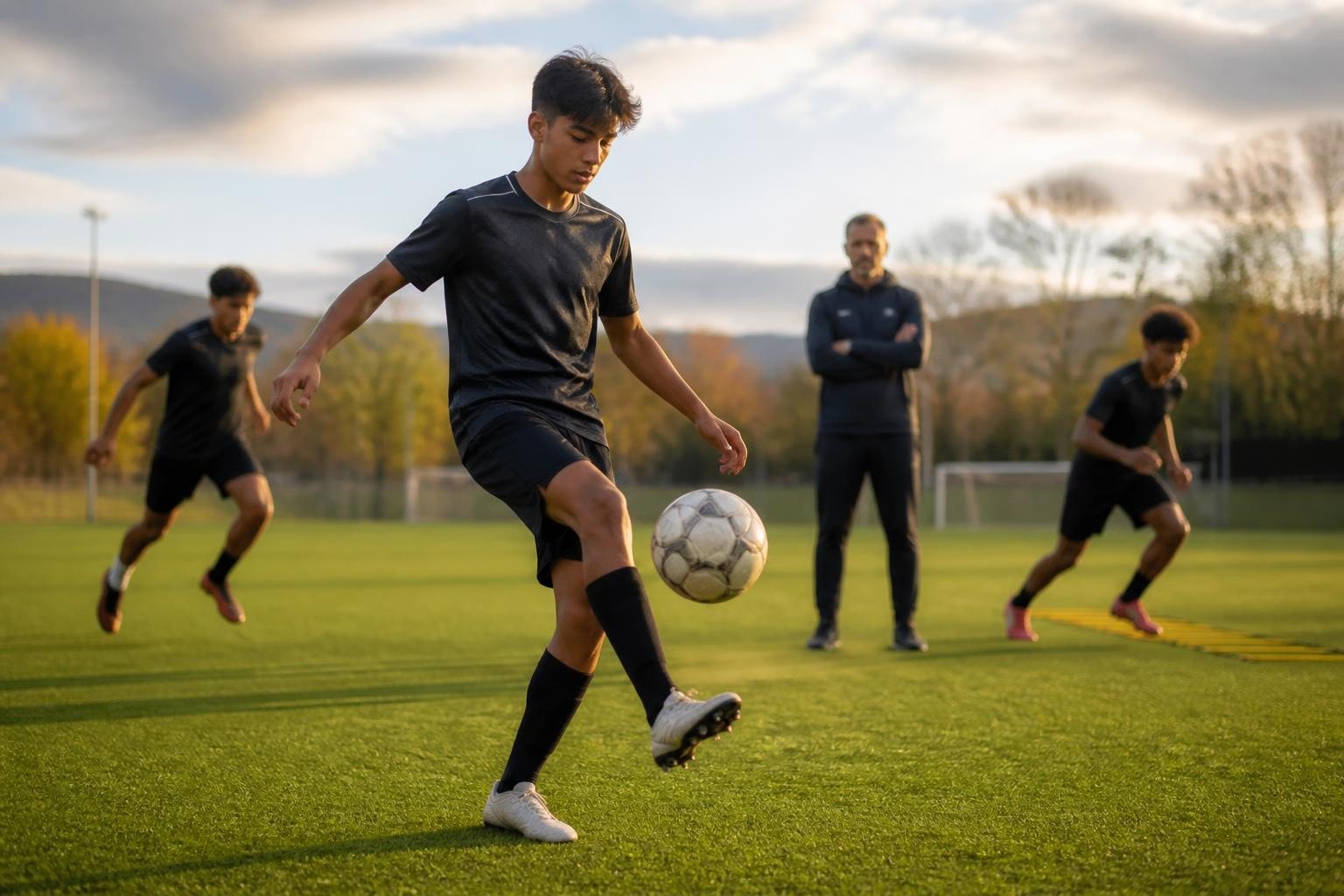
The journey from beginner to accomplished athlete follows patterns that unite players across continents and competitive levels. Whether a young player just learning to love the game or an experienced athlete refining advanced techniques, certain fundamentals form the foundation of success. Understanding what every soccer player needs to develop, both on and off the field, empowers parents, coaches, and athletes to make informed decisions about training priorities and long-term growth strategies.
Technical Foundation: The Building Blocks of Excellence
Technical skills form the language through which every soccer player expresses their understanding of the game. Without fluent ball control, precise passing, and confident receiving, even the most tactically astute player struggles to execute their vision. These fundamental abilities must become second nature, allowing players to shift their focus from basic execution to creative problem-solving during matches.
Ball Mastery and First Touch
The ability to control the ball under pressure separates good players from great ones. Every soccer player should dedicate time to first-touch training, practicing receiving passes from various angles and heights. This skill determines how quickly a player can transition from defense to attack and whether they can maintain possession in tight spaces.
Key components of ball mastery include:
- Close control: Keeping the ball within playing distance while moving at speed
- Surface variety: Using all parts of both feet, thighs, chest, and head
- Body positioning: Shielding the ball and scanning the field simultaneously
- Change of pace: Accelerating and decelerating while maintaining control
Research published in the Frontiers in Psychology journal demonstrates that soccer training significantly enhances cognitive performance in young athletes, with ball mastery drills contributing to improved decision-making speed and spatial awareness.

Passing Precision and Vision
Every soccer player must develop the ability to deliver accurate passes over various distances. Short passes maintain possession and rhythm, while long diagonal balls can unlock defensive structures. The weight of the pass, the timing of its release, and the spin applied all communicate intent to teammates and create scoring opportunities.
| Pass Type | Primary Use | Key Technique |
|---|---|---|
| Short ground pass | Maintaining possession, building play | Inside of foot, firm surface contact |
| Long diagonal | Switching play, exploiting space | Laces or inside curve, follow-through |
| Through ball | Breaking defensive lines | Weighted pace, timed release |
| Crossing | Creating goal-scoring chances | Lofted or driven, target area focus |
Vision extends beyond seeing open teammates. It encompasses understanding when to play forward, when to retain possession, and how to manipulate defensive positioning through passing angles. Developing this awareness requires thousands of repetitions in various game situations.
Tactical Intelligence: Reading and Responding to the Game
Technical ability provides the tools, but tactical understanding determines how effectively every soccer player uses those tools. Tactical intelligence involves recognizing patterns, understanding positional responsibilities, and making decisions that benefit team objectives. This dimension of player development grows through structured instruction combined with extensive match experience.
Positional Awareness and Spacing
Understanding where to be without the ball represents half the game for every soccer player. Proper spacing creates passing lanes, stretches defensive formations, and generates opportunities for penetrating runs. Players must constantly adjust their positioning based on ball location, teammate movements, and opponent pressure.
The concept of "scanning" teaches players to gather visual information before receiving the ball. By checking shoulders and surveying the field, every soccer player can make faster, more informed decisions. FIFA’s Talent Development framework emphasizes positional intelligence as a critical component of elite player development worldwide.
Young athletes working with professional soccer academies learn structured approaches to tactical concepts, building understanding through age-appropriate progressions that match their cognitive development.
Transition Moments and Game Phases
Modern soccer emphasizes rapid transitions between attack and defense. Every soccer player needs to recognize these critical moments and respond appropriately. When possession changes hands, the immediate reactions of all players determine whether the team launches a dangerous counterattack or establishes defensive shape to prevent one.
The four primary game phases are:
- Organized attack: Building play against a set defense
- Transition to defense: Immediate pressure after losing possession
- Organized defense: Maintaining shape and denying space
- Transition to attack: Exploiting space after winning possession
Understanding these phases allows players to anticipate requirements and adjust their intensity, positioning, and decision-making accordingly.
Physical Conditioning: Building Athletic Capacity
Athletic development ensures every soccer player can execute technical and tactical concepts throughout a full match and across an entire season. Speed, strength, endurance, agility, and flexibility work together to create resilient athletes capable of peak performance under fatigue.
Speed and Agility Development
Soccer demands various types of speed beyond straight-line sprinting. Acceleration over the first five to ten yards often proves more valuable than top-end speed. Change-of-direction ability allows players to beat opponents in tight spaces and recover defensively when beaten.
Training approaches for every soccer player should include:
- Linear speed work: Sprint mechanics, acceleration patterns, maximum velocity training
- Multi-directional movement: Cutting, pivoting, backpedaling, lateral shuffling
- Reaction drills: Response to visual and auditory cues
- Plyometric exercises: Explosive power development through jump training
The systematic review of load measures in soccer training provides evidence-based guidance on monitoring physical demands to optimize performance while managing injury risk. Every soccer player benefits when training loads are carefully tracked and adjusted based on individual responses.
Endurance and Recovery Capacity
Match fitness requires every soccer player to perform high-intensity efforts repeatedly across ninety minutes. Aerobic capacity provides the baseline endurance, while anaerobic systems power sprints and explosive movements. Recovery between intense efforts determines how many high-quality actions a player can produce throughout a match.
| Fitness Component | Match Relevance | Training Focus |
|---|---|---|
| Aerobic endurance | Baseline work capacity | Continuous running, position-specific drills |
| Anaerobic power | Sprints, jumps, duels | Interval training, repeated sprint work |
| Active recovery | Between high-intensity efforts | Movement quality, lactic acid clearance |
| Strength endurance | Holding off opponents, maintaining form | Functional strength circuits, body weight training |
Proper rest and nutrition accelerate physical adaptation. Every soccer player should understand sleep's role in recovery, hydration strategies, and fueling requirements before, during, and after training sessions. The UEFA medical initiatives provide player-welfare resources that emphasize holistic health approaches.
Psychological Resilience: The Mental Game
Mental strength often determines which talented players reach their potential and which fall short despite impressive physical gifts. Every soccer player faces pressure, setbacks, adversity, and competition. How athletes respond to these challenges shapes their development trajectory and ultimate success.
Confidence and Self-Belief
Confidence allows every soccer player to express their abilities without hesitation or fear. This quality must be built through consistent preparation, small successes accumulated over time, and supportive coaching that emphasizes growth over perfection. Players need permission to make mistakes in training environments that value learning over immediate results.
A meta-analytic review of psychological interventions demonstrates that structured mental skills training significantly enhances athletic performance. Techniques like visualization, positive self-talk, and goal-setting help every soccer player develop the confidence necessary for high-level competition.
Parents seeking comprehensive development for their young athletes often explore youth soccer training options that balance technical instruction with psychological skill-building, recognizing that mental strength requires deliberate cultivation.
Focus and Concentration
Maintaining concentration throughout training and matches challenges every soccer player, particularly younger athletes still developing attention capacity. The ability to stay present, avoid distractions, and refocus quickly after mistakes or unexpected events proves essential for consistent performance.
Concentration skills develop through:
- Mindfulness practices: Present-moment awareness exercises
- Pre-performance routines: Consistent preparation that triggers focused states
- Simulated pressure: Training under conditions that mimic match intensity and stakes
- Attention control: Learning to narrow or broaden focus based on situation demands
Handling Pressure and Adversity
Every soccer player encounters moments when the game isn't going their way. The team falls behind, an opponent dominates their matchup, or crucial mistakes compound. Resilient athletes respond to adversity by refocusing on controllable factors, maintaining effort, and trusting their preparation.
Building this resilience requires exposure to challenging situations in controlled environments. Quality coaching creates opportunities for players to experience pressure, make decisions under stress, and learn from outcomes without devastating consequences. Programs like Soccer High Performance Training provide high-intensity environments where players develop composure alongside technical and tactical skills.
Understanding the Laws and Spirit of the Game
Every soccer player should develop comprehensive knowledge of the rules governing play. Understanding the Laws of the Game prevents unnecessary fouls, helps players gain tactical advantages within legal boundaries, and fosters respect for officials and opponents.
Beyond memorizing offside rules or handball criteria, educated players grasp how referees interpret situations and how to position themselves advantageously. This understanding also extends to sportsmanship principles that maintain soccer's integrity and positive culture.
Safety and Injury Prevention
Physical safety concerns every soccer player, parent, and coach. Proper warm-up routines, technique coaching that emphasizes safe movement patterns, and awareness of injury warning signs all contribute to longevity in the sport. The evidence on return-to-play criteria following muscle injuries guides appropriate rehabilitation timelines.
Every soccer player should learn:
- Recognition of concussion symptoms and reporting protocols
- ACL injury prevention exercises and movement mechanics
- Overuse injury prevention through load management
- Proper hydration and heat illness awareness
- Growth plate considerations for young athletes
The Role of Quality Coaching
Development pathways for every soccer player depend heavily on coaching quality. Licensed coaches with formal education understand age-appropriate progressions, effective teaching methodologies, and how to create positive learning environments. The UEFA coaching education standards demonstrate the extensive knowledge required to guide player development effectively.
Experienced coaches recognize individual differences in learning styles, physical maturation, and psychological readiness. They adapt their instruction to meet players where they are while challenging them to grow. This personalized approach accelerates development and maintains athlete engagement through age-specific challenges.
Programs emphasizing coaching quality in youth soccer prioritize coach education and continuous professional development, ensuring instructors stay current with evolving best practices in player development.
Training Methodology and Practice Quality
How every soccer player trains matters as much as how often they train. Deliberate practice targeting specific weaknesses, game-realistic scenarios that demand decision-making, and appropriate challenge levels that avoid both boredom and excessive frustration optimize learning and skill acquisition.
Progressive Skill Development
Development follows predictable sequences, with each stage building upon previous foundations. Every soccer player moves from isolated technical work to opposed situations to full-game implementation. Rushing this progression creates gaps in ability, while moving too slowly limits potential.
| Development Stage | Training Focus | Success Indicators |
|---|---|---|
| Foundation | Basic techniques, movement literacy | Comfort with ball, enjoyment of activity |
| Skill Building | Technique refinement, 1v1 situations | Consistency under light pressure |
| Game Application | Small-sided games, tactical concepts | Decision-making, pattern recognition |
| Performance | Position-specific training, competition | Match-speed execution, creative solutions |
Balancing Structure and Creativity
While every soccer player needs structured instruction in fundamental techniques and tactical principles, the sport ultimately rewards creativity and individual expression. Effective training balances coach-directed learning with unstructured play that encourages experimentation and problem-solving.
Small-sided games provide ideal environments for developing game intelligence because they increase touches on the ball, create more decision-making opportunities, and allow coaches to manipulate constraints that emphasize specific learning objectives.
Analytics and Performance Measurement
Modern player development increasingly incorporates data and analytics to guide training priorities and track progress. Every soccer player can benefit from objective measurement of technical execution, physical output, and tactical decision-making. Expected goals models and other advanced metrics help players understand their contributions beyond traditional statistics.
However, metrics should inform rather than dictate development plans. The numbers provide valuable feedback, but human judgment about context, potential, and individual circumstances remains essential. Every soccer player develops along a unique timeline influenced by biological maturation, training history, psychological factors, and opportunity.
The Importance of Game Experience
Training provides the foundation, but match experience teaches lessons unavailable in practice sessions. Every soccer player needs regular competition at appropriate levels, facing different opponents, game situations, and pressure scenarios. Winning and losing both offer valuable learning opportunities when processed constructively.
Competitive experience helps players:
- Apply trained skills against unpredictable opposition
- Develop game management and time-awareness
- Experience emotional regulation under genuine stakes
- Build relationships and team chemistry
- Test themselves against varying quality levels
Parents evaluating development environments should consider how programs balance training and competition, ensuring sufficient preparation before matches while providing adequate game opportunities to apply learned concepts.
Long-Term Development Philosophy
The pathway for every soccer player extends across many years, with different priorities appropriate at each stage. Early specialization and excessive competition volume often undermine long-term potential despite creating short-term success. Understanding age-appropriate development emphases helps players, parents, and coaches make decisions that support sustainable growth.
Young players benefit most from varied movement experiences, enjoyment-focused environments, and technical foundation building. As athletes mature, training becomes increasingly specific, competitive intensity rises, and tactical sophistication deepens. Physical development follows biological rather than chronological age, requiring individualized approaches that account for maturation differences.
Quality programs align their methodologies with established development frameworks, resisting pressure to prioritize winning over appropriate long-term preparation. Resources like those found at Strive Soccer Academy demonstrate how European training philosophies adapt to North American contexts while maintaining focus on holistic player development across technical, tactical, physical, and psychological dimensions.
Building complete players requires attention to every dimension of development, from technical fundamentals through psychological resilience. Every soccer player benefits from structured, age-appropriate training delivered by qualified coaches who understand long-term development principles. At Strive Soccer Academy, we understand what parents want most for their young athletes – a program that develops skills, builds character, and creates real opportunities through our European-style training philosophy focused on Technical, Tactical, Physical, and Psychological growth.


